



Your tech quotes $450 for a blower motor replacement. Customer agrees instantly. That familiar sinking feeling hits—too low again. Meanwhile, across town, another tech quotes $750 for the exact same job on an identical unit. The difference? The second company has a structured flat rate estimating HVAC system that accounts for job complexity, not just parts and labor. Companies without standardized job libraries either undercharge and hurt margins, or overcharge and lose customers. Both scenarios damage the business.
The hidden cost of inconsistent pricing goes beyond lost revenue
When techs freestyle their estimates, you're not just losing money on individual jobs. You're creating operational chaos that compounds over time.
A customer calls back three months later for the same service. They paid $450 last time. This time, a different tech quotes $625. Now you've got an angry customer demanding explanations, a confused CSR trying to mediate, and a tech who has no idea what the previous price included. The trust erosion costs more than the pricing difference.
Your dispatcher can't accurately schedule because they don't know if a "simple capacitor replacement" means 30 minutes or 90 minutes depending on which tech shows up. Your parts manager orders inventory based on wildly varying usage patterns because some techs include filters in their tune-ups while others charge separately. Your accountant can't forecast revenue because similar jobs generate different margins.
Most companies try fixing this with spreadsheets. They build pricing sheets with hundreds of line items, thinking more detail equals more accuracy. Spreadsheets don't account for a 20-year-old unit in a cramped attic versus a 5-year-old unit with easy ground-level access.
Building a job-type library that actually works in the field
A functional job-type library starts with categorizing work into buckets that make sense to techs, not accountants. Create templates for common job patterns with built-in modifiers.
Eliminate scheduling chaos and missed jobs.
Coolyly helps HVAC companies book, coordinate, and track every service efficiently.
- Unified appointment & dispatch management
- Automated client notifications
- Technician scheduling & job tracking
No credit card required
Take a standard AC capacitor replacement. Your base template might include:
-
Diagnostic time (15 minutes)
-
Part retrieval and installation (20 minutes)
-
System testing (10 minutes)
-
Customer explanation (10 minutes)
-
Standard capacitor cost plus markup
Now add complexity modifiers that techs can quickly select:
Access difficulty:
-
Ground level unit
no modifier
-
Rooftop commercial
+25 minutes
-
Cramped attic
+35 minutes
-
Crawlspace
+40 minutes
System age:
-
Under 10 years
no modifier
-
10-15 years
+15 minutes (likely additional issues)
-
Over 15 years
+30 minutes (probable complications)
Customer type:
-
Residential standard
no modifier
-
Commercial property
+20% (additional documentation)
-
Property management
+25% (approval delays)
-
Warranty work
-15% (streamlined process)
Suddenly that $285 capacitor job becomes $485 for an attic unit over 15 years old at a property management site. The tech doesn't guess—they just select the modifiers and the system calculates.
Parts lists need smarter bundling logic
Every experienced tech knows certain parts fail together. When a contactor goes bad on a 12-year-old unit, the capacitor probably isn't far behind. When you're replacing a blower motor, might as well swap the run capacitor while you're there.
Smart flat rate estimating HVAC systems bundle these combinations automatically. Not as forced upsells, but as legitimate preventive replacements that save the customer a second service call.
| Primary Repair | Age Trigger | Auto-Include Parts | Optional Add-ons |
|---|---|---|---|
| Contactor | 10+ years | Capacitor check | Full electrical inspection |
| Capacitor | 8+ years | Contactor inspection | Surge protector |
| Blower Motor | Any | Run capacitor | Belt tensioning |
| Refrigerant Recharge | 5+ years | Leak detection dye | Coil cleaning |
| Thermostat | 10+ years | none | Wifi upgrade |
The system suggests these bundles during quoting, but techs can override based on actual inspection. This prevents the "I just replaced that last year" awkwardness while ensuring profitable, thorough service.
When you explain that replacing a $40 capacitor now prevents a $150 service call in three months, most customers appreciate the foresight.
Time standards that reflect reality, not wishful thinking
Nothing destroys flat-rate pricing faster than unrealistic time estimates. Too generous, and you're hemorrhaging labor costs. Too tight, and techs start cutting corners or padding other areas.
Track real completion times for at least 30 days. Not what techs report on their timesheets, but actual arrival-to-departure times from GPS data. You'll discover that your "45-minute" furnace cleaning actually averages 72 minutes when you include explaining the work, collecting payment, and small talk about the weather.
Once you have baseline data, build in appropriate buffers:
-
Standard job time
your median completion time
-
Complexity buffer
15-20% for unknowns
-
Customer interaction
10-15 minutes minimum
-
Documentation/photos
5-10 minutes
-
Payment processing
5 minutes
Basic AC Tune-up:
-
System inspection
15 minutes
-
Filter change
5 minutes
-
Coil cleaning
20 minutes
-
Refrigerant check
10 minutes
-
Electrical inspection
10 minutes
-
Performance testing
10 minutes
-
Customer walkthrough
10 minutes
-
Documentation
10 minutes
-
Total
90 minutes (not the 60 minutes most companies estimate)
These realistic standards prevent the 3pm appointment that was supposed to take an hour from destroying your entire afternoon schedule.
Complexity modifiers beyond basic categories
Most flat-rate systems stop at basic modifiers like "commercial" or "emergency." Real-world complications are more nuanced.
Consider environmental factors. A condensate pump replacement in a finished basement with carpeting requires plastic sheeting, extreme care, and possibly furniture moving. The same job in an unfinished mechanical room takes half the time.
Multi-system complications: When fixing one system requires accessing another (like shutting down the water heater to access the furnace), add 20-30 minutes.
Permit requirements: Certain repairs trigger permit needs. Add the time for photos, documentation, and municipal interaction.
Language barriers: Add 15-20 minutes when translation or extra-careful explanation is needed.
Previous work complications: If another company's botched repair complicates your work, that's a legitimate modifier.
Code update requirements: Older systems might need brought to current code during repairs. This isn't optional—price it in.
These modifiers transform vague "it depends" pricing into systematic calculations.
Integration with dispatch prevents scheduling disasters
When dispatch can see that a "thermostat replacement" in a 1960s home with plaster walls will take 2.5 hours (not the standard 45 minutes), they stop booking four of them back-to-back.
Modern operational software can analyze job-type patterns to optimize scheduling. It notices that motor replacements on Carrier units average 15 minutes longer than Trane units. It recognizes that jobs at property management sites take 25% longer due to access and approval delays.
This integration enables smarter routing too. Instead of sending techs zigzagging across town, the system batches similar job types in the same area. Three capacitor replacements in one neighborhood morning make sense. Mixing a complex diagnostic, routine maintenance, and emergency repair across different zip codes doesn't.
Here's a simple visual of that workflow.
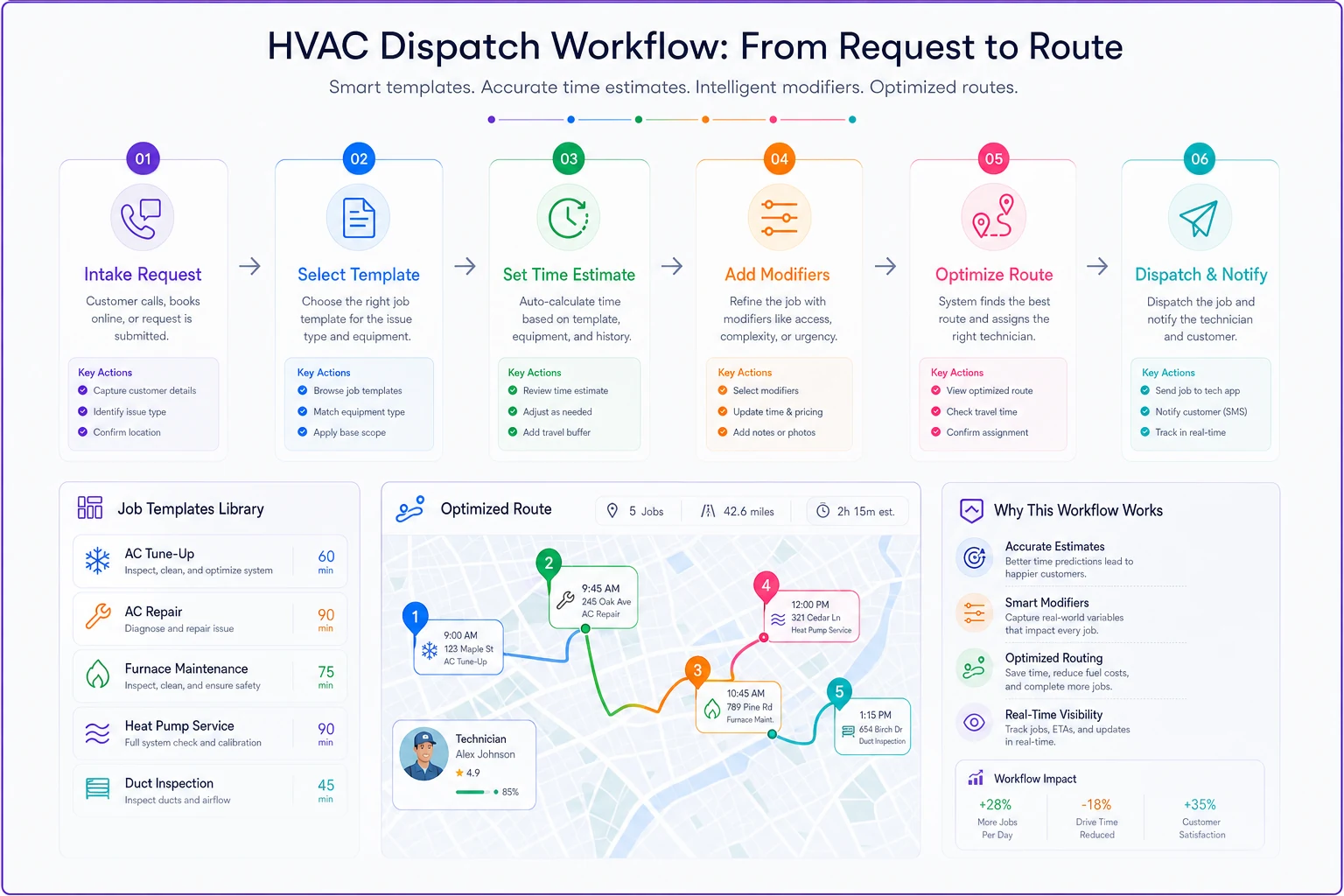
The dispatch system should flag pricing inconsistencies before they become customer problems. When a customer calls for a quote on work they had done last year, dispatch sees the previous price and any modifiers applied.
QA checks that catch problems before invoicing
Even the best job library needs quality control. Most QA happens too late—after the customer complains about their bill.
Effective QA builds checks into the workflow. Before a tech can close out a job, the system runs validations:
-
Did the quoted price match the final price? If not, what changed?
-
Were appropriate modifiers selected based on job conditions?
-
Does the time spent align with the time standard?
-
Were recommended add-ons documented even if declined?
-
Did parts usage match the job type template?
Flag anomalies immediately and assign them a reviewer to turn mistakes into training moments.
When anomalies appear, they trigger immediate review. A capacitor replacement that somehow took three hours gets flagged before the invoice generates. This isn't about micromanaging techs. It's about catching honest mistakes and training opportunities.
Common templates for the jobs that pay your bills
Focus on the 20% of job types that generate 80% of your revenue. For most residential HVAC companies, that means:
Diagnostic calls: Base fee plus tiered troubleshooting time based on symptom complexity. Simple ("won't turn on"): 30 minutes. Moderate ("sometimes doesn't cool"): 60 minutes. Complex ("makes weird noise occasionally"): 90 minutes.
Capacitor replacements: Standard 45-minute job with modifiers for access and system age. Include automatic suggestion for contactor inspection on units over 8 years.
Refrigerant recharge: Base service plus per-pound pricing with mandatory leak detection on systems needing more than 2 pounds. Automatic coil cleaning add-on for systems over 5 years.
Blower motor replacement: 2-hour base with modifiers for motor type (PSC vs. ECM) and installation difficulty. Bundle with capacitor replacement and belt inspection.
Maintenance agreements: Standardized twice-yearly service with clear inclusion list. No more debating whether filter replacement is included (it is) or if refrigerant top-off is covered (it's not, but leak detection is).
Thermostat installation: 45-minute base for standard replacement, 90 minutes for smart thermostat with app setup, 2.5 hours for systems requiring new wiring.
Build these templates from your actual job data, not industry guides. Your market, customer base, and operational reality are unique.
The math behind modifier stacking
When multiple modifiers apply, simple addition doesn't work. A 15-year-old rooftop commercial unit doesn't just add the age modifier plus the access modifier plus the commercial modifier. The complications compound.
Smart pricing systems use multiplication factors for stacked modifiers. The first modifier applies fully, the second at 75%, the third at 50%. This prevents a basic capacitor replacement from ballooning to a $900 job just because several modifiers technically apply.
-
Base capacitor replacement $285
-
Rooftop access (+25% = $71.25)
Full modifier
-
System age 15+ years (+20% = $57)
75% applied = $42.75
-
Commercial property (+15% = $42.75)
50% applied = $21.38
-
Total
$420.38 (not $456.75 with straight addition)
This stacking logic keeps prices reasonable while still accounting for genuine complexity. Some modifiers should never stack. Emergency service and after-hours fees are either/or, not both. Weekend rates override standard overtime.
Seasonal adjustments without reinventing your entire system
HVAC pricing fluctuates with demand, but constantly adjusting your entire job library creates chaos. Instead, apply seasonal modifiers to your base templates.
During peak cooling season (May-September in most markets), apply a 10-15% demand modifier to non-emergency repairs. Customers understand paying more when everyone needs service. During slow season, reduce routine maintenance pricing by 10-20% to fill schedules.
Emergency repairs during extreme weather warrant premium pricing—not price gouging, but fair compensation for the difficulty. A furnace repair during a January cold snap with 6 inches of snow deserves a 25-30% weather modifier.
Seasonal pricing should vary by job type, not just date. Refrigerant recharge in August? Peak pricing applies. Furnace maintenance in August? Discount it to fill slow afternoon slots.
Protection against the race to the bottom
When competitors advertise $49 tune-ups or $89 diagnostic fees, the pressure to match their pricing feels overwhelming. Their unsustainably low prices often hide aggressive upselling, corner-cutting, or businesses headed for bankruptcy.
Your job library protects against this race by documenting exactly what your price includes. That $49 tune-up probably doesn't include refrigerant checks, coil cleaning, or electrical inspection. Your $145 tune-up does.
| Service Component | Budget Competitor | Your Service |
|---|---|---|
| Visual inspection | ✓ | ✓ |
| Filter check | ✓ | ✓ |
| Filter replacement | Extra charge | Included |
| Refrigerant check | Extra charge | Included |
| Coil cleaning | Not offered | Included |
| Electrical inspection | Not offered | Included |
| Performance testing | Not offered | Included |
| Photo documentation | Not offered | Included |
| 90-day warranty | Not offered | Included |
When customers question your pricing, this comparison shifts the conversation from cost to value. You're not more expensive—you're more thorough.
Building customer trust through transparent pricing
Flat rate estimating HVAC systems shouldn't be black boxes. The more customers understand your pricing logic, the more they trust it.
Blower Motor Replacement Quote Breakdown:
-
Base service
$425
-
- Diagnosis and testing
30 minutes
-
- Motor replacement
90 minutes
-
- System calibration
20 minutes
-
- Standard motor cost
$185
-
Modifiers applied
-
- Attic access
+$65 (additional 25 minutes)
-
- System age (14 years)
+$45 (probable complications)
-
Optional additions
-
- Run capacitor replacement
+$85 (recommended preventive)
-
Total quote
$620
This transparency eliminates the "they're making this up" suspicion that damages customer relationships. Customers negotiate less when they understand the pricing logic.
Why spreadsheets fail and databases scale
You might think you can manage all this in Excel. For a one-truck operation, maybe. Spreadsheets break down fast as you grow.
Spreadsheets can't enforce modifier rules. They can't prevent inappropriate combinations. They can't automatically update parts prices across hundreds of templates. They definitely can't integrate with dispatch, invoicing, or inventory systems.
A proper database-driven system maintains relationships between job types, parts, modifiers, and outcomes. When you update the price of a standard capacitor, every template using that part updates automatically.
Databases also enable analysis spreadsheets can't match. Which modifiers correlate with callbacks? Which job combinations generate the highest margins? Which techs consistently select different modifiers for similar work?
Training techs to use the system without resentment
The best flat rate estimating HVAC system fails if techs won't use it properly.
Start implementation with your most successful techs, not your struggling ones. When the top performer embraces the system, others follow.
Frame the system as protecting techs, not restricting them. It eliminates awkward pricing conversations. It prevents customers from blaming them personally for high quotes. It ensures they get paid fairly for difficult jobs instead of eating the time to maintain margins.
Show them how modifiers protect their time. That customer who always wants everything explained three times? There's a modifier for that. The property manager who makes you wait 45 minutes for approval? Modifier.
Most importantly, involve techs in refining the system. They know which jobs consistently run long. They know which parts frequently fail together. Their input makes the system accurate, and their involvement creates buy-in.
The compound effect on business growth
A well-built job library does more than standardize pricing. It transforms your entire operation.
Your CSRs quote accurately over the phone because they're selecting from the same templates techs use. Your inventory manager knows exactly which parts each job type requires. Your trainer has clear standards for teaching new techs.
Business planning becomes possible. When you know your average ticket for each job type and your typical job mix, revenue forecasting gets accurate. When you track modifier patterns, you can identify operational improvements.
The data reveals growth opportunities. Perhaps commercial properties generate 40% higher margins due to less price sensitivity. Maybe weekend emergency calls offer the best profit margins despite the hassle. These insights only emerge from standardized job tracking and consistent pricing data.
The data reveals growth opportunities. Perhaps commercial properties generate 40% higher margins due to less price sensitivity. Maybe weekend emergency calls offer the best profit margins despite the hassle. These insights only emerge from standardized job tracking and consistent pricing data.
Ready to optimize your HVAC operations?
Join hundreds of HVAC businesses using Coolyly to save time, improve technician utilization, and enhance customer satisfaction.