

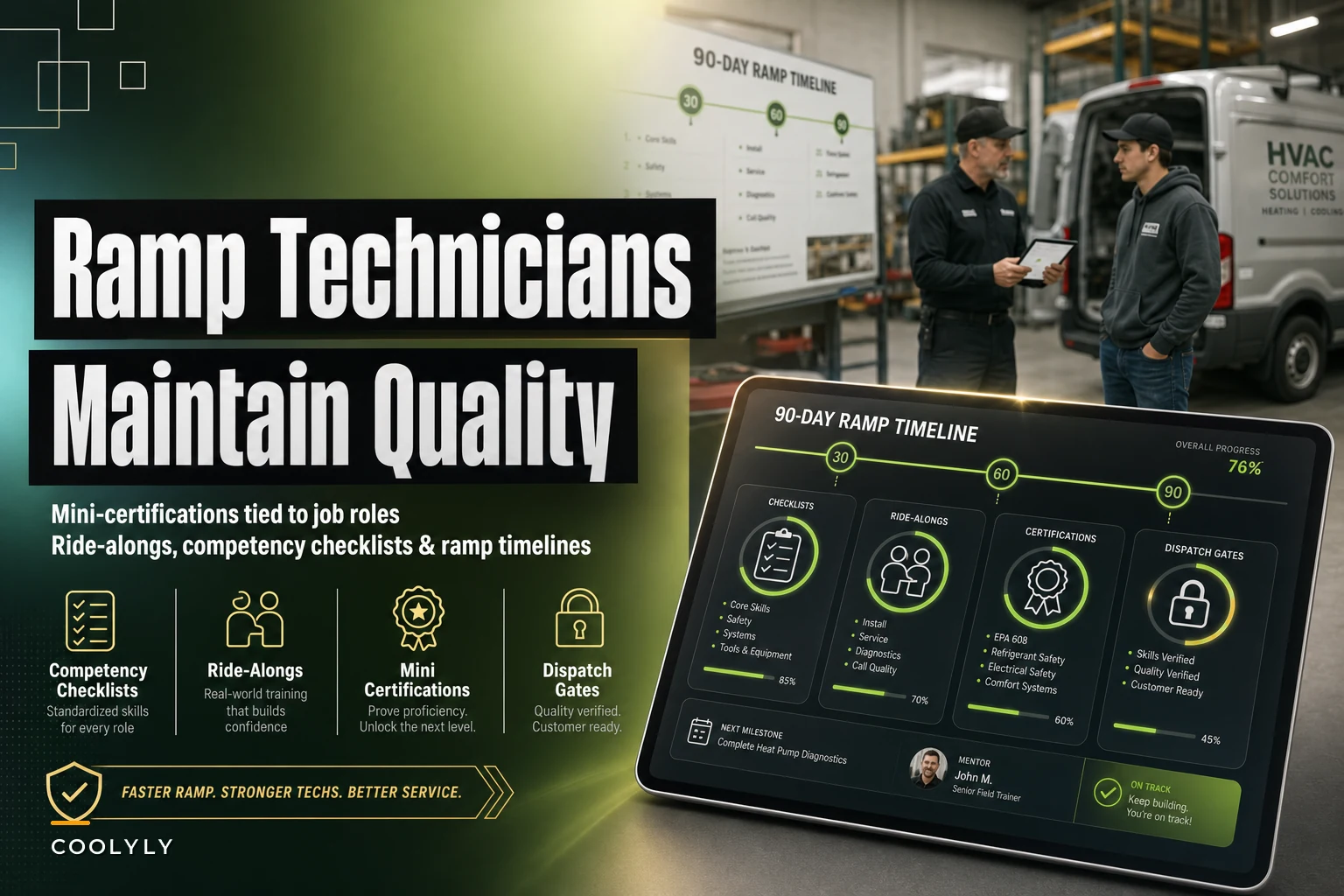

Most HVAC onboarding runs on vibes. A new tech shows up Monday, shadows somebody for a few days, gets handed a van by week two, and by week three the dispatcher is treating them like anyone else on the board. Nobody wrote down what "ready" means. There's no point where you can say "yes, this person can do a condenser changeout solo." So you either hold them back too long and burn payroll, or push them out too fast and eat callbacks.
The tension is real: you want speed and quality, and the default onboarding process gives you neither reliably. A longer training manual doesn't fix it. What actually works is breaking the job into small, testable chunks — micro-certifications tied to specific job types — so you always know what a tech can and can't handle, and you expand their board incrementally instead of all at once.
Why "shadow for two weeks then go" quietly fails
The shadow-then-solo model has a hidden flaw: shadowing is passive. A tech can ride along on 15 maintenance visits and still not be able to run one properly, because watching and doing are completely different things. You find this out later, on a callback, when the customer says the new guy left the panel loose or skipped the drain flush.
The other problem is that "productive" isn't one thing. A tech might be fully ready for filter-and-tune PM visits but nowhere near ready for a refrigerant diagnosis or a commercial rooftop unit. Traditional onboarding treats readiness as a single switch — training or live. In reality it's a dozen separate switches, and each job type flips at a different time.
Something worth noticing: the techs who cause the most callbacks in their first 90 days aren't usually the weakest ones. They're the ones who got promoted off the shadow board too broadly, into job types nobody ever confirmed they could handle. The gap wasn't skill — it was that nobody checked.
The core idea: certify by job type, not by tenure
Instead of "week 1, week 2, week 3," think in terms of job-type certifications. Each certification is a specific competency a tech either has or doesn't. You unlock their dispatch board one certification at a time.
Eliminate scheduling chaos and missed jobs.
Coolyly helps HVAC companies book, coordinate, and track every service efficiently.
- Unified appointment & dispatch management
- Automated client notifications
- Technician scheduling & job tracking
No credit card required
Here's how the job types typically break down for a residential-heavy service shop:
| Job type | Difficulty tier | Typical ramp to solo | What gates it |
|---|---|---|---|
| Filter/PM tune-ups | Entry | 1–2 weeks | Checklist accuracy, drain handling |
| Capacitor / contactor swaps | Entry | 2–3 weeks | Electrical safety, correct part ID |
| Diagnostic service calls | Mid | 4–7 weeks | Systematic troubleshooting, quoting |
| Refrigerant work | Mid-high | 6–10 weeks | EPA handling, charge verification |
| Condenser / coil changeouts | High | 8–12 weeks | Brazing, evacuation, startup |
| Full system installs | High | 3–6 months | Load sizing, ductwork, commissioning |
| Commercial rooftop units | Specialist | Varies | Site access, controls, safety |
The point of the table isn't the exact weeks — those flex with the person. It's that each job type gets its own finish line. A tech might be certified for the top three rows in three weeks and spend the next two months working toward refrigerant work. Dispatch always knows the boundary.
Building the micro-assessments
A micro-certification needs a way to be earned, or it's just a wish. The assessment doesn't have to be formal — what makes it work is that it's specific and observed, not self-reported.
For each job type, you want three things:
-
A knowledge check — a handful of questions the tech has to answer correctly. For capacitor work: how do you confirm a cap is bad, what's the safe discharge procedure, what rating do you match to. Five to eight questions, takes about ten minutes.
-
An observed live task — a senior tech watches them run the job start to finish on a real call and signs off against a checklist. Not "looked fine." Actually signs off.
-
A callback window check — their first handful of solo jobs in that category run clean for two weeks before the certification is considered locked.
That third one is the piece most shops skip, and it's the most important. A tech can pass a knowledge check and a supervised task and still be sloppy when nobody's watching. Tracking callback rate on their first solo runs in a given job type is what separates real competency from test-passing.
A sample competency checklist (capacitor/contactor swap)
-
[ ] Confirms diagnosis with meter reading, not guesswork
-
[ ] Photographs old part rating before removal
-
[ ] Discharges capacitor safely every time
-
[ ] Matches replacement part by microfarad + voltage, not "close enough"
-
[ ] Verifies unit startup and amp draw after swap
-
[ ] Cleans up and documents in the job notes with photos
-
[ ] Explains the repair to the customer clearly
Seven items. A senior tech can check this off in one ride-along. Do the same thing for every job type and you've got a full onboarding map that's actually measurable.
The ride-along schedule (and where it goes wrong)
Ride-alongs are where onboarding either compounds or wastes time. The mistake most shops make: they pair the new tech with whoever's free that day. The trainee sees a random slice of work, learns three different people's habits, and never gets a clean progression.
A better structure ties ride-alongs to the job-type ladder:
-
Days 1–3 Ride with a strong PM tech. Focus only on maintenance and entry-tier work. Trainee is doing hands-on by day 2.
-
Days 4–8 Rotate to a diagnostic-strong tech. Watching troubleshooting logic now, not just tasks.
-
Weeks 2–3 Trainee runs entry-tier jobs solo (already certified) while riding along on mid-tier work in the afternoons.
-
Weeks 4+ Ride-alongs get targeted — only on job types the trainee is actively working to certify.
The ride-along load drops as certifications stack up. That's the whole point. Early on they ride a lot; by week four they're mostly productive and only shadowing the specific things they haven't unlocked yet. This is what actually shortens time-to-productivity — not skipping training, but making it precise.
One thing worth flagging: pick your ride-along mentors deliberately. Your fastest tech is often the worst teacher because they cut corners you don't want copied. The best mentor is usually a mid-tenure tech with a clean callback record and enough patience to actually explain what they're doing.
A ramp-timeline template you can adapt
Here's a rough 90-day ramp that keeps the tech productive early while protecting quality:
-
Week 1 — Onboard admin, safety, van/tool orientation. Certify
PM tune-ups. Start earning capacitor/contactor cert.
-
Weeks 2–3 — Solo on PM and entry electrical. Ride-along on diagnostics. Earn diagnostic knowledge check.
-
Weeks 4–6 — Solo diagnostic calls under a quick end-of-day review. Begin refrigerant training.
-
Weeks 7–10 — Certify refrigerant work. Start changeout ride-alongs.
-
Weeks 11–13 — Certify changeouts. Full residential board except installs.
-
Beyond 90 days — Install and commercial certifications on a longer track.
The timeline is a template, not a promise. Some techs blow through the first half in two weeks; others need six. What matters is that progression is visible. You're never guessing whether someone's ready — the certifications tell you.
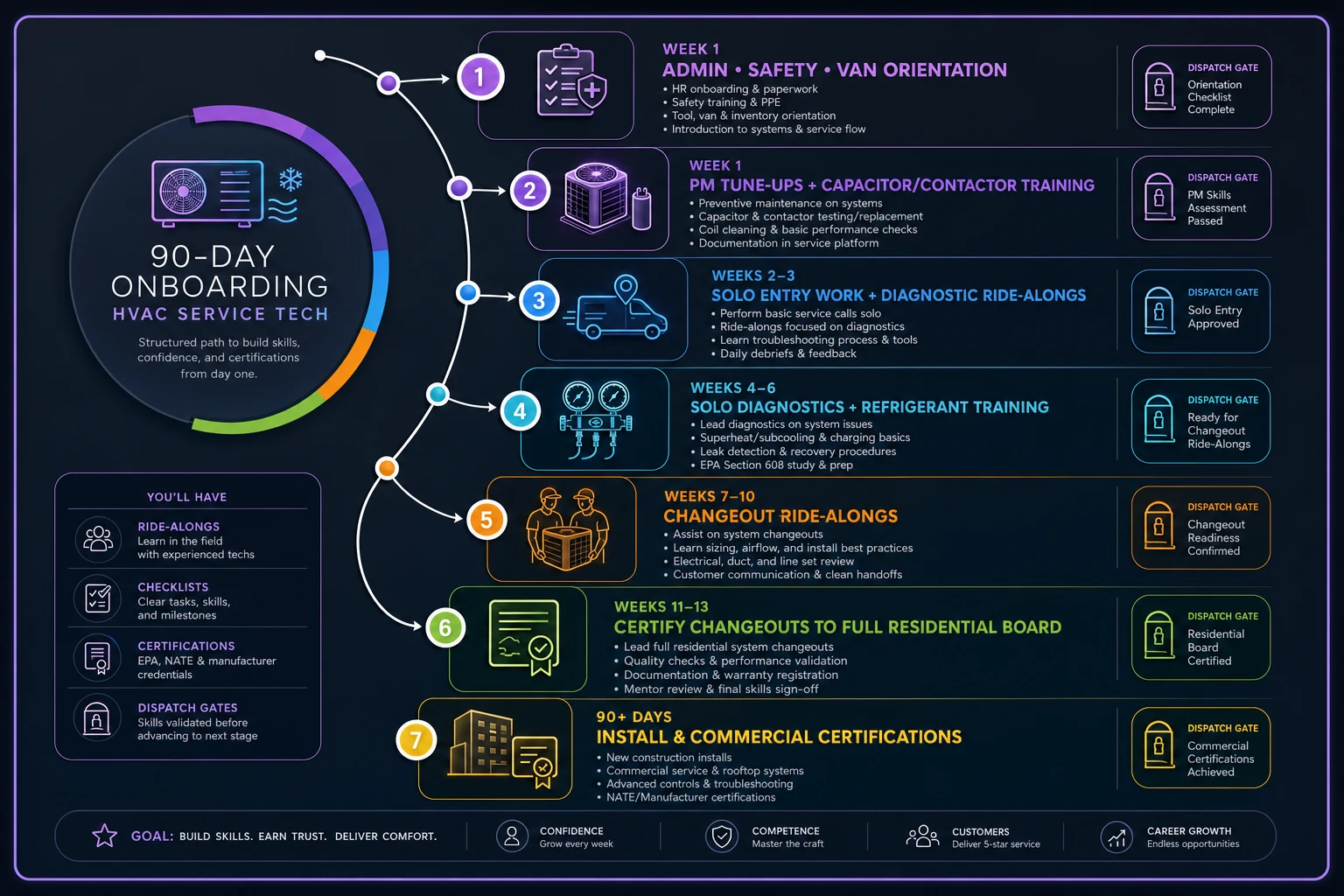
Here's a visual workflow of the ramp timeline.
Where this connects to the rest of your operation
Onboarding doesn't live in isolation. The certifications a tech holds should feed straight into how dispatch builds the board — you don't want the scheduler assigning a refrigerant job to someone who hasn't cleared that gate. When competency status is tracked in the same system your dispatch and job history live in, everything runs cleaner. Modern field operations platforms can flag a job type against a tech's certification level automatically, so a new hire simply doesn't get offered work they're not cleared for.
The same certification data is useful for coaching later. When you know exactly which competencies a tech has and which are shaky, performance reviews and callback investigations stop being guesswork. This works as a natural extension of a broader technician performance system rather than something you're maintaining separately on the side.
The quieter benefit: onboarding becomes repeatable. Once the job-type checklists and assessments exist, the tenth new hire ramps the same way as the first, even if a different senior tech runs the ride-alongs. That consistency is what lets a shop scale hiring without callback rates creeping up every time you add headcount.
When this makes sense — and when it doesn't
This makes sense when you're hiring more than a couple techs a year, running multiple job types, or seeing a spike in early-tenure callbacks. If your onboarding process currently lives in one senior person's head, formalizing it into certifications pays off fast.
This is overkill when you're a two-truck shop and the owner personally trains every hire on every job. At that scale the checklist ceremony can slow you down more than it helps. You'll still benefit from a simple ride-along schedule, but you don't need the full certification ladder yet.
Who should not do this: shops trying to use micro-certifications as a substitute for hiring qualified people. The system speeds up ramp for capable techs and exposes weak ones faster — it doesn't turn a bad hire into a good one. If your real problem is who you're hiring, no onboarding playbook fixes that.
A quick real-world scenario
A mid-sized residential shop — around 9 techs, growing to 14 over a season — was running the old shadow-then-solo model. New hires were going fully live on the board around the three-week mark. Their first-90-day callback rate on new techs was noticeably higher than on veterans, and two of the past four hires had washed out inside two months because nobody caught the gaps early enough.
They switched to job-type certifications. New techs went solo on PM and entry work in the first week — actually faster than before — but didn't touch refrigerant or changeouts until certified, which took anywhere from six to nine weeks depending on the person. New-hire callbacks on early jobs dropped substantially, and the two struggling hires the next season got flagged in week two instead of month two, saving weeks of payroll on people who weren't going to work out anyway.
The interesting part: time-to-first-productivity actually got shorter. Because entry work was unlocked immediately and gated work was held back, the shop got billable hours out of new hires sooner while cutting the expensive mistakes. That's the trade the certification model is designed to win.
The takeaway
The reason HVAC technician onboarding feels like a choice between speed and quality is that most shops treat readiness as one big switch. Break it into job-type certifications and that trade-off mostly disappears — you unlock the easy, safe work immediately and hold back the risky work until it's genuinely earned. New techs get productive faster on the jobs they can handle, and your callback rate stays flat because nobody's guessing.
You don't need fancy software to start. Write the checklists, build the assessments, map the ride-along schedule, and pick good mentors. Once that structure exists, everything downstream — dispatch, coaching, scaling — gets easier, because for the first time you actually know what each tech can do.
You don't need fancy software to start. Write the checklists, build the assessments, map the ride-along schedule, and pick good mentors. Once that structure exists, everything downstream — dispatch, coaching, scaling — gets easier, because for the first time you actually know what each tech can do.
Ready to optimize your HVAC operations?
Join hundreds of HVAC businesses using Coolyly to save time, improve technician utilization, and enhance customer satisfaction.