


Your dispatcher takes a frantic call at 2 PM. "No cooling, house is 85 degrees, need someone NOW." Standard emergency dispatch, right? Tech grabs the van, drives 40 minutes across town, arrives to find... a tripped breaker. Customer reset it while waiting. System's running fine. That's $800 in lost opportunity cost because another tech had to cover a profitable install while this one drove around playing electrician.
This destroys HVAC operations every summer. Not because techs aren't skilled or dispatchers aren't trying. The breakdown happens during that first phone call when nobody asked the right questions or prepped the right parts.
The hidden math behind emergency truck rolls
Most HVAC owners track truck rolls as fuel costs and hourly wages. The real damage runs deeper.
Emergency calls cannibalize your schedule. That tech racing across town for the tripped breaker? They were supposed to handle three maintenance contracts this afternoon. Those get bumped to tomorrow, which pushes tomorrow's install to next week, which means overtime to catch up. One unnecessary emergency creates a cascade of scheduling chaos that costs roughly $2,400-3,200 when you factor in overtime, rescheduling friction, and customer satisfaction hits.
Peak season economics get uglier. A properly utilized tech generates around $1,800-2,400 daily in gross margin during July. Every wasted truck roll torches half a day's margin. Do that twice weekly June through August, and you're looking at $28,000-38,000 in lost gross margin from poor triage alone.
Parts inventory chaos compounds this. Emergency calls mean grabbing whatever's on the truck and hoping. No pre-staging, no prep. Techs carry duplicate inventory "just in case," which ties up $15,000-25,000 in rolling stock per vehicle. Meanwhile, the warehouse has the exact capacitor sitting on a shelf because nobody communicated what the actual problem might be.
Why standard intake processes fail under pressure
Traditional HVAC intake follows a simple pattern: customer calls, describes problem, gets scheduled. Works fine for routine maintenance. Falls apart completely for service calls.
Eliminate scheduling chaos and missed jobs.
Coolyly helps HVAC companies book, coordinate, and track every service efficiently.
- Unified appointment & dispatch management
- Automated client notifications
- Technician scheduling & job tracking
No credit card required
Your CSRs aren't technicians. They hear "no cooling" and schedule a service call. They don't know to ask about breaker positions, filter conditions, or thermostat settings. Even when they have a script, real customer conversations derail quickly.
Customer: "It's making a weird noise and not cooling right." CSR: "When did this start?" Customer: "Yesterday maybe? Or last week? It's been hot. Can someone come today?" CSR: "We can get someone there between 2-4 PM."
Notice what didn't happen? No diagnostic questions. No symptom clustering. No parts identification. That tech shows up blind, carrying generic parts, hoping for the best. When it's a failed capacitor but they only brought contactors, that's another truck roll tomorrow.
Peak season amplifies these failures. CSRs handle 40-60 calls daily in July. They're rushing, customers are panicked, and nobody has time for proper triage. Everything becomes an emergency dispatch. Your best techs spend their days driving between false alarms while real emergencies wait in queue.
Building triage scripts that actually work
Forget complex diagnostic trees. Real triage needs simple binary questions that even non-technical staff can handle.
Start with reset verification. Not "did you check the breaker" but specifically: "Can you flip the breaker labeled AC or HVAC completely off, wait ten seconds, then flip it back on?" This single question eliminates roughly 15% of emergency calls. Same with thermostat batteries—walk them through pulling the unit off the wall and checking.
-
0-5 years Capacitors, contactors, basic electrical
-
6-10 years Add refrigerant leaks, fan motors
-
11-15 years Include compressor issues, major components
-
15+ years Everything possible, prepare for replacement discussion
Sound identification beats customer descriptions every time. Train CSRs to have customers hold their phone near the unit. A clicking sound suggests contactor issues. Humming but no fan movement means capacitor. Grinding indicates mechanical failure. These audio cues tell techs what to pre-stage better than any customer explanation.
Record actual failure sounds from field calls so CSRs can learn the difference and improve phone diagnostics.
Temperature differential quickly identifies refrigerant issues versus electrical problems. Have customers feel the supply and return vents. Barely cool air suggests low refrigerant. No temperature change at all points to electrical or mechanical failure. This simple check helps techs load the right equipment.
Pre-staging parts based on symptoms
Once you've triaged the problem, pre-staging becomes mechanical. Build symptom-to-parts matrices that warehouse staff can follow without thinking.
-
Universal capacitor kit
-
Matching contactor
-
Basic electrical supplies
-
Refrigerant gauges (just in case)
These parts get pulled, labeled with the work order number, and staged at dispatch. Tech grabs the pre-staged kit on the way out. No searching, no guessing, no carrying unnecessary inventory.
Create tiered kits for common scenarios. Level 1 for basic electrical (capacitors, contactors, fuses). Level 2 adds refrigerant and basic mechanical parts. Level 3 includes major components for older systems. Each kit lives in a labeled bin, ready to grab.
| Kit Level | Symptoms | Core Parts | Typical Age Range |
|---|---|---|---|
| Level 1 | Electrical | Capacitors, contactors, fuses | 0-8 years |
| Level 2 | Mixed | Level 1 + refrigerant, basic mechanical | 6-12 years |
| Level 3 | Complex | Level 2 + major components, replacement quotes | 10+ years |
Standardization is key. Every "no cooling, electrical" call gets the same kit. Warehouse staff don't need HVAC knowledge, just pattern matching. Symptom matches pattern, pattern determines kit, kit goes to staging. This cuts pre-dispatch time from 15-20 minutes to under 5.
Track kit accuracy religiously. If techs consistently return unused capacitors from refrigerant calls, your triage needs adjustment. If they're calling for parts mid-job, the kits need expansion. This feedback loop sharpens your pre-staging until first-visit fix rates hit 85% or higher.
The technician prep conversation
The five-minute prep call between dispatcher and tech changes everything. Not a briefing—a tactical planning session.
Here's a quick workflow showing how dispatcher triage, staged parts, and the tech's load-out connect before departure.
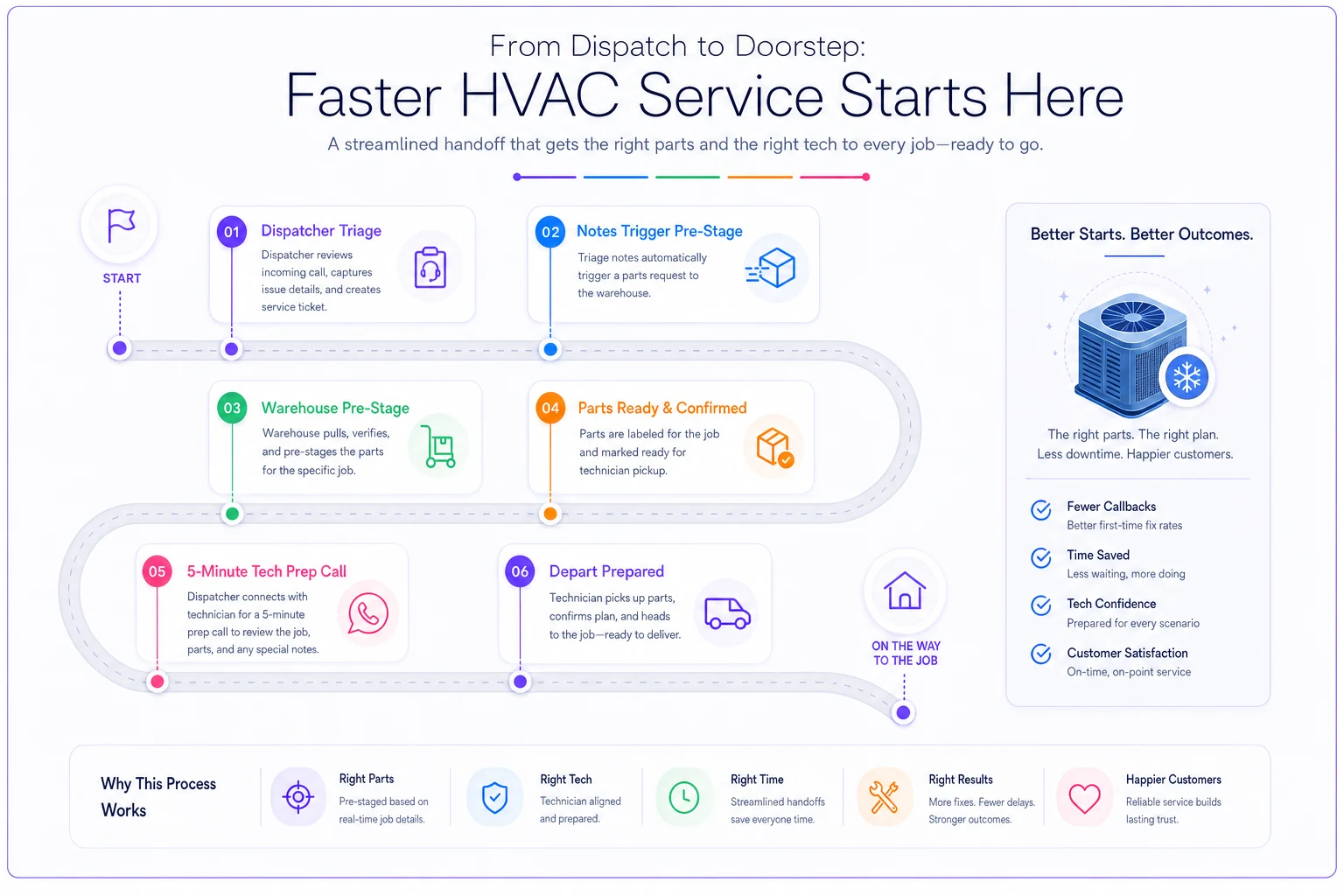
Dispatcher pulls up the triage notes while the tech loads the pre-staged parts. They review symptoms, customer history, and likely scenarios together. "Seven-year-old Lennox, no cooling, humming but no fan movement. Customer says it worked fine yesterday then nothing. Breaker's been reset, thermostat has fresh batteries."
Tech immediately knows: probably capacitor, possibly contactor, unlikely but could be fan motor. They've got all three in the staged kit. More importantly, they're mentally prepared for the most likely scenarios instead of walking in blind.
This conversation also surfaces customer context that affects approach. "Elderly customer, hard of hearing, very worried about cost." Now the tech knows to speak clearly, explain simply, and have pricing ready upfront. Or "Commercial customer, restaurant, needs it fixed TODAY." Tech knows to carry extra parts and prepare for approval to work overtime if needed.
Include upsell intelligence in these prep calls. "Last service was 2019, no maintenance contract, original equipment from 2008." Tech knows to photograph everything, document age-related wear, and prepare a replacement quote alongside the repair. This systematic preparation turns emergency calls into revenue opportunities.
Routing tactics for emergency response
Smart routing for emergency calls isn't about speed—it's about coverage maintenance. The fastest response often creates the biggest operational hole.
Zone preservation beats pure proximity. If your north-side tech races to a south-side emergency, you've got no coverage up north for the rest of the day. Better to send the central tech south and shift the north tech to central. Maintains coverage while handling the emergency.
Build overlapping response zones during peak season. Each tech owns a primary zone but shares borders with neighbors. Emergency calls in overlap areas go to whoever has the lightest scheduled load, not whoever's closest. This prevents any single zone from getting stripped of coverage.
-
Morning emergencies (before 10 AM) - Pull from install crews since they're often still loading
-
Afternoon emergencies (after 3 PM) - Use maintenance techs who've completed routes
-
Evening emergencies - Dedicated on-call staff, not whoever's still working
Batch emergency calls when possible. Sounds counterintuitive, but two emergencies in the same neighborhood can often wait 45 minutes for a single tech rather than pulling two techs immediately. Customers accept "our tech will be there after completing an emergency two streets over" better than vague time windows.
Create emergency float capacity without dedicated staff. Rotate one experienced tech weekly as the "emergency float." They take no scheduled calls, just emergencies and overflow. This costs you one tech's routine productivity but prevents 4-5 other techs from schedule destruction. During peak weeks, the float might handle 15-20 emergencies that would've otherwise created chaos.
Measuring what matters: fix rates and roll costs
First-visit fix rate is your north star metric. Track it, segment it, obsess over it. Overall rate masks critical patterns.
Segment by symptom category. Electrical issues should hit 90%+ first-visit fixes with proper triage. Refrigerant problems might only reach 75% due to leak detection complexity. If your electrical fix rate drops below 85%, your triage scripts need work. If refrigerant stays above 80%, you're probably over-staging parts.
-
Tech hourly wage during travel
-
Opportunity cost of missed scheduled calls
-
Overtime triggered by schedule disruption
-
Customer satisfaction impact of delays
-
Inventory carrying costs for unused parts
A typical unnecessary truck roll costs $450-600 in direct expenses, but the fully loaded cost including disruption reaches $1,400-1,800. Reducing rolls by just two per week saves $150,000+ annually for a 10-tech operation.
Monitor triage accuracy separately from fix rates. Did the symptom match the actual problem? Even if the tech fixed it first visit, incorrect triage means you're succeeding despite the process, not because of it. This usually indicates CSRs need better training or scripts need simplification.
The compound effect of systematic triage
When these pieces work together, magic happens.
A customer calls with classic capacitor failure symptoms. Your CSR follows the triage script, identifies the likely cause, and schedules appropriately. Warehouse staff pull and stage the right parts. Dispatcher preps the tech with symptoms and customer context. Tech arrives with correct parts and fixes it in 35 minutes instead of diagnosing for 20 minutes then driving back for parts.
That same call without proper triage? Tech spends 20 minutes diagnosing, 40 minutes round-trip for parts, 35 minutes fixing. You've burned two hours of tech time plus disrupted their afternoon schedule. The four maintenance calls they missed become tomorrow's overtime. The customer waited three hours instead of one.
Multiply this across 20-30 emergency calls weekly during summer. Proper triage saves 40-60 hours of tech time weekly. That's an entire additional technician worth of capacity, created through process improvement alone.
Systematic triage transforms your operation's capability. Techs trust dispatch because they show up prepared. CSRs feel confident because they have clear processes. Customers get faster resolution because problems are identified early. The entire operation runs smoother when the intake process works correctly.
The real competitive advantage isn't having more techs or newer trucks. It's consistently fixing problems on the first visit while others make multiple trips. When customers realize you solve problems in one visit while competitors need two or three, price becomes secondary. They'll pay premium rates for reliable resolution.
Making it stick: implementation without disruption
Week 1-2: Implement basic reset verification only. Just the breaker and thermostat battery questions. Track how many calls this eliminates. Usually 10-15%. Show CSRs the impact—"You prevented 12 truck rolls this week just by asking about breakers."
Week 3-4: Add sound identification for no-cooling calls only. Don't try every symptom type yet. Focus on the highest volume category. Record actual sounds from service calls to train CSRs. When they hear what a failed capacitor actually sounds like, the phone diagnosis becomes obvious.
Week 5-6: Launch pre-staging for electrical issues only. These are your easiest wins—predictable parts, clear symptoms. When techs see staged kits ready at dispatch, adoption accelerates. Success with simple electrical problems builds confidence for complex scenarios.
Week 7-8: Expand to full triage for all emergency calls. By now, CSRs are comfortable with the process, warehouse understands staging, and techs expect prepped parts. Full implementation feels like natural evolution, not dramatic change.
The hardest part isn't training—it's maintaining standards under pressure. When July hits and calls stack up, CSRs default to old habits. Build forcing functions into your process. Make work order creation require triage fields. No dispatch without staged parts confirmation. These systematic requirements prevent regression during chaos.
AI-powered operational software makes this significantly easier to implement and maintain. Instead of CSRs remembering scripts, the system guides them through questions based on customer responses. Pattern recognition automatically suggests likely problems and required parts. Dispatchers see real-time triage confidence scores that indicate whether additional diagnosis might be needed. This removes human memory from the equation—the process becomes the default path, not something staff need to remember under pressure.
Stop treating emergency calls as unavoidable chaos. With proper triage, pre-staging, and prep, most "emergencies" become routine service calls that happen to be urgent. Your techs arrive prepared, fix problems quickly, and move on to the next call. That's how you reduce HVAC truck rolls while actually improving service quality—not by working harder, but by asking better questions before the truck ever leaves the shop.
Ready to optimize your HVAC operations?
Join hundreds of HVAC businesses using Coolyly to save time, improve technician utilization, and enhance customer satisfaction.