


Most HVAC businesses hit a wall around 12-15 technicians. Not because they can't find more techs or generate calls—they hit the wall because their operation starts eating itself. Dispatch gets overwhelmed, quality drops, callbacks spike, and suddenly you're working harder to make less money per job.
The problem isn't growth. It's growing without a system.
This pattern plays out everywhere. The companies that successfully scale HVAC field service from small shops to regional players don't just hire more people—they build an operational framework that makes growth predictable instead of chaotic.
The territory math nobody teaches you
Territory planning in HVAC isn't about drawing circles on a map. It's about understanding capacity, drive time economics, and seasonal variance in ways that match how your business actually runs.
Take a typical residential service territory. Most owners think in terms of zip codes or mile radius. Wrong approach. Your actual territory capacity depends on three things: average job duration (including diagnosis time), realistic daily routing, and your callback rate by area.
A single tech running maintenance calls can handle 6-8 stops in a tight 5-mile radius. That same tech doing diagnostic work on commercial units? Maybe 3-4 calls if they're lucky. The territory that supports one tech in spring maintenance season needs three techs during July AC breakdown season.
Here's what actually works:
Start with time, not distance. Calculate backwards from available hours. If your tech works 9 hours with a 30-minute lunch, you have 8.5 hours. Subtract 30 minutes for morning prep and truck stock. Now you have 8 hours. Your average service call takes 1.5 hours onsite. Drive time between calls averages 20 minutes. That's roughly 4 calls per day in suburban areas, maybe 5 if routing works perfectly.
Now layer in your business mix. If 30% of your calls turn into repairs needing parts runs, your actual capacity drops. If you're running 15% callbacks (industry average is 12-18%), you need to reserve capacity for those too.
-
Base capacity
8 productive hours ÷ (avg job time + avg drive time)
-
Actual capacity
Base capacity × 0.85 (callback buffer) × 0.9 (parts/delay buffer)
-
Territory size
Actual capacity × 5 days × 4.3 weeks
A territory that theoretically handles 86 calls per month actually handles about 65-70 reliably. Miss this math and you'll either have techs sitting idle or customers waiting too long.
When one dispatcher becomes three (and why it breaks at two)
Dispatcher capacity is the invisible constraint that breaks most HVAC companies trying to scale. One dispatcher can handle 8-12 techs if everything runs perfectly. But nothing runs perfectly in HVAC.
Eliminate scheduling chaos and missed jobs.
Coolyly helps HVAC companies book, coordinate, and track every service efficiently.
- Unified appointment & dispatch management
- Automated client notifications
- Technician scheduling & job tracking
No credit card required
The real breaking points happen earlier than you think. Around 6-7 techs, your dispatcher starts making routing mistakes. They're juggling too many variables—who's closest, who has the right skillset, who's about to hit overtime, which customer is actually a priority versus just loud.
But hiring a second dispatcher too early creates confusion. Two dispatchers managing 10 techs leads to overlap, conflicting directions, and techs getting bounced between handlers. You need clear handoff rules before you add that second person.
The progression that works:
-
1-7 techs
Single dispatcher with clear priority rules
-
8-12 techs
Lead dispatcher + routing assistant (not two equal dispatchers)
-
13-20 techs
Two full dispatchers with territory or service type separation
-
20+ techs
Dispatch team with specialized roles
The handoff gates between stages matter more than the headcount. When your single dispatcher consistently works past 6 PM to close out the day, you need help. When callbacks take more than 2 hours to schedule, you need help. When techs spend more than 10 minutes on hold daily trying to get answers, you definitely need help.
The hiring cadence that prevents operational collapse
Growing too fast kills HVAC companies. Growing too slow kills them too. The sweet spot is a hiring cadence that matches your operational capacity to absorb new people.
Most shops hire reactively—they're drowning in calls, so they grab whoever has a pulse and EPA certification. Three months later, that desperation hire is creating more problems than they solve, quality scores tank, and you're back where you started but with higher overhead.
The cadence that works runs about 90 days ahead of need. If your capacity planning says you'll need 2 more techs by June for AC season, you start recruiting in February, interviewing in March, hiring in April, and training through May.
But here's the key insight: you can't hire more than 20% of your workforce at once without breaking culture and quality. A 10-tech shop adding 3 techs in one month is asking for chaos. Those same 3 techs hired one per month with proper onboarding? Totally manageable.
The template that scales:
Month 1-3 (Foundation):
-
Map seasonal demand patterns from last 2 years
-
Calculate capacity gaps by month
-
Build hiring pipeline 90 days ahead
Month 4-6 (Execution):
-
Hire maximum 1 tech per 5 existing techs per month
-
Each new hire gets assigned a buddy for first 30 days
-
No solo calls until 20 jobs completed with oversight
Month 7-9 (Optimization):
-
Track new hire metrics separately for first 90 days
-
Callback rate should stay under 20% for new techs
-
If it spikes above 25%, pause hiring to fix training
Month 10-12 (Scale):
-
Proven performers become trainers
-
Repeat cycle with improved metrics
Stagger new hires so culture and training keep pace.
Companies that successfully scale treat hiring like preventive maintenance—consistent, scheduled, never panicked.
KPI gates that actually predict problems
Everyone tracks revenue and profit. But those are lagging indicators—by the time they drop, the damage is done. The KPIs that actually matter are the ones that predict problems before they hit your P&L.
First call completion rate is your canary in the coal mine. When it drops below 75%, something's broken. Maybe techs aren't carrying enough parts inventory. Maybe dispatch is sending the wrong skill level. Maybe your diagnostic training sucks. But whatever it is, that metric drops 30-60 days before your profits tank.
Average tickets per tech per day tells you about routing efficiency. But the variance matters more than the average. If Tech A runs 5 calls while Tech B runs 2, you've got a dispatch problem. If everyone's at 3 calls when you budgeted for 4, you've got a capacity planning problem.
The escalation rate shows training gaps. How often do techs call senior techs or managers for help? Under 10% is healthy. Over 20% means you're scaling beyond your experience base.
Green Zone (Keep Scaling)
-
First call completion
>75%
-
Callback rate
<12%
-
Same-day close rate
>85%
-
Tech utilization
80-90%
-
Customer wait time
<24 hours
-
Escalation rate
<10%
Yellow Zone (Fix Before Scaling)
-
First call completion
65-75%
-
Callback rate
12-18%
-
Same-day close rate
75-85%
-
Tech utilization
70-80% or >95%
-
Customer wait time
24-48 hours
-
Escalation rate
10-20%
Red Zone (Stop Everything and Fix)
-
First call completion
<65%
-
Callback rate
>18%
-
Same-day close rate
<75%
-
Tech utilization
<70% or >95%
-
Customer wait time
>48 hours
-
Escalation rate
>20%
Companies that scale successfully never leave the green zone for more than a week. They treat yellow metrics like emergency repairs—fix them before they cascade.
The capacity reservation nobody talks about
Your schedule needs buffer zones, but not where you think. Most shops leave Friday afternoon open for callbacks and emergencies. That's backwards. Your buffer capacity should be distributed throughout the week, hidden in your routing.
The model that works reserves 15-20% capacity, but spreads it strategically:
-
Monday morning
10% buffer for weekend emergency overflow
-
Tuesday-Thursday
5% buffer each day for same-day add-ons
-
Friday
25% buffer for callbacks and incompletions
This buffer isn't idle time. It's capacity you sell at premium rates for same-day service. A customer willing to pay $50 extra for today vs tomorrow? That's your buffer zone generating margin.
The math changes by season too. During peak AC season, you might run 5% buffers because demand exceeds capacity anyway. During shoulder season, 25% buffers let you grab profitable emergency calls while competitors are booked solid.
Handoff gates that prevent dropping the ball
Growth breaks at the handoffs. The call taker to dispatcher handoff. The dispatcher to tech handoff. The tech to parts handoff. The service to sales handoff. Each one is a chance for information to get lost, customers to get frustrated, and profits to leak.
Most shops handle handoffs with sticky notes and "hey, remember that call about..." conversations. That works for 5 techs. At 15 techs, you're dropping balls daily.
The handoff system that scales has three components: trigger conditions, required information, and confirmation loops.
Take the service-to-sales handoff. Tech identifies a system that needs replacement. Without a system, maybe they mention it to sales, maybe they don't.
With a proper gate:
-
Trigger
System over 12 years or repair exceeds 40% of replacement cost
-
Required info
Model, age, failure type, customer interest level (1-5 scale)
-
Confirmation
Sales confirms receipt within 2 hours, contacts customer within 24 hours
Every handoff needs similar structure:
Here's a quick visual of the handoff workflow.
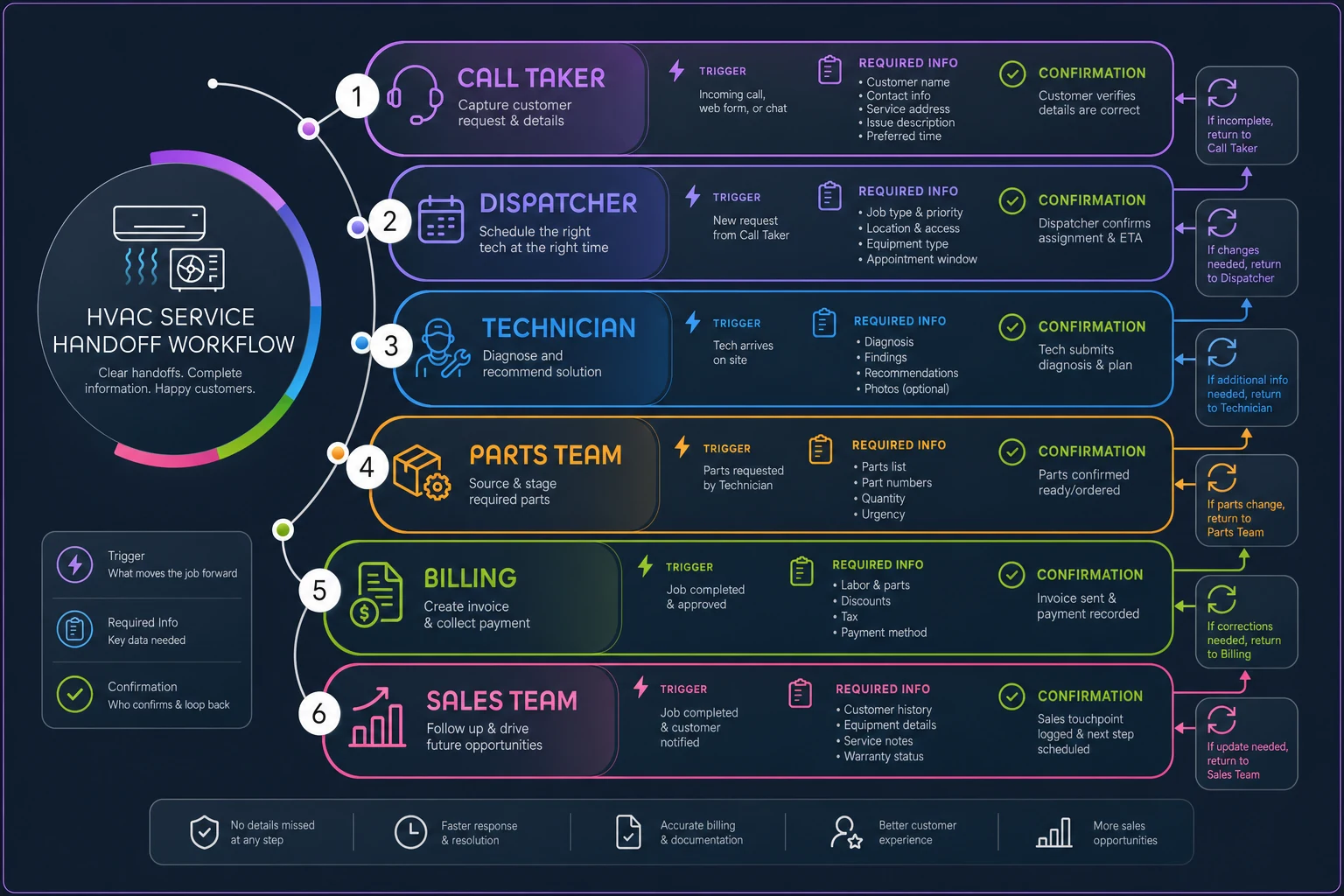
It highlights triggers, required info, and confirmation steps so teams know exactly what to send and when to confirm.
Dispatch to Tech:
-
Trigger
Job assigned
-
Required
Address, issue, customer history, parts likely needed, time window promised
-
Confirmation
Tech accepts and confirms ETA
Tech to Parts:
-
Trigger
Part needed not on truck
-
Required
Part number, quantity, job location, urgency level
-
Confirmation
Parts confirms availability and delivery time
Tech to Billing:
-
Trigger
Job complete
-
Required
Work performed, parts used, warranty status, payment collected or terms
-
Confirmation
Invoice generated within 4 hours
Without these gates, information flows like water through a colander—some gets through, but you're never sure how much you're losing.
Sample territory and staffing models that actually work
Real numbers for a shop growing from 10 to 25 techs.
Current State: 10 Techs
-
Service area
150 square miles
-
Population
180,000
-
Monthly call volume
650-750
-
Average response time
24-36 hours
Territory Division Model:
| Territory | Area (sq mi) | Population | Techs | Monthly Calls | Drive Time |
|---|---|---|---|---|---|
| North | 40 | 50,000 | 3 | 195 | 18 min avg |
| South | 45 | 55,000 | 3 | 215 | 20 min avg |
| East | 35 | 40,000 | 2 | 155 | 15 min avg |
| West | 30 | 35,000 | 2 | 135 | 14 min avg |
Scaling Model to 25 Techs:
Phase 1 (Months 1-4): Add 5 techs
-
2 to South (highest demand)
-
2 to North (second highest)
-
1 float tech for coverage
Phase 2 (Months 5-8): Add 5 techs
-
Split East into East/Northeast (2 territories, 4 techs total)
-
Add 2 to West
-
Add 1 commercial specialist
Phase 3 (Months 9-12): Add 5 techs
-
Create Central territory from overlap areas (3 techs)
-
Add 1 to each existing territory for density
Support Staff Scaling:
| Tech Count | Dispatchers | CSRs | Parts | Office Manager | Service Manager |
|---|---|---|---|---|---|
| 10 | 1 | 2 | 1 | 1 | 0 |
| 15 | 1.5 | 3 | 1 | 1 | 1 |
| 20 | 2 | 4 | 2 | 1 | 1 |
| 25 | 3 | 5 | 2 | 1 | 2 |
The ".5 dispatcher" at 15 techs is a routing assistant, not a full dispatcher. They handle scheduling and confirmations while the lead dispatcher manages real-time routing.
The software backbone that makes scaling possible
Manual systems break around 12-15 techs because humans can't hold that many variables in their heads. You can't mentally track 15 truck locations, 60+ daily jobs, inventory levels, customer histories, and skill matching while running the business.
This is where AI-powered operational software becomes mandatory. But most shops get it wrong: they think software replaces systems. It doesn't. Software amplifies whatever system you have. Chaos in, chaos out—just faster.
The platforms that actually help scaling HVAC businesses handle the computational heavy lifting that breaks human dispatchers:
-
Calculating optimal routes considering traffic, job type, and tech skills
-
Tracking capacity utilization in real-time across territories
-
Flagging when KPIs drift into yellow zones before you notice
-
Automatically handling handoff confirmations that get dropped
-
Predicting next week's capacity needs based on weather and historical patterns
The automation matters most in the mundane stuff. Automatic dispatch notifications so techs aren't calling in for their next job. Automated parts ordering when truck stock runs low. Customer notification systems so CSRs aren't making 200 calls a day.
But the real value comes from centralizing information. When your dispatcher can see that Tech A just freed up early while Tech B is running behind, and there's an emergency call halfway between them, that's when operational software pays for itself. When your service manager can spot that callbacks spike 40% when Tech C works alone on heat pumps, you just prevented six months of quality problems.
Companies that successfully scale treat their software platform like their truck fleet—essential infrastructure that needs daily attention and regular upgrades.
When to pull the trigger on each growth stage
Timing matters more than most owners realize. Hire too early and overhead kills margins. Hire too late and service quality drives customers away. The trigger points aren't based on revenue—they're based on operational stress signals.
Add your first dedicated service manager when any dispatcher spends more than 2 hours daily on tech coaching or problem-solving. That's the signal that dispatch can't handle both routing and management.
Split territories when drive time averages exceed 25 minutes between calls. That's the threshold where windshield time starts killing productivity more than territorial efficiency helps.
Add a second shift when same-week scheduling hits 80% capacity for three consecutive weeks. Don't wait until you're turning away business—by then customers have already started calling competitors.
Bring on a dedicated recruiter (or outsource recruiting) when time-to-fill exceeds 45 days for experienced techs. In hot markets, if you're not filling positions in 30 days, you're already behind.
-
8-10 techs
Operational stress appears, systems strain
-
11-15 techs
First management layer required (service manager)
-
16-20 techs
Territory specialization necessary
-
21-30 techs
Department separation (install vs service)
-
31-50 techs
Multiple location consideration
Each stage has a "point of no return"—once you commit to the infrastructure, you need to grow into it or overhead kills you. A service manager for 10 techs is expensive. For 15 techs, they're profitable. The gap between 10 and 15 is where companies die.
The operational reality check
Scaling an HVAC business isn't about having perfect systems. It's about having systems that bend without breaking, catching problems before customers notice them, and building capacity ahead of demand instead of behind it.
The companies stuck at 10-12 techs aren't failing because they're bad at HVAC. They're failing because they're trying to run a 20-tech operation with 5-tech systems. Their owner is still dispatching, their lead tech is still training, and their office manager is still handling everything from payroll to parts ordering.
The ones that break through don't just add people. They build the operational framework first, then grow into it. They know their KPI triggers, respect their capacity limits, and treat handoffs like customer touchpoints.
Most importantly, they recognize that scaling isn't a destination—it's a discipline. Every new tech changes the operation slightly. Every new territory shifts the dynamics. Every season brings new challenges. The framework isn't about creating rigid rules. It's about creating flexible boundaries that keep growth profitable instead of chaotic.
Your next growth stage isn't about having more techs or more calls. It's about having the operational backbone to handle them without sacrificing the quality and margins that got you here. Build the framework first. The growth follows
Ready to optimize your HVAC operations?
Join hundreds of HVAC businesses using Coolyly to save time, improve technician utilization, and enhance customer satisfaction.