


Most HVAC businesses run dispatch like air traffic control during a thunderstorm—everyone's shouting coordinates, nobody knows who's landing where, and somehow you're supposed to prevent crashes while keeping everyone happy. The dispatcher becomes a human switchboard, juggling sticky notes, WhatsApp messages, and scheduling software that's basically a glorified calendar.
The real problem isn't the people or even the software. It's that dispatch operates without actual rules. Every decision becomes a negotiation. Every emergency becomes a fire drill. Every tech calling out sick creates a domino effect that ruins the next three days.
Why dispatch breaks at 8 techs (sometimes sooner)
Small HVAC operations start simple. Owner takes calls, assigns jobs, techs go out. Works fine with 3-4 people. Then you hire tech number 5, then 6, and suddenly the wheels start wobbling.
Around tech number 8, something interesting happens. The dispatcher starts making about 140 micro-decisions per day. Which tech gets the emergency call? Who covers the north side today? Should we bump Mrs. Johnson's maintenance for the restaurant emergency? Each decision takes 30 seconds to 2 minutes when you factor in checking schedules, calling techs, updating customers.
That's 4-5 hours daily just making dispatch decisions. Not coordinating. Not optimizing. Just deciding.
The hidden cost compounds quickly. Your best residential tech starts getting commercial calls because "he was closest." Your commercial specialist ends up doing residential installs because "we needed coverage." Suddenly everyone's doing everything, nobody's doing what they're best at, and your efficiency metrics look terrible.
The territory problem nobody talks about
Territory management in HVAC kills me—everyone draws lines on a map and calls it done. North side, south side, maybe east and west if you're fancy. Then reality hits.
Eliminate scheduling chaos and missed jobs.
Coolyly helps HVAC companies book, coordinate, and track every service efficiently.
- Unified appointment & dispatch management
- Automated client notifications
- Technician scheduling & job tracking
No credit card required
Your north side tech lives in the south. Your commercial guy's territory includes both downtown (all commercial) and the suburbs (all residential). One territory has 80% new construction, another has 80% retrofit work. The skill requirements are completely different, but the map doesn't care.
One company lost $47,000 in overtime last year because their territory system ignored traffic patterns. Their east side tech spent 90 minutes each morning fighting rush hour to reach his first call, while the west side tech who lived east sat in his driveway waiting for 8 AM. Simple switch would've saved them an hour of overtime daily per tech.
Real territory design isn't about geography. It's about matching tech capabilities, equipment requirements, customer density, and traffic flow. Most shops never get past step one.
Building dispatch rules that actually stick
A dispatch system without rules is just organized chaos. The rules need to be specific enough to eliminate constant decision-making but flexible enough to handle reality.
Start with job prioritization. Not "emergencies first"—that's not a rule, it's a suggestion. Real rules look like:
Priority 1 (immediate dispatch):
-
No heat calls when temp below 40°F
-
No cooling calls when temp above 95°F
-
Commercial refrigeration failures
-
Water heater floods (active)
Priority 2 (same day):
-
Commercial HVAC during business hours
-
Residential replacement quotes (hot leads)
-
No heat/cooling during moderate temps
Priority 3 (within 24 hours):
-
Maintenance contracts due
-
Non-urgent repairs
-
Installation prep visits
Each category needs specific response windows. Priority 1 gets dispatched within 30 minutes. Priority 2 within 4 hours. Priority 3 gets scheduled normally. No negotiation, no debates.
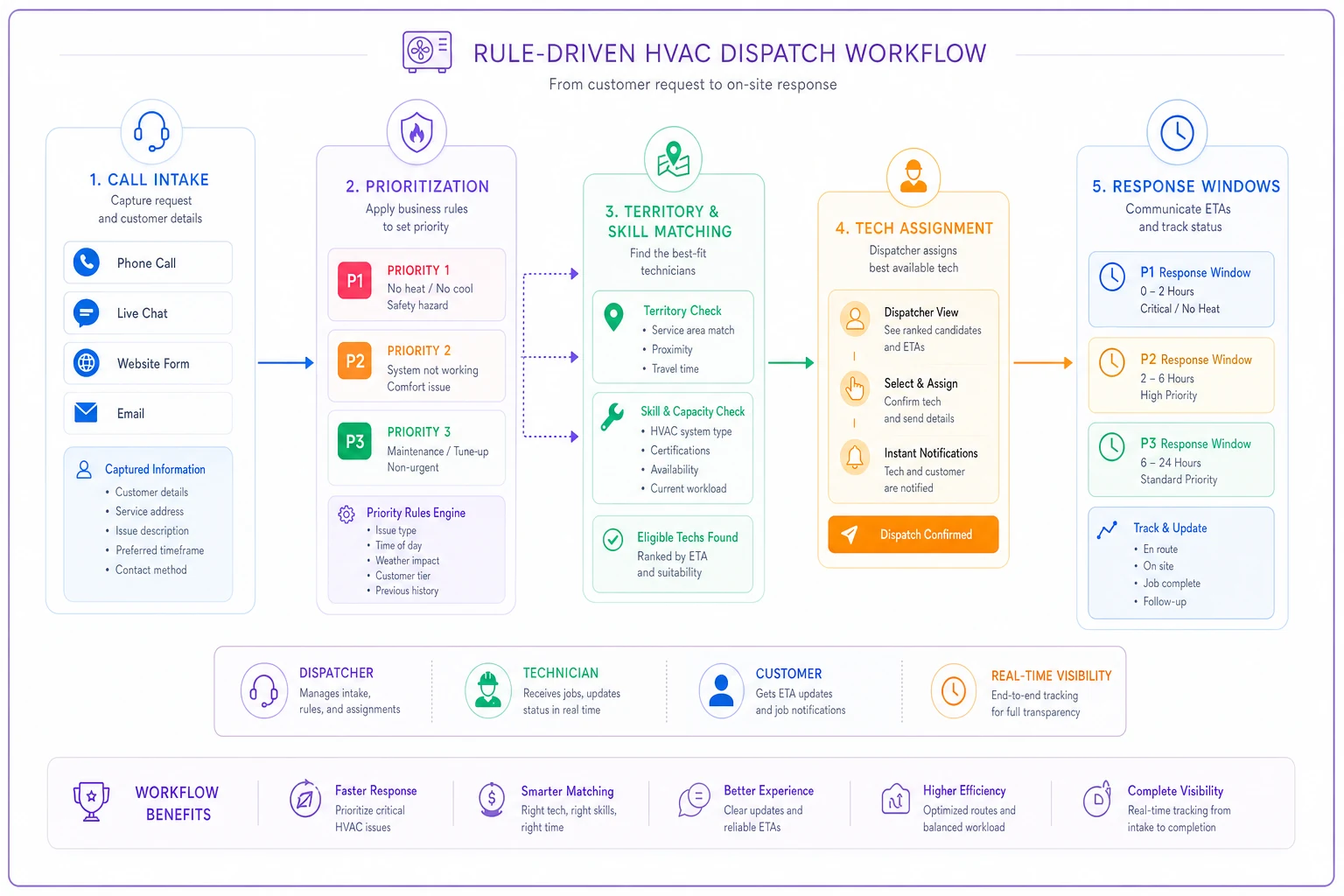
Here's a quick sketch of the workflow.
The handoff system everyone screws up
Handoffs kill more profit than almost any other operational failure. Tech A diagnoses, tech B arrives to fix and can't find the notes. Or the parts list was wrong. Or nobody told the customer about the follow-up.
Most handoff problems stem from information living in people's heads instead of systems. Tech knowledge, customer history, job specifics—all scattered across text messages, memory, and maybe some notes in the truck.
A working handoff protocol captures everything:
-
Initial diagnosis with photos
-
Parts already tried
-
Customer's actual vs stated concern
-
Access issues (gate codes, dogs, parking)
-
What the customer has already been told
-
Price discussions already had
Require a photo with the initial diagnosis to reduce ambiguity and speed up parts verification.
One company tracked this—incomplete handoffs cost them about $280 per occurrence. Between rework, extra truck rolls, and customer credits, they were bleeding $8,400 monthly from bad handoffs alone. That's a full tech's salary going to pure waste.
Decision matrices that remove the guesswork
The dispatcher shouldn't be evaluating every situation from scratch. Build decision matrices for common scenarios:
Tech called out sick:
| Scenario | Scheduled Jobs | Action |
|---|---|---|
| 1 tech out | <6 jobs | Redistribute to team |
| 1 tech out | 6-10 jobs | Call in on-call tech |
| 1 tech out | >10 jobs | Call on-call + overtime authorized |
| 2+ techs out | Any amount | Manager approval required |
Emergency call routing:
| Customer Type | Time | Regular Tech Available | Action |
|---|---|---|---|
| Maintenance contract | Business hours | Yes | Regular tech |
| Maintenance contract | Business hours | No | Next available, comp difference |
| Maintenance contract | After hours | -- | On-call tech, 1.5x rate |
| Non-contract | Business hours | Yes | Regular rates |
| Non-contract | After hours | -- | Premium rates + 2-hour minimum |
These matrices eliminate 80% of dispatch debates. The decision is already made.
Sample SOPs that actually get followed
Most SOPs fail because they're either too vague ("provide excellent service") or too complex (17-step process for a simple dispatch). Working SOPs are specific but simple.
Morning Dispatch SOP:
-
Check overnight emergencies (2 min)
-
Confirm all techs checked in (1 min)
-
Review today's schedule for conflicts (3 min)
-
Assign emergencies per priority matrix (5 min)
-
Send route lists to techs by 7
45 AM
-
Customer confirmation texts by 8
00 AM
Total time: 11 minutes. No decisions required—just execution.
End-of-day Reconciliation SOP:
-
Verify all jobs closed in system (5 min)
-
Flag incomplete jobs for tomorrow
-
Note any customer issues for follow-up
-
Check tomorrow for gaps/conflicts
-
Send preliminary schedule to techs
This prevents the morning scramble where nobody knows what happened yesterday.
When to automate vs. keep manual (the expensive mistakes)
Everyone wants to automate everything or nothing. Both approaches fail spectacularly.
Automate these immediately:
-
Appointment confirmations and reminders
-
Basic dispatching based on territories
-
Time tracking and arrival notifications
-
Parts ordering for common items
-
Customer history lookup
These are repetitive, rule-based tasks where human judgment adds no value. A decent HVAC dispatch system design handles these without thinking.
Keep manual (for now):
-
Complex emergency prioritization
-
Customer complaint resolution
-
Tech performance coaching
-
Strategic territory adjustments
-
Pricing for custom work
These require context, relationship understanding, and judgment that software struggles with. Though AI-powered operational software is getting surprisingly good at providing recommendations even for these complex decisions.
The governance structure nobody wants but everyone needs
Dispatch governance sounds corporate, but it's really about who can break the rules and when. Without it, everyone becomes an exception.
Level 1 (Dispatcher):
-
Follow all standard matrices
-
Can swap techs within same skill level
-
Cannot override priority rules
-
Cannot approve overtime
Level 2 (Operations Manager):
-
Can override priority for VIP customers
-
Approves overtime and call-ins
-
Can modify territories temporarily
-
Cannot change base pay rates
Level 3 (Owner):
-
Can override any rule
-
Approves permanent territory changes
-
Sets new policies
-
Changes compensation structures
The key: higher levels should rarely override. If they're constantly breaking rules, the rules are wrong.
What rule-driven dispatch actually delivers
A company with 12 techs implemented this system last spring. Not perfectly—maybe 75% compliance initially. Their numbers after 6 months:
-
Overtime dropped from $7,200 to $3,100 monthly
-
Average response time for emergencies
2.3 hours to 47 minutes
-
Customer callbacks about scheduling
down 64%
-
Dispatcher time on routine decisions
4 hours to 90 minutes daily
The biggest surprise? Tech satisfaction scores went up. Turns out they prefer clear rules to constant confusion.
The dispatcher role transformed completely. Instead of being a full-time referee, they became a system optimizer. They spent time analyzing patterns, improving routes, identifying training needs. Actual management work instead of crisis control.
The software question (eventually comes up)
Manual dispatch with rules beats automated dispatch without rules. But rule-driven dispatch with the right operational software beats everything.
Modern platforms incorporate your rules, territories, and matrices directly into the workflow. The AI components can predict conflict points, suggest optimal routings, and flag when someone's trying to break protocol. It's less about replacing human judgment and more about enforcing the decisions you've already made.
The trap is thinking software fixes process problems. It doesn't. Software amplifies whatever process you have. Good process with good software creates compound improvements. Bad process with good software creates automated chaos.
Making it stick (the part everyone skips)
Implementation fails when you try changing everything at once. Start with one piece. Get it working. Then add the next.
Week 1-2: Implement priority matrix only Week 3-4: Add territory rules Week 5-6: Introduce handoff protocols Week 7-8: Deploy decision matrices Week 9-12: Refine and enforce
Track one metric obsessively during implementation: dispatch decision time. How long does it take to assign an incoming job? This number should drop weekly. If it doesn't, something's broken in your system.
The resistance period lasts about 3 weeks. Everyone will hate it. "The old way was fine." "This is too rigid." "What about special cases?" Push through. By week 4, the complaints stop because the results become undeniable.
The compound effect nobody calculates
Most HVAC businesses miss this—dispatch efficiency compounds throughout the operation. Better dispatch means:
-
Techs complete more calls per day
-
Less overtime and emergency coverage
-
Higher first-call completion rates
-
Better customer satisfaction scores
-
Lower tech turnover (less chaos = happier techs)
-
More accurate job costing (known routes and times)
A 20% improvement in dispatch efficiency typically yields 35-40% improvement in overall operational metrics. It's the highest-leverage optimization most shops can make.
One operation tracked every metric for a year. Their rule-driven dispatch system generated roughly $127,000 in combined savings and revenue increases. From rules. From structure. From doing the boring work of defining how decisions get made.
Where dispatch evolution goes next
The best HVAC companies are moving beyond basic rule systems. They're implementing dynamic dispatching that accounts for:
-
Real-time traffic conditions
-
Tech skill progression (who's ready for harder calls)
-
Customer lifetime value (VIPs get the best techs)
-
Weather pattern predictions
-
Equipment failure probability
This isn't sci-fi stuff. It's operational software using data you already have, just organized intelligently. The AI automation components can process patterns no human dispatcher could track—like knowing that Tech A's closure rate drops after 2 PM, or that certain zip codes always run 30 minutes longer than estimated.
But none of this advanced optimization matters without the foundational rules. You can't optimize chaos. You can only optimize systems.
The uncomfortable truth about staying manual
Some owners insist on keeping dispatch fully manual because "we're different" or "our customers expect personal service." Fair enough. But understand the real cost.
Manual dispatch without rules costs the average 10-tech HVAC company approximately $200,000 annually in:
-
Dispatcher overtime
-
Inefficient routing
-
Lost jobs from slow response
-
Tech overtime from poor scheduling
-
Customer churn from bad experiences
-
Opportunity cost of dispatcher not doing strategic work
That's not software vendor math. That's operational reality. The question isn't whether you can afford to systematize dispatch. It's whether you can afford not to.
Building your own dispatch blueprint
Stop treating dispatch like an art form that requires years of experience to master. It's a system that can be documented, taught, and optimized. Your blueprint should include:
Core Components:
-
Territory definitions based on skills and logistics, not just geography
-
Priority matrices for every common scenario
-
Clear handoff protocols with required information
-
Decision tables removing daily judgment calls
-
Governance structure defining override authority
-
SOPs that take less than 15 minutes to execute
-
Automation rules for repetitive tasks
-
Performance metrics focused on decision speed and accuracy
The difference between companies that scale successfully and those that hit a ceiling at 10-15 techs? The scaled ones built systems before they needed them. The stuck ones are still trying to dispatch like they did with 3 techs, just with more phone calls and sticky notes.
Your dispatch system is either an asset that enables growth or an anchor that prevents it. Rule-driven dispatch isn't about being rigid—it's about being intentional. Every decision should have a framework. Every exception should be truly exceptional. Every day should run smoother than the last because the system is getting smarter, not because people are working harder.
The business case is clear: systematic dispatch delivers measurable ROI within 90 days and transforms your operation within 6 months. The question isn't whether to implement rules-driven dispatch. It's whether you'll do it now while growing, or later while struggling.
Ready to optimize your HVAC operations?
Join hundreds of HVAC businesses using Coolyly to save time, improve technician utilization, and enhance customer satisfaction.