

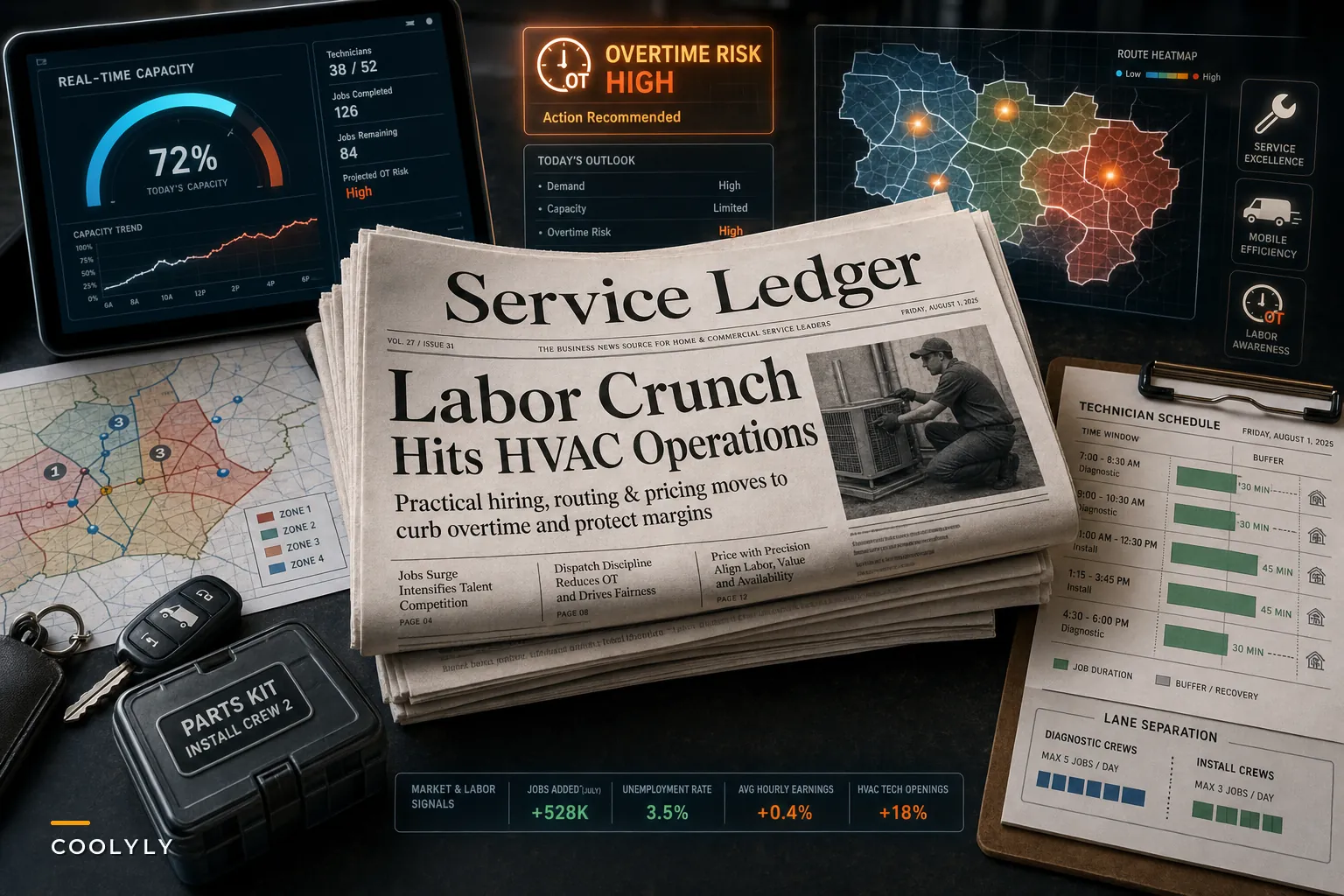

The August employment numbers landed harder than most people expected. Nonfarm payrolls jumped by roughly 162,000, and according to Reuters reporting on the August jobs report, the labor market stayed firmer than forecasters were betting on. Services demand held up too. On paper, that sounds like good news — more work, more money moving around.
For an HVAC owner, though, it reads differently. A tight labor market with resilient services demand means the guy you were hoping to hire at $28/hour now has three other offers. It means your best installer is quietly wondering what he's worth. It means overtime creeps up, parts stay expensive, and if the Fed reacts to strong data, your financing on that new van or your equipment line gets a little pricier.
So instead of treating this as a headline, treat it as a planning signal. The rest of this is about what changes in your operation when labor gets scarce and expensive — and where most HVAC shops quietly lose money without noticing.
The mistake most shops make when labor tightens
The reflex is almost always the same: raise pay to compete, then try to bill more hours to cover it. That's the trap. You end up in a wage-and-overtime spiral where every problem gets solved by throwing more labor at it, and margins slowly erode while your team burns out.
Shops that survive tight labor markets aren't necessarily the ones who pay the most — they're the ones who waste the fewest technician hours. A tight market doesn't reward the highest bidder. It rewards the operator who gets the most productive work out of the crew they already have.
That reframing matters because it changes what you do next. Instead of "how do I hire faster," the real question becomes "how do I make each tech-hour worth more before I add another payroll line."
Your HVAC labor strategy for the next few quarters should sit on top of that idea. Hiring is part of it, but it's the smaller part.
Where technician hours actually leak
Before you post a job listing, audit where hours already disappear. In most residential and light-commercial shops, the leaks look like this:
Eliminate scheduling chaos and missed jobs.
Coolyly helps HVAC companies book, coordinate, and track every service efficiently.
- Unified appointment & dispatch management
- Automated client notifications
- Technician scheduling & job tracking
No credit card required
-
Windshield time — techs driving across the service area because dispatch batched jobs by call order, not geography
-
Return trips for parts that should have been on the van
-
Overtime that wasn't scheduled but happened because the last job of the day ran long and nobody rebalanced
-
Diagnostic-only visits that don't convert to repair because the tech didn't have authorization or pricing on the spot
-
"Quick favors" — unbilled 20-minute stops that add up to hours a week
None of these show up as a line item on your P&L. They show up as a vague sense that you're busy but not making money. In a tight labor market, these leaks get expensive fast, because every wasted hour is an hour you're now paying a premium for.
A quick example. A two-truck residential shop running around 340 calls a month found that each tech was averaging close to 90 minutes of daily windshield time. That's roughly 15 hours a week of paid driving across two techs. Cut that in half with tighter routing and you've effectively recovered close to a part-time tech's worth of billable capacity — without hiring anyone.
Rework your dispatch rules before you touch pay
Your dispatch rules are your real labor budget. They decide how many hours it takes to serve your demand. If those rules are loose, no amount of hiring fixes the underlying inefficiency — you just have more expensive people idling in traffic.
A few dispatch adjustments that matter more when labor is tight:
-
Batch by geography and time window, not by phone-call order. Group calls into zones so a tech isn't crossing town twice.
-
Set a hard buffer between jobs so a long ticket doesn't cascade into unplanned overtime on the back half of the day.
-
Separate diagnostic capacity from install capacity. When you mix them, your high-value install days get eaten by emergency calls.
-
Assign your fastest, most reliable techs to the highest-margin job types during peak weeks, not just whoever's next up.
-
Track jobs-per-day per tech as a trend, not a target. If it's drifting down, something structural changed.
The point isn't to squeeze people. It's to stop paying overtime rates for problems that are really scheduling problems. This is also where a rule-driven dispatch and scheduling platform earns its keep — not by replacing your dispatcher's judgment, but by enforcing the buffers and batching rules consistently so they don't quietly slip on a busy Tuesday.
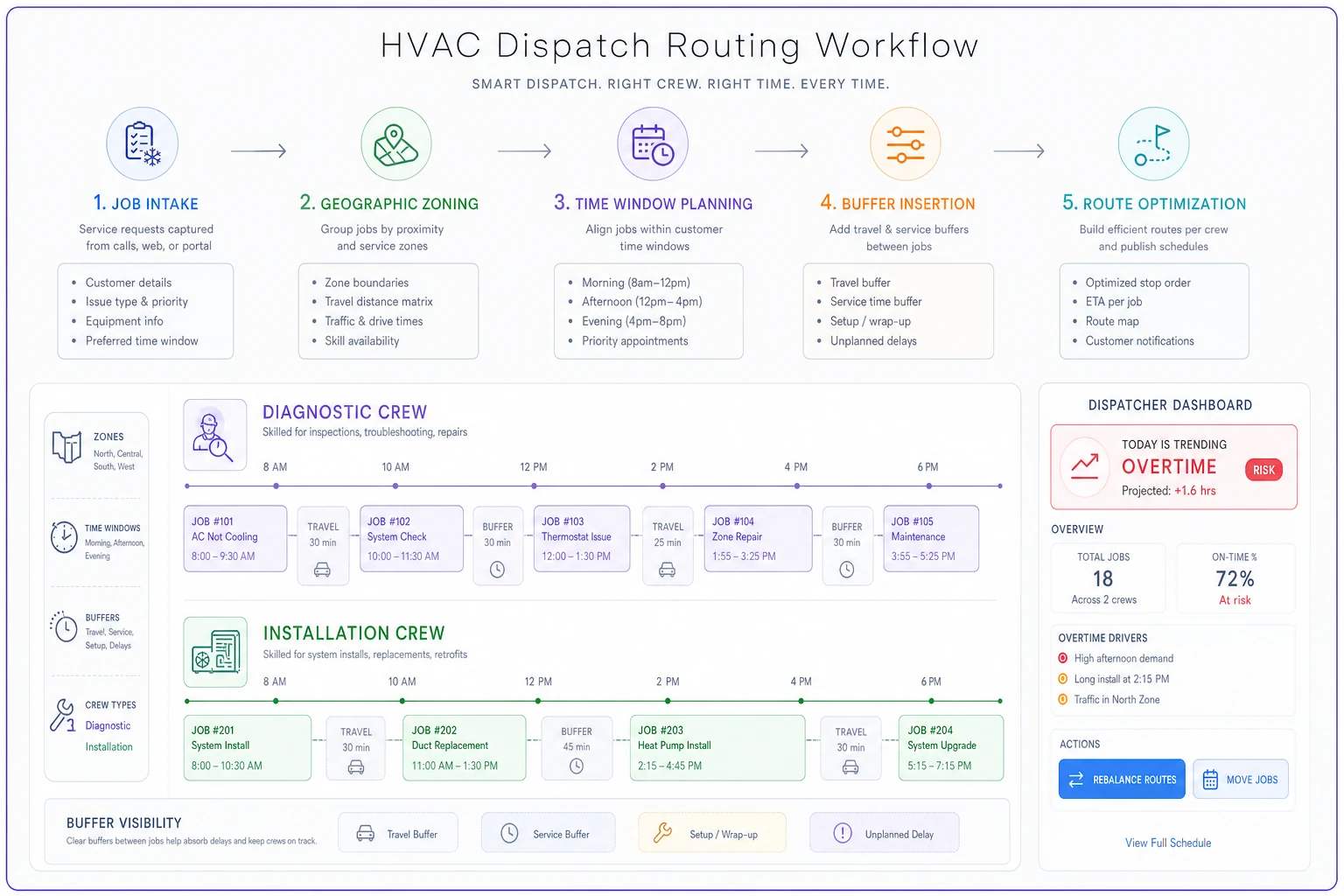
Pro-tip: set an alert when a day's schedule is trending toward overtime so you can rebalance before paying OT.
Operational software built around dispatch workflows can also flag when a day's schedule is trending toward overtime before it happens, giving whoever's running the board a chance to rebalance rather than just react after the fact.
Hiring: slower, more selective, and cheaper per hire
When everyone's hiring, the temptation is to take anyone with a pulse and a set of gauges. That's how you end up with callbacks, warranty costs, and a mediocre tech you're now paying market rate to underperform.
In a tight market, your recruiting math flips. It's cheaper to be selective and retain than to churn. A bad hire in HVAC doesn't just cost their wage — it costs the callbacks, the customer goodwill, the senior tech's time babysitting them, and the eventual re-hire.
A few things that actually work when the pool is thin:
-
Recruit from adjacent trades. Electricians, refrigeration techs, even strong general handymen can be cross-trained faster than you'd think if your systems document the work well.
-
Build a bench, not a panic list. Keep a warm pipeline of two or three candidates even when you're fully staffed, so you're not hiring under pressure.
-
Compete on schedule quality, not just wage. Predictable schedules and fair rotation retain people better than a dollar more per hour.
-
Make apprenticeship a real path. A cheaper hire you develop over 18 months is often better economics than a lateral hire at top-of-market pay.
When aggressive hiring actually makes sense
If you've got signed install backlog stretching weeks out and you're turning away profitable work, then yes — pay up and hire. Backlog you can't serve is lost revenue, and that's worth a premium hire.
When it's a bad idea
If your "we need more people" feeling comes from disorganized dispatch, poor routing, or techs doing unbilled favors, hiring just makes the inefficiency more expensive. Fix the operation first. Adding headcount to a leaky process is the single most common way HVAC shops destroy margin during a boom.
The overtime and burnout problem hiding underneath all of this
Strong services demand — the kind Reuters flagged in its August services-sector report — is a double-edged thing. More demand feels great until you realize you're covering it by grinding the same four techs into the ground.
That's the quiet crisis in a tight labor market. You can't easily replace the people you have, so you lean on them harder. Overtime climbs. The good techs — the exact ones with three other offers — start feeling it first. And when one of them walks, you're hiring a replacement in the worst possible market at the worst possible time.
Workload distribution stops being a "nice to have" and becomes a retention strategy. If your dispatch consistently dumps the ugliest, longest jobs on your two most senior guys because they can handle it, you're taxing your most valuable and least replaceable people. That's how retention loss compounds quietly until it blows up.
This is where fairness rules and recovery scheduling matter more than usual. It's worth reading through the approach in our breakdown on preventing technician burnout with dispatch fairness rules and workload caps. The short version: capping consecutive heavy days, rotating the hard jobs, and building in recovery time isn't soft. In a market where you can't replace people, it's the cheapest insurance you have.
A quick comparison: throwing hours at demand vs. tightening the operation
Most shops end up somewhere in the top two rows of this table during a busy stretch — not because they chose it, but because it was the path of least resistance. The bottom row takes more discipline upfront, but it's the one that doesn't fall apart by October.
| Approach | Short-term feel | What it costs you | 6-month outcome |
|---|---|---|---|
| Cover demand with overtime | Easy, no hiring | OT premiums, burnout, callbacks | Best techs leave, margin erodes |
| Hire fast to keep up | Feels proactive | Bad hires, training drag, warranty | More people, same chaos |
| Tighten dispatch + selective hiring | Slower, harder | Requires process discipline | More capacity per hour, better retention |
The middle column is where most shops live during a strong-demand stretch. The bottom row is boring and unglamorous, which is exactly why fewer shops do it — and why the ones that do quietly out-earn everyone else.
A real scenario
A light-commercial HVAC shop with five techs was staring down a summer where demand was clearly outrunning their capacity. Their instinct was to hire two more techs immediately. Instead, they spent about three weeks auditing the operation first.
What they found: roughly a third of their overtime came from just two recurring problems — jobs booked back-to-back across opposite ends of their territory, and diagnostic calls landing on install-heavy days. They restructured the schedule into geographic zones, protected two "install-only" days a week, and set a rule that the two senior techs couldn't be assigned more than three heavy jobs in a row.
The result wasn't dramatic on paper, but it mattered. Overtime dropped noticeably over the next couple months, and they ended up hiring one tech instead of two — with the savings from reduced OT roughly covering the new hire's ramp-up period. The senior guys stopped grumbling about being buried. Nobody quit that summer, which, in that market, was the real win.
Pricing and financing: don't let the cost side lag
The last piece is on the money side. Elevated input prices mean parts and equipment costs aren't dropping anytime soon, and if strong data pushes the Fed toward action — something Reuters noted Fed officials were weighing — your financing on vans, equipment lines, and customer install financing could get more expensive.
A few practical moves:
-
Re-check your flat-rate pricing against current parts cost. If your labor rate hasn't moved with wages, you're eating the difference on every ticket.
-
Build wage inflation into your install quotes for jobs scheduled months out, not just today's cost.
-
Lock in equipment pricing where you can and watch lead times, since delivery delays turn into scheduling delays turn into overtime.
-
Model your financing costs before rates move, not after. If you're planning a fleet addition, the math changes if borrowing gets pricier.
None of this is exotic. It's just the discipline of keeping your pricing tied to your real, current costs instead of last year's numbers.
The through-line
A strong jobs report isn't really a hiring story for HVAC owners. It's a productivity story.
When labor is scarce and expensive, the shops that come out ahead aren't the ones who hire fastest — they're the ones who waste the fewest hours, protect their best people, and keep pricing honest against rising costs.
Get your dispatch rules tight, be selective about who you add, distribute workload fairly so your senior techs don't walk, and make sure your pricing reflects what the work actually costs today. Do that, and a tight labor market becomes something you manage instead of something that manages you.
A strong jobs report isn't really a hiring story for HVAC owners. It's a productivity story.
When labor is scarce and expensive, the shops that come out ahead aren't the ones who hire fastest — they're the ones who waste the fewest hours, protect their best people, and keep pricing honest against rising costs.
Get your dispatch rules tight, be selective about who you add, distribute workload fairly so your senior techs don't walk, and make sure your pricing reflects what the work actually costs today. Do that, and a tight labor market becomes something you manage instead of something that manages you.
Ready to optimize your HVAC operations?
Join hundreds of HVAC businesses using Coolyly to save time, improve technician utilization, and enhance customer satisfaction.