
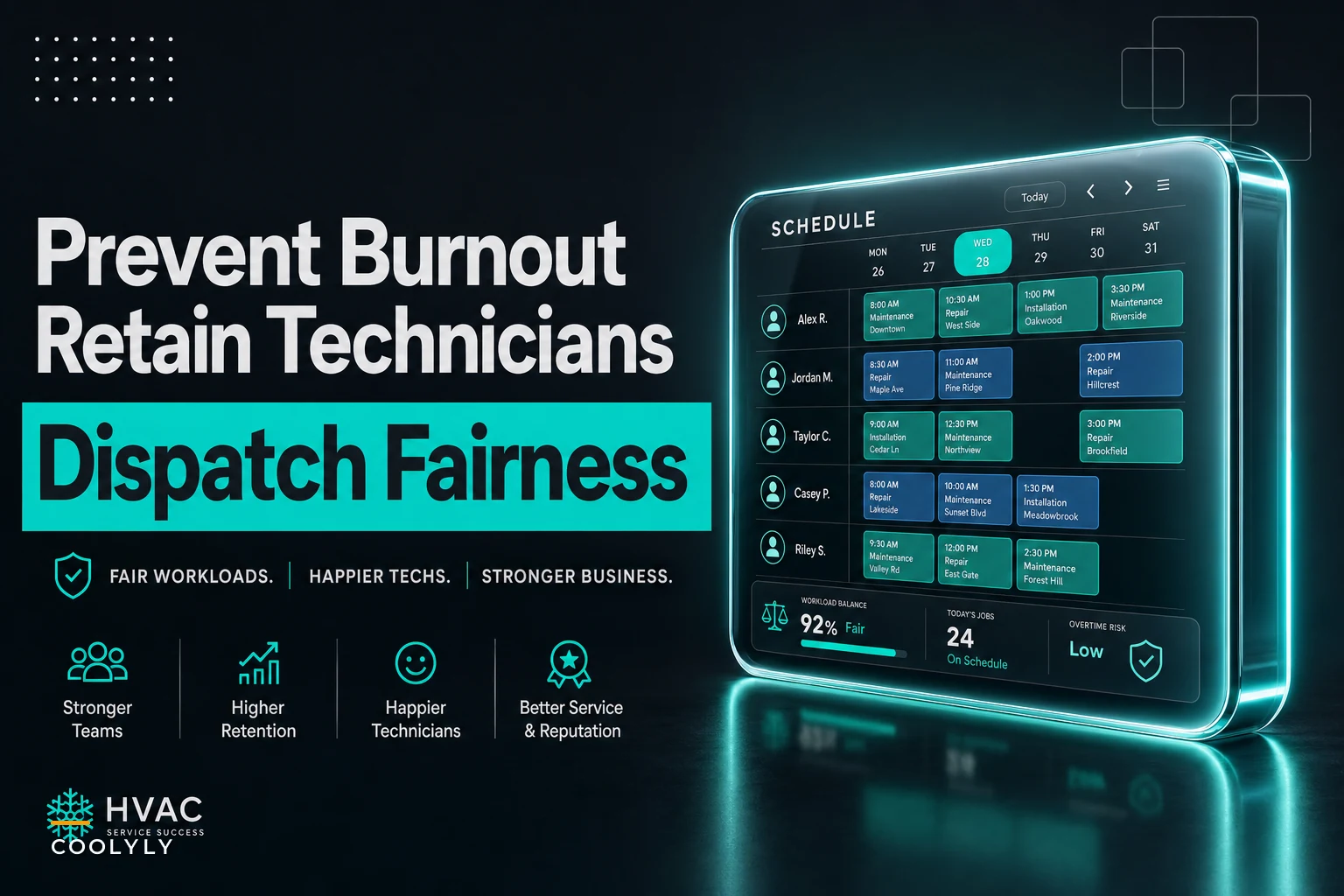

Most owners think they lose techs over pay. Sometimes that's true. But the pattern that shows up in exit conversations more often is subtler: the tech who "always got the tough calls," the guy who ended up with three attic jobs on a July afternoon while someone else cruised through easy filter swaps, the senior installer who hadn't had a real day off in six weeks because he was the only one trusted with the commercial rooftop units.
Burnout in HVAC isn't usually a wellness problem. It's a dispatch fairness problem. The scheduling decisions you make every morning — often on gut feel — accumulate into resentment, fatigue, and eventually a two-week notice. And the techs who leave first are almost always your good ones, because they're the ones you lean on hardest.
This post is about the operational rules that actually fix that: how you rotate the miserable work, cap what one person can absorb, build in recovery windows that stick, and tie all of it to KPIs so you can see the problem before someone quits.
The uneven-load problem, and why it hides so well
When a call comes in, most dispatchers optimize for one thing: who can close this fastest with the least drama. That means the reliable, skilled, uncomplaining tech gets routed the hard stuff over and over, because sending it to him means fewer callbacks and fewer angry customers.
Rational in the moment. Corrosive over months.
In real operations, this usually looks like a 20/80 split nobody intended. Two or three techs absorb the bulk of the physically brutal jobs — crawlspaces, no-attic-access changeouts, the 4:30pm no-cool that turns into a two-hour diagnostic. Meanwhile newer or lower-trust techs get a lighter, cleaner day. Nobody planned it. It just emerged from a thousand small "who can handle this" decisions.
The reason it hides so well is that your headline metrics look fine. Total jobs completed is healthy. Revenue per tech might even look great — because your overloaded people are producing. The damage only shows up in numbers nobody tracks: overtime concentration, callback clustering, and PTO that never gets used.
A quick way to spot it: pull the last 90 days and count physically demanding job types per tech. If your top two techs each handled 40–50% more "hard" jobs than your median tech, you've got a fairness gap that's quietly building toward turnover.
Rotation algorithms: making "who gets the bad job" a rule, not a vibe
The fix isn't complicated in concept — you rotate undesirable work so no single person eats it repeatedly. The hard part is defining "undesirable" clearly enough to enforce the rotation when the day gets chaotic.
Eliminate scheduling chaos and missed jobs.
Coolyly helps HVAC companies book, coordinate, and track every service efficiently.
- Unified appointment & dispatch management
- Automated client notifications
- Technician scheduling & job tracking
No credit card required
Start by tagging job types with a difficulty or strain weight. You don't need a science project here. A simple 1–3 scale works:
| Job type | Strain weight | Notes |
|---|---|---|
| Filter/maintenance visit | 1 | Quick, low physical toll |
| Standard diagnostic | 1 | Manageable, predictable |
| Condenser/compressor repair | 2 | Moderate, weather-exposed |
| Attic/crawlspace work | 3 | High heat, physical strain |
| Full changeout (tight access) | 3 | Long, heavy, exhausting |
| Emergency after-hours no-cool | 3 | Unpredictable, high pressure |
Now instead of tracking just job count per tech, you track weighted strain per tech per week. A tech who did five weight-1 jobs (total strain: 5) had a very different day than one who did three weight-3 jobs (total strain: 9), even though the second guy technically "only did three calls."
The rotation rule becomes: when a weight-3 job comes in, it goes to whoever has the lowest accumulated strain score that fits the skill requirement and route — not simply whoever's best at it. You still respect competence. You just stop defaulting to the same person out of habit.
One thing worth flagging: rotation breaks the moment you allow "just this once" overrides. Every emergency feels urgent. Every hard call feels like a special case. If your dispatcher can sidestep the rotation whenever it's inconvenient, you don't have a rotation — you have a suggestion. The rule has to hold specifically on the busy days, because that's when it matters.
Workload-cap templates: the ceiling that protects your best people
Rotation spreads the strain. Caps stop the strain from getting dangerous in the first place.
-
Daily strain cap roughly 7–8 weighted points per tech
-
Weekly strain cap roughly 32–36 weighted points
-
Consecutive high-strain days no more than 3 in a row before a lighter day is scheduled
-
After-hours calls max 2 per tech per week during summer
These aren't universal numbers — you'll tune them to your climate, team size, and job mix. A crew running service calls in Phoenix in July needs tighter caps than a mild-climate team in spring. The point is that the cap exists and is visible, so you're making a conscious decision when you exceed it rather than discovering the damage after the fact.
The mistake most owners make is treating caps like targets rather than ceilings. A cap isn't "everyone should hit 36 points." It's "nobody should exceed 36." Most weeks your techs should land comfortably under it. If your whole team is regularly pinned against the cap, that's a staffing issue, not a scheduling one — and it's covered in more depth in scaling field operations without chaos.
Mandatory recovery windows: the rule everyone skips
Rotation and caps handle the distribution of work. Recovery windows handle accumulation over time — the slow grind that no single day reveals.
The core rule: after a stretch of high-strain days or a brutal on-call weekend, the tech gets a protected lighter day or a real day off. Not "if we're slow." Protected. Blocked on the calendar before the day fills up.
This is the rule that dies fastest in practice, because the recovery day always looks like slack capacity when Tuesday morning's call volume spikes. Someone calls in, the board is red, and the natural move is to pull the tech who was supposed to have a light day. Do that a few times and your techs learn quickly that recovery windows are fiction.
A few things that make recovery windows actually hold:
-
Schedule them backward from on-call rotations. Whoever covered the weekend gets Monday afternoon capped low. Automatic, not requested.
-
Make the recovery day a hard scheduling constraint, not a preference. The dispatcher shouldn't be able to fill it without a manager override — and overrides should be rare enough to notice when they happen.
-
Track PTO utilization as a health signal. If a tech is carrying a growing unused balance while working every peak week, that's a burnout flag, not a savings account.
The thing most owners miss: recovery isn't generosity, it's error prevention. Fatigued techs make more diagnostic mistakes, generate more callbacks, and defer more work with "I'll come back tomorrow" — which costs you a second truck roll. The recovery day pays for itself.
KPIs that connect fairness to the numbers you actually care about
This is where the conversation stops being about looking after your team and becomes a straight operations argument. Fairness is measurable, and it correlates with two things owners care about deeply: retention and error rates.
-
Strain distribution ratio — the gap between your highest-loaded and median-loaded tech. Under roughly 1.3x is healthy. Above roughly 1.6x, a fairness problem is building.
-
Overtime concentration — what percentage of total OT hours land on your top three techs. If three people carry 60%+ of your OT, you're one resignation away from a capacity crisis.
-
Callback rate by fatigue state — callbacks on days where the tech was above cap versus below. This is the number that proves fatigue drives errors.
-
PTO utilization — percentage of earned PTO actually taken. Low utilization on senior techs is a leading indicator of exits.
-
On-call load balance — after-hours calls per tech per rotation period. Uneven after-hours distribution is one of the fastest burnout accelerants.
When you chart these consistently, a pattern usually emerges: callback rates rise on over-cap days, and the techs with the worst strain ratios tend to leave within the next couple of quarters. You can often see a resignation coming two to three months out if you're watching the strain ratio. Most owners just aren't looking there.
For the broader argument on why rule-based scheduling beats gut-feel dispatch, the business case for a rule-driven dispatch system covers the operational and financial side in more depth.
How this looks in practice
A mid-size residential HVAC shop — around 14 field techs, somewhere between 330 and 360 calls a month in peak season — was losing one experienced tech per summer, always to a competitor, always framed as "better pay." When they finally charted strain distribution, two of their senior installers were running at nearly 1.7x the median load and pulling well over half the after-hours calls.
They rolled out three things: strain-weighted rotation on the hard job types, a weekly cap of around 34 points, and a protected recovery day tied to on-call weekends. Nothing complicated.
The following season, OT concentration on the top three techs dropped from roughly 60% to somewhere around 40%. Callbacks tightened on what used to be their heaviest days — not dramatically, but consistently. And for the first time in three years, they didn't lose a senior tech that summer. When they dug into it later, they found the "better pay" those departed techs had left for was usually pretty marginal. The real driver had been load, not money.
When this makes sense — and when it doesn't
This makes sense when:
-
You have enough techs (roughly 6 or more) that rotation is actually possible
-
You're in a climate with real seasonal strain spikes
-
You've lost experienced people and the pay explanation never quite added up
-
Your OT is consistently concentrated on a few names
This is overkill when:
-
You're a 2–3 person shop where everyone does everything anyway
-
Your work mix is genuinely uniform with little strain variation
-
You're in an off-season lull where nobody's near capacity
Who should be careful: shops with big skill gaps between techs. If only two people can handle commercial rooftop work, pure rotation will route jobs to people who can't execute them. In that case, fix the skill gap first through cross-training — otherwise your fairness rules will just generate callbacks. Rotation works within competence, not as a substitute for it.
Where software quietly helps
You can run all of this on a spreadsheet. Plenty of shops do, at least early on. The reason it usually breaks down isn't the math — it's enforcement in the moment. Nobody's cross-referencing a strain-distribution spreadsheet at 4:45pm when three calls just landed and everyone's slammed.
This is where an operational scheduling platform earns its place: it holds the strain weights, tracks accumulated load per tech in real time, and flags when a routing decision would push someone over cap or break the rotation — right at the moment the dispatcher is making the call. The recovery day shows up as a locked block, not a hopeful note in someone's calendar. The KPIs update on their own instead of waiting for a monthly export that never gets run.
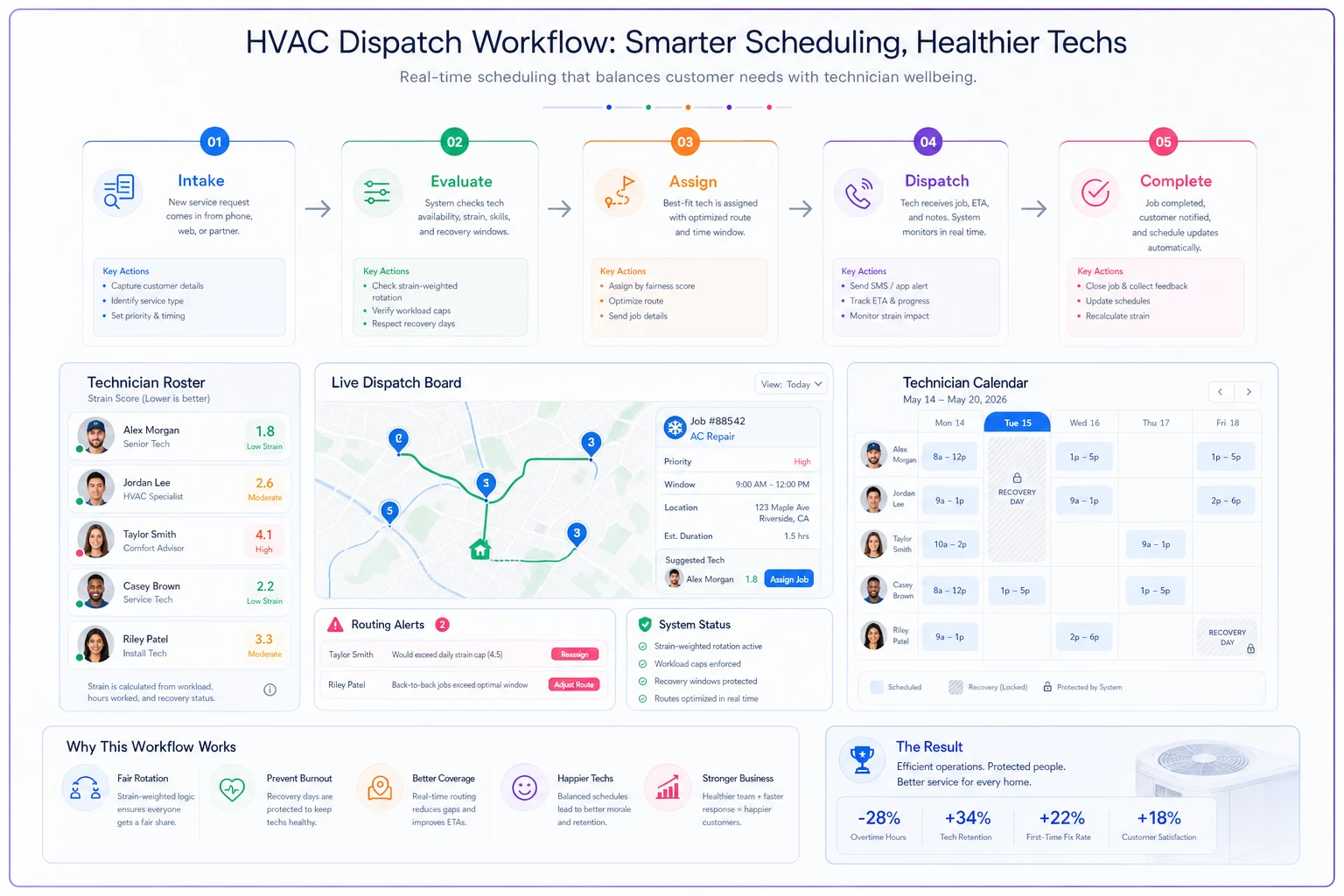
A simple visual like this shows how rules are enforced at decision time, not just recorded afterward.
Lock recovery days in the platform calendar so overrides require a manager action you can audit.
The value isn't automation for its own sake. It's that the fairness rules actually hold on the busy days — the only time they matter, and the exact time manual tracking falls apart.
Technician turnover in HVAC gets diagnosed as a pay problem because that's what exit interviews say, and it's the easiest thing to point at. But underneath it is usually a load problem: the same people getting the hard jobs, the concentrated overtime, the recovery day that got eaten, the on-call rotation that was never really balanced.
You can't fix that with a raise. You fix it with rules — strain-weighted rotation, real caps, protected recovery windows — and by watching a few KPIs that most shops never bother to chart. Do that, and fairness stops depending on whether your dispatcher happened to feel generous that morning. It becomes part of how the schedule is built. And your best techs, the ones you've been quietly overloading, stop looking for the exit.
Ready to optimize your HVAC operations?
Join hundreds of HVAC businesses using Coolyly to save time, improve technician utilization, and enhance customer satisfaction.