


A first‑time‑fix rate drop in residential HVAC rarely announces itself cleanly. It doesn't collapse overnight. It erodes — a couple points one month, a couple more the next — until a dispatcher mentions offhand that "we're sending a lot of guys back out lately," and you pull the numbers and realize you're sitting at 68% when you were at 81% back in April.
The frustrating part is that FTFR is a composite symptom. It's downstream of dispatch decisions, parts availability, technician skill, and whatever's happening on the mobile device in the tech's hand. So when it drops, there's a strong temptation to blame "the techs" and move on. That's almost always the wrong call. In real operations, a falling FTFR is usually three or four small failures stacking on each other, and the fix is boringly specific.
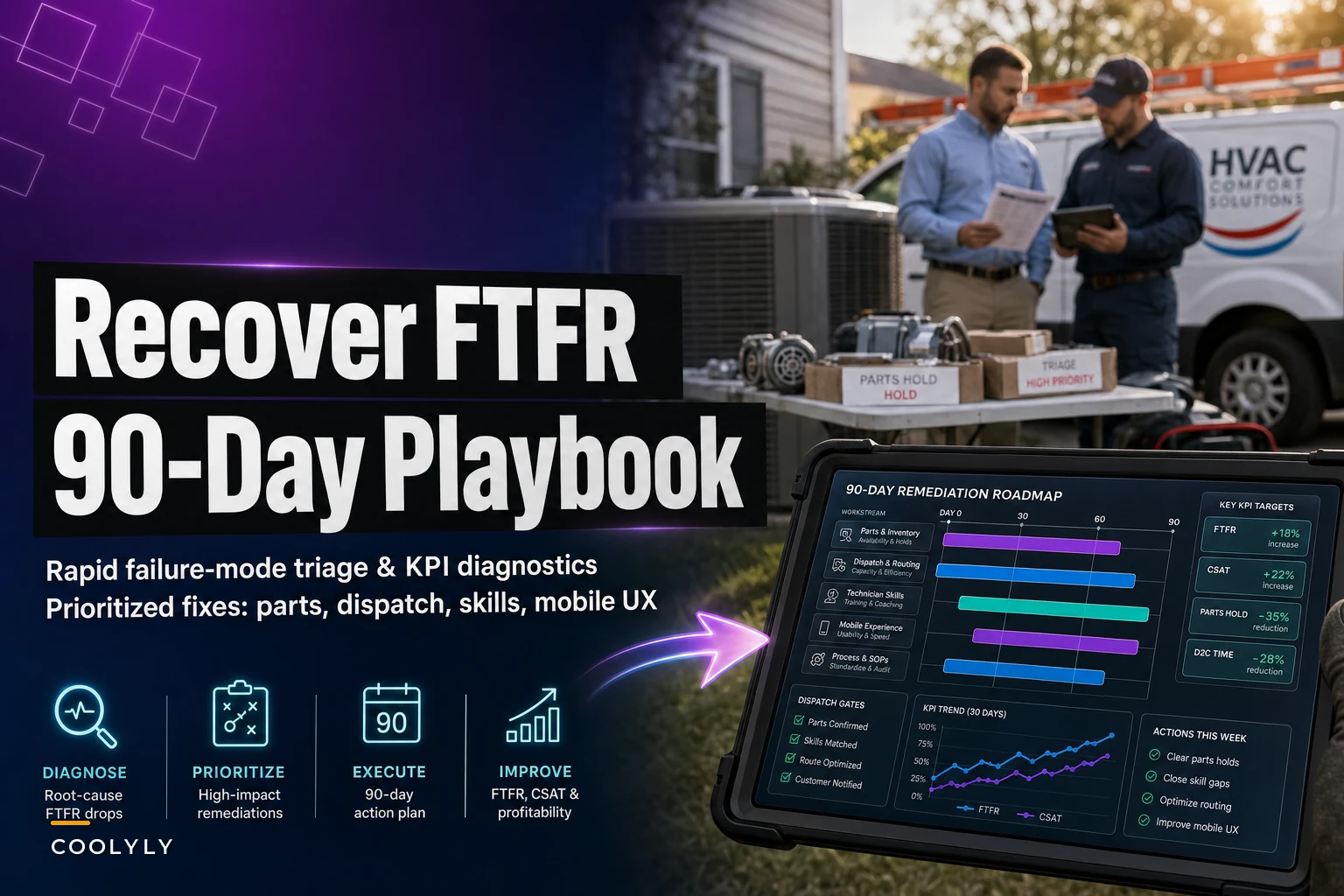
This is a 90‑day playbook. First you triage. Then you execute across four domains in a deliberate order — because fixing dispatch routing before you've staged your high‑failure parts is like repainting a house with a leaky roof.
Step 1: Rapid Diagnostics (Days 0–7)
Run the failure‑mode triage
Pull every non‑first‑time‑fix job from the last 90 days and bucket each one into a cause. Four or five categories is plenty:
-
Parts not on hand (tech diagnosed correctly, couldn't finish)
-
Misdiagnosis (wrong fault identified, came back with wrong part or no fix)
-
Access / scope (customer not home, wrong equipment, job bigger than booked)
-
Skill gap (tech couldn't complete a task within their supposed role)
-
Tooling / data (missing model info, no manual, couldn't look up the part)
The split tells you everything. What shows up consistently across residential shops is that "parts not on hand" and "misdiagnosis" together account for somewhere around 60–75% of repeat visits. If your triage confirms that, you already know where the first 60 days of effort go.
Key reports to run
-
Repeat‑visit reason report — the triage above, as a running table.
-
FTFR by technician — but read it carefully. A tech with low FTFR on condenser calls and high FTFR on everything else is probably a routing problem, not a performance problem.
-
FTFR by job type / fault code — isolates the categories actually killing you (ignition faults, refrigerant circuit, control boards).
-
FTFR by part SKU — which specific parts, when needed, trigger a second trip.
-
Appointment window vs. actual arrival — late arrivals compress diagnostic time and quietly cause rushed, wrong calls.
A quick note on data hygiene: if your fault codes and reason categories aren't standardized, your reports will lie to you. Before you trust any of this, make sure two dispatchers would code the same job the same way. If they wouldn't, fix that first.
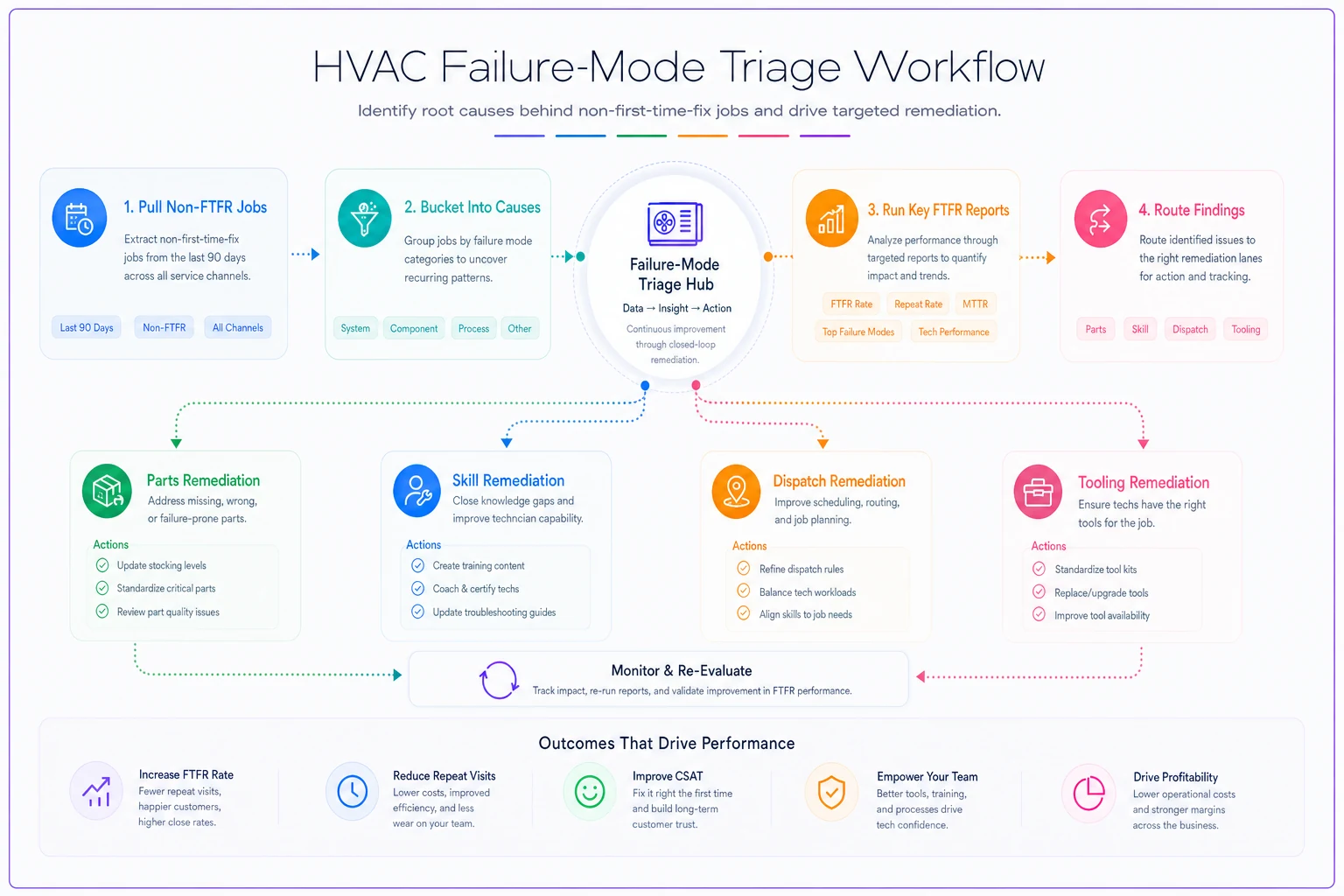
This visual summarizes the rapid diagnostics steps and how the reports feed into prioritized fixes.
The Four Domains, Ranked by Impact
Here's the order of operations, with the reasoning:
Eliminate scheduling chaos and missed jobs.
Coolyly helps HVAC companies book, coordinate, and track every service efficiently.
- Unified appointment & dispatch management
- Automated client notifications
- Technician scheduling & job tracking
No credit card required
| Domain | Why this priority | Typical FTFR contribution |
|---|---|---|
| Parts staging & inventory | Fastest to fix, biggest single lever | 30–40% of misses |
| Technician capability | Slower to fix, high ceiling | 20–30% of misses |
| Dispatch routing & windowing | Structural, needs rule changes | 15–25% of misses |
| Mobile UX / tooling | Enables all the above | 10–20% of misses |
Attack parts first because it's the quickest win with the least organizational friction. Capability runs in parallel but pays off later. Dispatch and tooling are the structural fixes that make the gains stick.
Domain 1: Parts Staging & Inventory (Days 0–45)
This is where the fastest points come from. If your triage shows a pile of "diagnosed correctly, couldn't finish," the tech did their job — the parts process failed them.
Quick win: overnight staging for high‑failure SKUs (Days 0–14)
From your FTFR‑by‑SKU report, pull the top 15–20 parts causing repeat trips. These are usually boring: contactors, run capacitors, specific board revisions, common igniters, a handful of TXVs. Set up an overnight staging process where the next day's booked jobs get these parts pulled and placed on the right truck before the tech clocks in.
-
Expected impact 5–8 FTFR points within three weeks
-
Owner Parts manager / warehouse lead
-
Metric % of next‑day jobs with staged parts; repeat visits tagged "parts not on hand"
-
Timing 0–14 days
One shop running around 900 service calls a month found that eight SKUs were behind roughly 40% of their parts‑related callbacks. Overnight staging those eight alone moved FTFR about six points in a month. Not because they bought more inventory — because the right parts were on the right truck.
Prioritize SKUs that appear across multiple job types first to maximize the impact of overnight staging.
Quick win: captive parts list in the app (Days 0–14)
Every truck should carry a defined, enforced "captive" list — parts that never drop below a set stock level. The failure mode here is silent: a tech uses the last contactor on Tuesday, nobody reorders, and Thursday's contactor job becomes a two‑trip job. Make the captive list visible in whatever mobile tool the techs use, and require a quick end‑of‑day stock confirmation.
-
Expected impact 3–5 points, mostly from reduced "surprise empty bin" misses
-
Owner Service manager
-
Metric captive‑list stockout rate per truck
-
Timing 0–14 days
Medium fix: two‑way parts holds (Days 15–45)
When a tech needs a part that isn't staged, the current process is usually a phone call and a prayer. A two‑way hold means the tech flags the part from the field, the counter confirms it's physically set aside with the job number on it, and the tech gets a confirmation back. No more "I drove to the branch and someone else grabbed the last one."
-
Expected impact reduces the 10–15% of second trips caused by phantom availability
-
Owner Parts manager + dispatch
-
Metric % of field part requests confirmed held vs. lost
-
Timing 15–45 days
Longer fix: local caches & inventory accuracy (Days 46–90)
If your trucks and branches don't agree with your system on what's actually in stock, every other fix is built on sand. Cycle‑count the high‑failure SKUs weekly, not quarterly. Set up small local caches for geographic clusters so techs aren't driving 40 minutes back to the main branch. Loose parts control shows up as FTFR damage before it ever shows up as a theft number — and bin custody discipline is what keeps it from becoming both.
Domain 2: Technician Capability Checks (Days 0–90)
Capability is the domain owners most want to skip, because it feels like an accusation. The better frame: you're not grading people, you're finding the two or three fault categories where your routing is sending the wrong skill level.
The competence matrix
Build a simple grid — technicians down the side, fault categories across the top, a 1–3 rating in each cell (1 = can't, 2 = can with support, 3 = independent). The pattern shows up fast: three techs are a "2" on inverter/mini‑split diagnostics, and those are exactly the jobs bleeding FTFR.
-
Owner Field supervisor
-
Metric % of calls routed to a tech rated 3 for that fault category
-
Timing matrix built in days 0–14, maintained ongoing
Micro‑assessments and shadowing (Days 15–90)
Rather than pulling people into a classroom, run short targeted micro‑assessments on the specific fault categories your triage flagged. Ten minutes, hands‑on, on the actual failure type. Where a tech rates a 2, pair them on two or three live calls with a 3. This lands better than generic training because it's aimed precisely at the jobs that are failing — not HVAC fundamentals in a conference room.
-
Expected impact 4–7 points on the targeted fault categories over 60 days
-
Owner Lead tech / trainer
-
Metric FTFR on the specific fault codes being coached
-
Timing 15–90 days
When this makes sense: your triage shows skill gaps concentrated in a few categories. When it's a bad idea: when "skill gap" is actually a disguised parts or data problem — don't coach a tech for a miss that was really an empty bin.
Domain 3: Dispatch Routing & Windowing (Days 15–90)
Dispatch problems are sneaky because the schedule looks full and efficient while quietly wrecking FTFR. The classic pattern: a dispatcher books by availability, not capability, so your best refrigerant tech spends the morning on filter swaps while a newer tech gets a compressor replacement they can't finish.
Medium fix: dispatch rule changes & triage (Days 15–45)
Before you build full skill‑based routing, fix the obvious rules. Add a triage question set at booking that captures equipment type, symptom, and model number so the office knows what's coming. Then write a handful of hard rules: certain fault categories only go to techs rated 3; mini‑split and inverter calls never go to an unrated tech; jobs with a likely board replacement get the part flagged for staging the night before.
-
Expected impact 4–6 points, mostly from stopping obvious skill/call mismatches
-
Owner Dispatch lead
-
Metric % of misrouted calls (routed to a tech below required rating)
-
Timing 15–45 days
Appointment windowing
Wide windows that compress diagnostic time are a hidden FTFR killer. When a tech arrives at the back edge of a four‑hour window with three jobs still queued, they rush the diagnosis. Flagging "diagnostic‑heavy" jobs for longer blocks — even informally at first — gives techs time to actually get it right the first time. This doesn't require a scheduling overhaul; it just requires someone in dispatch paying attention to job type when they're building the day.
Longer fix: skill‑based routing (Days 46–90)
The structural fix is routing that automatically matches fault category to technician competence, rather than relying on a dispatcher's memory of who's good at what. A rule‑driven dispatch layer earns its keep here — but only after the matrix is accurate and the triage data at booking is clean. Build it last, because it codifies decisions you should have validated manually first.
Expected impact: locks in and extends earlier dispatch gains. Owner: Operations manager. Metric: routing‑match rate; FTFR by fault category. Timing: 46–90 days
Domain 4: Mobile UX & Field Tooling (Days 0–90)
Everything above depends on what the tech can actually see and do on their device. If pulling up the right part number requires a phone call to the counter, your parts fixes leak.
Quick win: mandatory pre‑visit checklist (Days 0–14)
A short, enforced pre‑job checklist in the app: confirm equipment model, confirm symptom, confirm staged parts present, confirm customer and access. Five fields. It catches the "wrong equipment" and "parts not loaded" misses before the tech leaves the previous job.
-
Expected impact 3–5 points from access and scope misses
-
Owner Service manager
-
Metric checklist completion rate; access‑related repeat visits
-
Timing 0–14 days
Field capabilities to build out (Days 15–90)
-
Pre‑job data — model, serial, service history, prior tech notes surfaced before arrival
-
In‑app parts lookup — searchable, with compatible substitutions, so a tech isn't guessing at the counter
-
Photo evidence — before/after and nameplate photos, which cut misdiagnosis and give you an audit trail
-
In‑app triage flows — guided fault paths for the categories that fail most, so a newer tech follows a proven diagnostic sequence rather than improvising
These tooling improvements also shore up your cash and documentation discipline — the same device habits that keep FTFR honest are what keep field collections and receipts clean. If you haven't tightened that side yet, this guide on field cash collection and reconciliation pairs naturally with the mobile workflow changes here.
Modern operational software platforms with built-in AI automation can handle a lot of this coordination automatically — surfacing the right job history before a tech arrives, flagging parts that weren't confirmed on the truck, or alerting dispatch when a booking looks mismatched to the assigned tech's rating. The tooling doesn't replace the process decisions above, but it does reduce how much has to happen manually to keep those decisions working every day.
A Real Scenario
A residential HVAC company running somewhere between 780 and 850 calls a month watched FTFR slide from around 80% to 66% over a summer. Leadership assumed it was two new hires dragging the average.
The triage said otherwise. Of their repeat visits, about 44% were "parts not on hand," 22% were misdiagnosis concentrated entirely in ignition and control‑board faults, and only around 14% was a genuine skill issue — and that skill issue was entirely the two new techs being routed to jobs above their rating.
What they actually did:
-
Overnight‑staged the top 12 failure SKUs (days 0–14)
-
Added a dispatch rule keeping board and inverter calls off the two new techs (day 10)
-
Built a competence matrix and ran micro‑assessments on ignition faults (days 15–45)
-
Rolled out a mandatory pre‑visit checklist in the app (day 7)
By day 75, FTFR was back to around 78%. The parts staging and the single dispatch rule did most of the heavy lifting in the first month; the capability work pushed the last few points. Total out‑of‑pocket cost was mostly process change, not new inventory.
Measurement Cadence to Sustain the Gains
Gains erode if nobody watches them. Keep it light but consistent:
-
Daily staged‑parts completion rate, checklist completion rate (dispatch standup, 5 minutes)
-
Weekly FTFR overall + by fault category, repeat‑visit reason split, misrouted‑call count
-
Monthly FTFR by technician, competence matrix review, top failure SKUs refresh
The monthly SKU refresh matters more than most people expect. Your high‑failure parts list shifts as equipment ages out and new models come in. A staging list built in March is stale by August.
Communication Plan
The fastest way to lose field buy‑in is rolling out FTFR tracking as a scoreboard that punishes. Frame every change as "making the second trip not your fault anymore."
-
Kickoff show the triage data to the whole team. When techs see that most misses were parts and routing — not them — they engage instead of defending.
-
Weekly a short dispatch‑and‑lead huddle on the week's repeat visits — reason, not blame.
-
Monthly share the FTFR trend openly. Recognize the categories that improved. Pick the next SKU and fault category to attack.
A falling first‑time‑fix rate isn't a mystery once you force it into reason codes. Triage first, fix parts fastest, route by real capability, and give techs tools that don't betray them in the field — in that order, inside 90 days, and you'll have the number back where it belongs with a cadence that keeps it there.
A falling first‑time‑fix rate isn't a mystery once you force it into reason codes. Triage first, fix parts fastest, route by real capability, and give techs tools that don't betray them in the field — in that order, inside 90 days, and you'll have the number back where it belongs with a cadence that keeps it there.
Ready to optimize your HVAC operations?
Join hundreds of HVAC businesses using Coolyly to save time, improve technician utilization, and enhance customer satisfaction.