



Most HVAC owners can tell you exactly how much they billed last month. Ask them how much cash their techs collected in the field — and how much of it actually landed in the bank — and the answer gets fuzzy fast. That fuzziness is where the money leaks.
Cash is a small slice of most HVAC revenue now. Cards and financing dominate. But cash jobs, COD service calls, tip-outs, small parts sales, and the petty-cash float in every van still add up. And because it's the one payment type with no automatic paper trail, it's the one that quietly disappears. Nobody's necessarily stealing. Cash just falls through cracks that a card transaction never would.
Below is where those cracks actually are, and a mobile-first workflow that closes them without turning your techs into bookkeepers.
Where the cash actually leaks (it's rarely dramatic theft)
When owners imagine cash loss, they picture a tech pocketing a $400 service payment. That happens, but it's rare and usually gets caught. The bigger, steadier bleed comes from ordinary process gaps.
A homeowner pays $180 cash for a capacitor swap and a diagnostic. The tech writes it on a paper invoice, tosses the cash in the console, and forgets to note it in the system because he's already rolling to the next call. Three days later he remembers, but now he's not sure if it was $180 or $160, and there's no receipt copy. The job gets marked "paid" with no reconciliation. Multiply that by a few dozen cash jobs a month.
Or the petty-cash angle. Each van carries a $150 float for parts runs, gas, small purchases. A tech buys a $40 fitting at the supply house, loses the receipt, and just remembers "it was around forty bucks." At end of month the float is short and nobody can explain why. It's never one big number — it's a stack of $12, $30, $45 gaps.
Then there's the tip-and-round problem. Customer hands over $200 for a $185 job and says "keep it." Is that $15 a tip to the tech or revenue to the company? Without a clear rule, it depends on who's holding the cash. In practice, that ambiguity almost always resolves in favor of whoever's standing in the driveway.
The pattern across most shops: cash loss isn't a theft problem, it's a documentation-and-timing problem. The money leaks in the gap between when cash changes hands and when it gets recorded — and that gap is where you build your controls.
The mobile receipt is the foundation — everything else hangs off it
The single highest-leverage fix is making it faster to document a cash payment than to skip it. If logging cash takes 90 seconds and skipping it takes zero, techs will skip it under pressure. Flip that math.
Eliminate scheduling chaos and missed jobs.
Coolyly helps HVAC companies book, coordinate, and track every service efficiently.
- Unified appointment & dispatch management
- Automated client notifications
- Technician scheduling & job tracking
No credit card required
A mobile receipt template that a tech fills out on their phone at point of payment should be dead simple. Not a form with fifteen fields. Something they can complete before they leave the driveway:
-
Job/invoice number (pre-filled if it links to the work order)
-
Amount collected
-
Payment type (cash / check)
-
Customer name (pre-filled)
-
Tip amount, separate line (forces the tip-vs-revenue decision on the spot)
-
Photo of the signed paper receipt or the cash-in-hand if you want belt-and-suspenders
-
Auto-timestamp and auto-GPS stamp
The GPS and timestamp matter more than people expect. They tie the collection to the actual job location and time, which kills the "I collected it but wrote it down later and got the amount wrong" problem. When the receipt is created at the point of sale, the amount is right because the cash is literally in the tech's hand.
Send an SMS or email receipt copy to the customer automatically. This does two things: gives the customer a record — professional, reduces disputes — and creates a second party who knows the exact amount. A tech is far less likely to fudge a number the customer also received.
One thing that trips shops up: don't make the receipt template optional based on payment type. Techs should generate a receipt for every job, card or cash. If cash triggers a special extra form, it stands out and gets skipped. Make it the same flow for everything, with the payment-type field doing the work.
End-of-day tech cash logs: reconcile before the van goes home
Here's the rule that changes things: cash gets reconciled at end of shift, every shift, before the tech leaves. Not weekly. Not "when we get around to it." Daily, while memory is fresh and the cash is still countable.
The end-of-day cash log is a short close-out each tech does from their phone or at the shop:
-
System pulls up every job the tech marked "cash paid" that day and sums the expected total.
-
Tech counts the cash on hand (collections + starting float).
-
Tech enters the counted amount.
-
System shows the variance instantly — expected vs. counted.
-
If it balances, tech confirms and it's logged. If it's off, tech flags it with a note before leaving.
-
Cash gets dropped in the shop safe or logged for next-day deposit.
The magic is in step 4. A $20 variance caught the same evening is a two-minute conversation — "oh, I forgot to log the Hendersons, that was cash." A $20 variance discovered three weeks later during month-end is an untraceable mystery that gets written off. Same-day reconciliation turns unsolvable problems into solvable ones.
For the petty-cash float, the close-out includes any purchases: receipt photo, amount, category. The float should always reconcile to starting amount − documented purchases + any collected cash. If a receipt is missing, the tech notes it that day, not at month-end when nobody remembers a $38 fitting from the 14th.
This is the same operating principle behind tightening any field process — catch the exception at the moment it's cheap to fix. The shops that run disciplined daily closes on cash tend to be the same ones running disciplined preventive maintenance programs and triage playbooks. The habit transfers.
Require a quick photo of the deposit or safe drop at shift end to create an immediate, time-stamped proof of deposit.
A simple visual helps show the daily cash-close workflow.
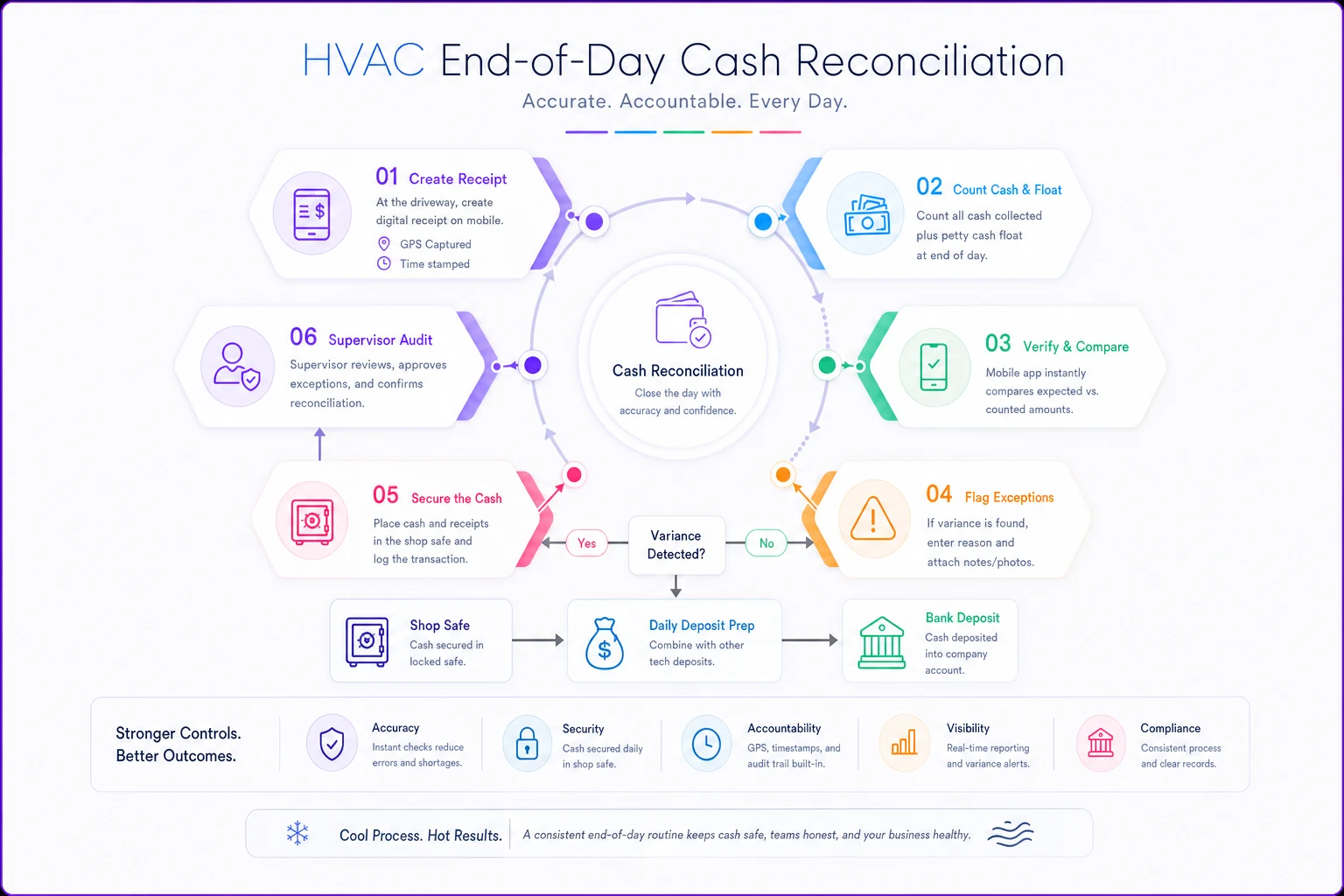
The visual ties the steps together so everyone understands where control points are and who owns each state.
Supervisor audit checks: light touch, high frequency
Daily reconciliation catches honest mistakes. Supervisor audits catch patterns — the tech whose variances are always slightly negative, the van whose float is chronically short, the receipts that are always "lost."
You don't need to audit every transaction. You need a sampling rhythm that makes the field team assume any given day could be checked. A workable cadence for most shops:
| Check | Frequency | What the supervisor looks at |
|---|---|---|
| Daily variance review | Every day | Any close-out with a variance over ~$10, flagged for a quick note |
| Random receipt pull | 3–5 jobs/week per tech | Compare mobile receipt amount to work-order amount and customer confirmation |
| Petty-cash spot count | Weekly, rotating vans | Physically count float vs. system-expected balance |
| Missing-receipt review | Weekly | Any cash job or purchase with no receipt photo attached |
| Trend review | Monthly | Variance patterns by tech, by van, by job type |
The trend review is where the real value is. A single missing receipt is noise. A tech who's produced eleven "approximately" purchase amounts and four missing receipts in a month is a signal — could be sloppiness, could be worse, but either way it's a coaching conversation backed by data instead of a vague suspicion.
Keep the tone right. Techs handling cash correctly should feel protected by the audit, not accused. When someone's numbers reconcile clean for months, that record defends them if a customer later disputes a payment. Frame it that way and you get cooperation instead of resentment.
AR handoff rules: the gray zone between "collected in field" and "on the books"
The messiest leakage happens in the handoff. A tech collects a partial cash payment on a $900 job — customer pays $500 now, "I'll drop the rest at the office." Who owns tracking that remaining $400? If the answer is "someone in accounting will notice eventually," you've just created a receivable with no owner.
You need explicit handoff rules for anything that isn't paid-in-full in the field:
-
Partial payments logged against the invoice with the balance auto-converted to an open AR item with a due date and an owner. Not "we'll remember."
-
Promise-to-pay if a customer says they'll mail a check, that's an AR item, not a paid job. The job stays open until the check clears.
-
COD that fell through tech arrives, customer can't pay, work still done. This has to route to AR immediately, not sit as a "completed" job that looks paid in the dashboard.
-
Collected cash not yet deposited this is "cash on hand," a distinct state from "deposited." Track the float of collected-but-not-banked cash separately so a delayed deposit doesn't look like missing money.
The core rule: a job is only "paid" when the money is in the company's control — deposited or in the safe. Everything between the driveway and the bank is a tracked state with a named owner. Most cash leakage lives precisely in the states that shops don't bother naming.
This connects to how you handle field exceptions generally. The same discipline that keeps you from rolling unnecessary emergency trucks — clear routing rules for edge cases — is what keeps cash from vanishing into ambiguous states. If you've built triage-and-prestage rules for calls, you already understand the value of defining the gray zones before they cost you.
A real scenario: what tightening this up actually looks like
A residential HVAC shop running six trucks, mixed residential service and small commercial. Roughly 15–20% of their volume touched cash in some form — COD calls, older customers who pay cash, small diagnostic fees, van petty-cash floats.
Month-end was a recurring headache. Petty cash was consistently short — usually somewhere in the $200–$400 range across all vans combined — with no way to explain it. Cash jobs occasionally showed up as "paid" with no matching deposit, and a couple of times a year a customer would dispute an amount with no receipt to check against. Nothing catastrophic, but a steady drip. The reconciliation itself ate most of a half-day of office time every month.
They moved to a mobile receipt at point of payment plus a mandatory end-of-shift cash close-out. The first month was rough — techs griped about the extra step, and the daily variances exposed how loose things had been. Within about two months, the unexplained petty-cash gap basically disappeared, because missing receipts got flagged the same day instead of vanishing into month-end.
Hard to put an exact dollar figure on the leakage they stopped — that's the nature of money that was disappearing untracked. But the office time for month-end cash reconciliation dropped from most of a day to under an hour, and the customer-dispute problem essentially went away because every payment had a timestamped receipt with a photo. The owner's read was that they'd been quietly losing somewhere in the low thousands per year across missing petty cash and unrecorded small collections. Not a business-killer. Just money that was theirs and wasn't ending up in the bank.
When this level of control is worth it — and when it's overkill
When it makes sense: You've got multiple trucks, any meaningful cash volume, and you can't personally eyeball every transaction anymore. The moment you're past the point of knowing every job by heart, you need the system. Also non-negotiable if you carry van petty-cash floats — those leak by default without documentation.
When it's overkill: A solo operator or two-truck shop where the owner handles the cash and knows every dollar. Adding a five-step daily close-out to a business where you already count the cash yourself each night is just friction. Keep it simple until the volume outgrows your personal visibility.
Who should be careful: Shops with high tech turnover or a lot of subs. More hands touching cash means more handoff gaps — but it also means you need to introduce controls carefully, because a heavy-handed audit rollout on a stressed team reads as "the boss thinks we're stealing." Lead with the receipt template and daily close-out first. Add audit sampling once the daily habit is solid.
The quick-start checklist
If you're going to fix this, do it in this order:
-
[ ] Build one mobile receipt template used for every job, cash or card, with auto-timestamp and GPS
-
[ ] Add a separate tip line so the tip-vs-revenue call happens at point of payment
-
[ ] Auto-send the customer a receipt copy by text or email
-
[ ] Require an end-of-shift cash close-out with instant expected-vs-counted variance
-
[ ] Reconcile petty-cash floats daily against documented purchases, not monthly
-
[ ] Define the "paid" states clearly
collected-in-field, in-safe, deposited — a job isn't paid until it's in company control
-
[ ] Route every partial payment, promise-to-pay, and failed COD to a tracked AR item with an owner and a due date
-
[ ] Set a light supervisor audit rhythm
daily variance flags, weekly receipt pulls and float spot-counts, monthly trend review
-
[ ] Frame audits as protection for honest techs, not accusation
If you're going to fix this, do it in this order:
The real point
Cash leakage in HVAC almost never shows up as one obvious loss you can point to. It's the accumulation of tiny undocumented gaps — the un-logged $180 call, the lost $38 receipt, the $15 that may or may not have been a tip, the partial payment nobody tracked. Each one is small enough to ignore, which is exactly why it keeps happening.
The fix isn't tighter surveillance or distrust. It's collapsing the gap between when cash changes hands and when it gets recorded, and refusing to call anything "paid" until the money is actually yours. Get the mobile receipt fast enough that documenting beats skipping, close out cash every shift while the numbers are fresh, and name the gray zones so nothing sits in an undefined state. Do that, and field cash collection stops being the one part of your revenue you can't quite account for.
Cash leakage in HVAC almost never shows up as one obvious loss you can point to. It's the accumulation of tiny undocumented gaps — the un-logged $180 call, the lost $38 receipt, the $15 that may or may not have been a tip, the partial payment nobody tracked. Each one is small enough to ignore, which is exactly why it keeps happening.
The fix isn't tighter surveillance or distrust. It's collapsing the gap between when cash changes hands and when it gets recorded, and refusing to call anything "paid" until the money is actually yours. Get the mobile receipt fast enough that documenting beats skipping, close out cash every shift while the numbers are fresh, and name the gray zones so nothing sits in an undefined state. Do that, and field cash collection stops being the one part of your revenue you can't quite account for.
Ready to optimize your HVAC operations?
Join hundreds of HVAC businesses using Coolyly to save time, improve technician utilization, and enhance customer satisfaction.