

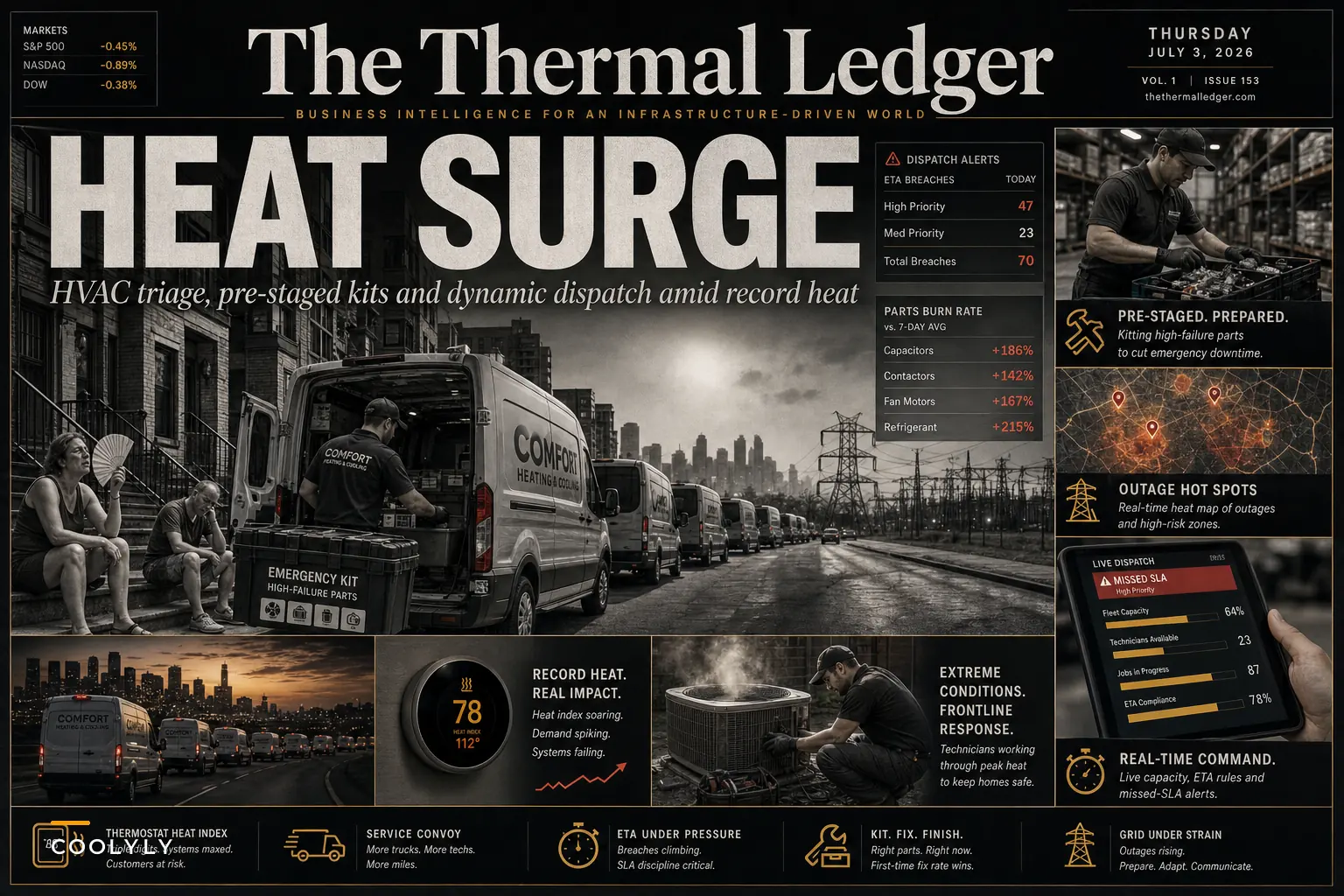

Temperatures are pushing past 105°F across major population centers from Kansas to New York, with Reuters reporting that the electric grid faces record demand that could trigger rolling blackouts. For HVAC companies, this isn't just another hot week—it's the operational equivalent of Black Friday happening every single day while your workforce operates at physical limits.
A contractor in Phoenix mentioned his call volume jumped over 300% in 48 hours. His dispatch board looks like a war zone. Techs are working 14-hour days. Parts inventory that should last two weeks disappeared in three days. And every customer thinks their emergency is the most urgent one.
This heat wave exposes something most HVAC owners already know but don't want to admit: when surge hits, the default move is running the normal playbook harder instead of switching to different operational rules entirely. You can't work faster when it's 108°F outside and every attic feels like a furnace. You need to operate differently.
The surge demand math that breaks normal dispatch logic
During extreme heat events, your typical service mix flips upside down. Instead of 60% maintenance, 30% repairs, and 10% emergencies, you're suddenly dealing with roughly 70% emergencies, 25% critical repairs, and maybe 5% maintenance if you're lucky.
Average call duration climbs from 90 minutes to around 2.5 hours. Techs need more recovery breaks. Diagnostic time increases when every system is stressed. Customers want explanations for why their 8-year-old unit suddenly died. Meanwhile, no-cool calls spike from maybe 15 per day to 80+, and half those customers haven't serviced their units in years.
The scheduling math stops working. If you normally handle 8 calls per tech daily, you're now down to 4 or 5 maximum—but demand tripled. That gap widens every day the heat holds.
What kills most HVAC companies during a heat wave isn't the volume. It's treating every call equally. You end up sending experienced techs to swap capacitors while complex failures sit in queue. Your best diagnostic guy burns three hours driving across town. Parts get allocated first-come-first-served until critical components are gone.
Build your heat wave triage matrix before the phones explode
Start with honest prioritization about what constitutes a true emergency when it's 105°F outside. An 85-year-old with no cooling needs an immediate response. A healthy 30-year-old with one working zone can wait. A commercial kitchen or medical facility jumps the line. The vacation rental with guests arriving tomorrow does not.
Eliminate scheduling chaos and missed jobs.
Coolyly helps HVAC companies book, coordinate, and track every service efficiently.
- Unified appointment & dispatch management
- Automated client notifications
- Technician scheduling & job tracking
No credit card required
Priority 1 - Life Safety (respond within 2-4 hours)
-
Elderly residents (70+ years)
-
Customers with documented medical conditions
-
Households with infants under 12 months
-
Complete system failures with no cooling zones
-
Medical facilities, assisted living, daycare centers
Priority 2 - Critical Comfort (respond within 8-12 hours)
-
Families with young children
-
Multi-family properties with multiple units affected
-
Partial cooling (less than 50% capacity)
-
Commercial clients with customer-facing operations
Priority 3 - Standard Emergency (respond within 24 hours)
-
Single adults under 65
-
Partial cooling still functional
-
Secondary residences
-
Non-critical commercial spaces
Priority 4 - Deferred Service (next available after surge)
-
Maintenance requests
-
Minor issues (unusual noises, small leaks)
-
Efficiency concerns
-
System upgrades
Train your call center staff to ask specific qualifying questions: age of residents, medical conditions, percentage of home without cooling, access to temporary cooling, ability to stay elsewhere. Document those answers. It protects you legally and keeps triage consistent when things get chaotic.
Pre-stage your parts like you're preparing for battle
Normal parts management assumes steady demand. Heat wave logistics requires forward positioning. Three days before the heat hits, you should already be redistributing inventory.
Pull historical failure data from previous heat events. Capacitors fail at roughly 3x the normal rate above 100°F. Condenser fan motors run at 2.5x failure rate. Contactors burn constantly. Refrigerant demand spikes hard. If you normally keep 20 capacitors per truck, bump it to 50. If you stock 10 fan motors centrally, spread them across your fleet.
Five days before predicted heat wave:
-
Order emergency stock of high-failure components
-
Identify alternate suppliers for critical parts
-
Pre-negotiate priority delivery agreements
-
Reserve rental equipment for temporary cooling
Three days before:
-
Redistribute parts from warehouse to trucks
-
Build "emergency kits" — 5 capacitors, 2 contactors, 1 fan motor
-
Position extra refrigerant cylinders at strategic points
-
Load portable AC units for critical medical customers
Day before:
-
Final inventory count and gap analysis
-
Assign parts runners for mid-day resupply
-
Establish parts-sharing protocol between techs
-
Set up an emergency parts line for field requests
The goal isn't having everything everywhere. It's having the right parts in the right trucks when calls cluster geographically. That distinction matters a lot more than it sounds once you're three days into a heat event and techs are calling in asking for parts that are sitting in a warehouse across town.
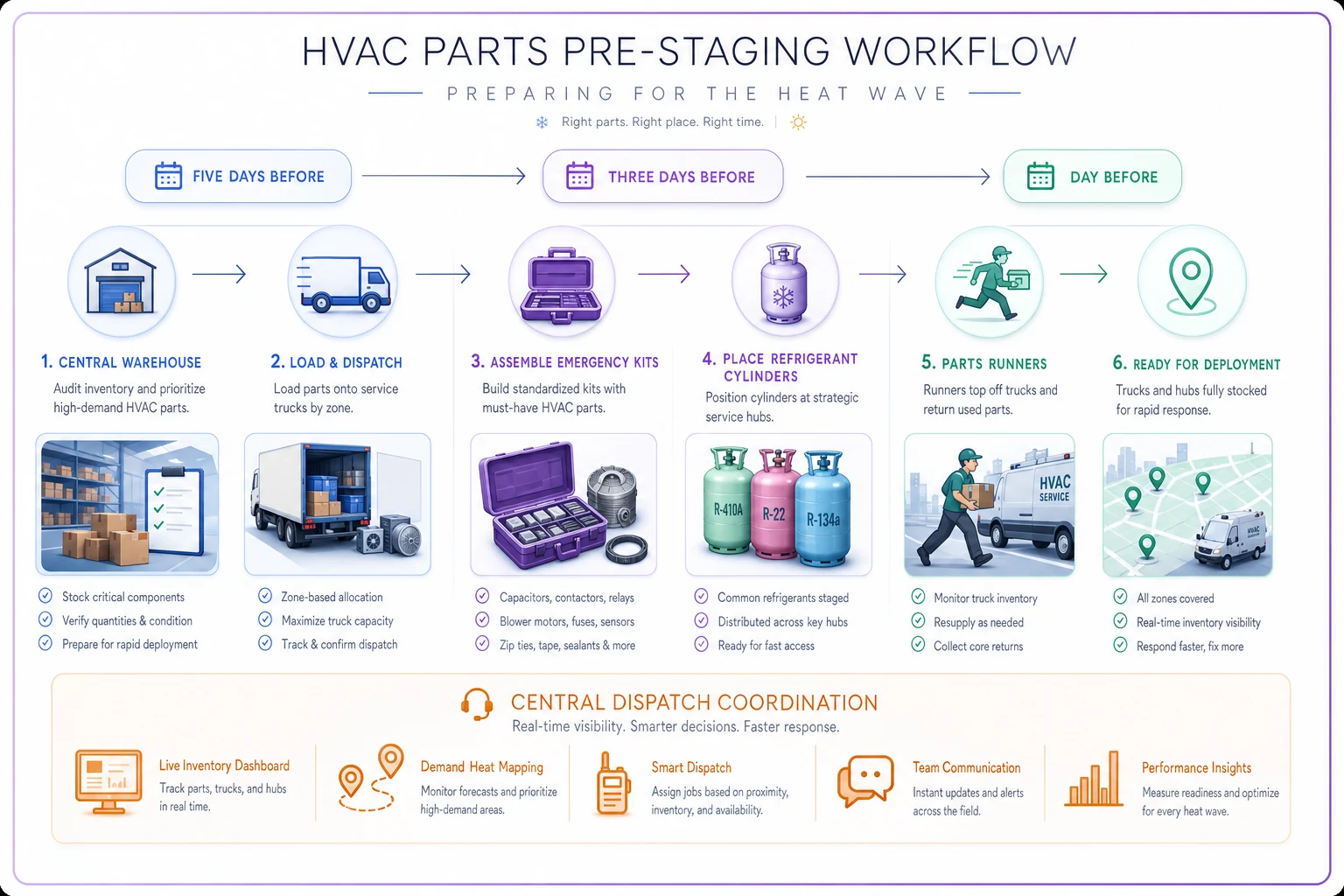
This visual lays out the key pre-staging steps so your ops team can follow the timeline when a heat event is forecast.
Dynamic dispatch rules that prevent technician meltdown
Your normal territory assignments become irrelevant during heat waves. Cluster-based routing matters more—minimize windshield time, maximize recovery breaks.
Divide your service area by call density, not geography. If you're getting 30 calls from one neighborhood and 3 from another, stack resources accordingly. Put 3 or 4 techs in that hot zone exclusively, rotating through calls while keeping drive time short.
Mandatory break protocols matter more than most owners want to admit:
-
15-minute cooldown every 90 minutes
-
30-minute lunch break indoors (not in truck cabs)
-
Hydration check at every stop
-
Buddy system for attic work over 120°F
Shift your dispatch rhythm from "next available tech" to zone saturation. Instead of sending a tech across town after finishing a call, have them hold 20 minutes for the next call in their current area. The downtime feels wasteful until you do the math on drive time saved, reduced heat exposure, and better parts utilization.
Pro-tip: Pre-label emergency kits by zone to speed handoffs and avoid searching for parts mid-shift.
Build your surge bench before you need it. Line up qualified contractors for overflow work—negotiate terms in advance, typically around 70% of your standard rate for referred calls. Be clear about which calls can go external (Priority 3-4) versus what stays internal (Priority 1-2).
Track surge metrics that actually matter for next time
Most companies track call volume and revenue during heat waves but miss the operational data that actually improves future response. You need visibility into triage accuracy, parts utilization, technician productivity degradation, and the downstream impact on customer relationships.
Measure your triage effectiveness rate: what percentage of Priority 1 calls actually required immediate response? Below 80% means your criteria are too loose. Above 95%, you're probably being too restrictive and missing real emergencies.
| Component | Normal Daily Usage | Heat Wave Daily | Variance | Stockout Risk |
|---|---|---|---|---|
| Capacitors | 8-10 units | 35-40 units | 4x | High |
| Contactors | 3-4 units | 12-15 units | 4x | High |
| Fan Motors | 2-3 units | 8-10 units | 3.5x | Medium |
| Refrigerant | 30 lbs | 150 lbs | 5x | Critical |
| Thermostats | 5-6 units | 8-10 units | 1.5x | Low |
Document technician fatigue indicators too: errors per call, average call duration by day of the heat event, callback rate within 48 hours. Performance degrades predictably after day 3 of extreme heat. Plan your rotation around that reality instead of hoping people push through it. Most owners don't track this until they've already had a bad callback week—don't be that owner.
Protect your maintenance contract relationships while managing chaos
Maintenance agreement customers will get frustrated when they can't get same-day service during a heat wave. They paid for priority. But if their system is running at 60% while an elderly customer has zero cooling, the ethical call is obvious—even if the contract conversation isn't easy.
Create a heat wave amendment to your service agreements that explicitly defines emergency override conditions. When temperatures exceed 100°F for 48+ hours, life-safety calls take precedence regardless of contract status. Offer make-good provisions: free filter replacements, discounted fall tune-ups, account credits.
Set up proactive communication for contract holders:
-
Text blast when heat wave protocols activate
-
Daily status updates on response times
-
Direct contact line for contract customers (staffed separately)
-
Post-heat wave scheduling priority for deferred maintenance
Some contractors offer "heat wave insurance" as a maintenance agreement add-on—guaranteed same-day service during extreme weather for an extra $200 annually. Roughly a third of customers buy it, and it funds additional surge capacity without squeezing your base margin.
The grid failure scenario nobody wants to discuss
CNN reports this heat dome could persist for over a week, and utilities are already warning about potential rolling blackouts. When power goes out during extreme heat, your phone rings non-stop with customers who don't understand why their AC won't work without electricity.
Prepare your grid failure response before it happens:
-
Draft template responses explaining power versus AC issues
-
Partner with generator rental companies now
-
Identify customers with medical needs who require backup power
-
Create a standby list for immediate dispatch when power returns
When power comes back, expect a wave of breaker trips and compressor lockouts. Systems trying to start simultaneously create demand spikes that protection circuits can't handle. Train your techs on rapid reset procedures and stock extra time-delay fuses and surge protectors. This is predictable enough that there's no excuse not to be ready for it.
The Tuesday-after-the-heat-wave avalanche
Everyone focuses on surviving the heat wave itself. The operational problem that catches companies off guard is what happens 2-3 days after temperatures drop. Duct-tape fixes fail. Temporary repairs give out. Customers who waited suddenly want service immediately.
Call volume can stay well above normal for a full week after extreme heat breaks. Customers who jury-rigged window units want central systems repaired. Businesses that closed early need work done before Monday. Everyone who deferred maintenance wants tune-ups at the same time.
-
Keep overtime authorization active for 5 days post-heat
-
Hold expanded parts inventory for at least a week
-
Schedule a maintenance push for the second week
-
Prepare for elevated warranty claims from components that got stressed
Build your recovery window into your surge plan from the start.
Making surge protocols stick with operational software
The playbook above works—if your team can execute it consistently under pressure. That's where most HVAC companies fall apart. When call volume triples and everyone's stressed, people revert to what's familiar instead of following new protocols.
Modern operational platforms help enforce these surge rules automatically. Dispatch software can switch to triage mode when trigger conditions hit—temperature thresholds, call volume spikes. Customer intake forms populate with health and safety qualifying questions. Parts allocation follows preset priority rules instead of whoever calls the loudest.
The real value shows up in preventing unnecessary truck rolls through better triage protocols, which becomes critical when every tech hour counts. AI-assisted platforms can analyze call patterns, predict failure types, and flag parts pre-staging needs based on weather forecasts and historical data.
Companies using rule-based operational software during the last major heat event handled roughly 35-40% more calls with the same workforce compared to those dispatching manually. The difference wasn't working harder—it was maintaining consistent protocols when chaos hit.
Beyond survival mode
Heat waves like this week's record-breaker are going to keep happening. The question isn't whether to build surge protocols—it's whether you build them in advance or scramble through another crisis and figure it out again from scratch next summer.
Start with three things: triage categories, mandatory break schedules, and parts pre-staging. Test them during your next busy week, not during an actual emergency. See what breaks. Fix it. Write down what worked.
Most HVAC companies treat heat waves as unavoidable chaos. The ones that handle them well treat them as predictable surge events that follow recognizable patterns. With the right protocols in place, what feels like disaster becomes manageable—exhausting, intense, but manageable.
Your techs will still work long days. The dispatch board will still look overwhelming. But you'll serve more customers, protect your workforce, and keep the relationships that matter for long-term growth intact.
Ready to optimize your HVAC operations?
Join hundreds of HVAC businesses using Coolyly to save time, improve technician utilization, and enhance customer satisfaction.