



Single-family housing starts fell in July to their lowest point in more than three and a half years, according to reporting from Reuters. For contractors leaning heavily on new-construction install work, that headline isn't abstract. It's a schedule gap showing up 60 to 90 days out, right when installers should be booking the fall backlog.
If a meaningful chunk of your revenue comes from builder relationships and new-build crews, the immediate reaction is usually to sit tight and hope the pipeline refills. That's the wrong instinct. The shops that come out of soft-construction stretches in decent shape are the ones that treat the slowdown as a reason to rebalance where their labor hours go — not just wait for the phone to ring differently.
This isn't about "diversifying." Everybody says diversify. The real question is operational: what do you do with install crews, dispatch capacity, and truck inventory when the install queue thins out and you can't afford to bench techs for a season?
The uncomfortable math of an install-heavy shop
New-construction install work has a specific profile. High-ticket, predictable in duration, light on dispatch complexity — a crew shows up to a site, works a day or two, and leaves. Easy to schedule, easy to manage. That's exactly why it becomes a crutch.
When starts drop, the shops that hurt most aren't necessarily the ones losing the most revenue. They're the ones whose entire operational muscle is built around big, clean, single-site jobs. Ask that same crew to run eight scattered residential service calls in a day and things fall apart fast — routing gets sloppy, trucks aren't stocked for variety, and techs used to install rhythm burn time on diagnostics they're rusty at.
A typical scenario: a shop doing around 60% new-install revenue sees builder orders drop by a third. On paper they've lost 20% of revenue. In practice they've lost the easy 20%, and now have idle crews who aren't fast at the work that's left. The margin damage ends up worse than the revenue number suggests.
That's the underlying problem the housing data exposes. Install-heavy firms have optimized for the wrong kind of efficiency — efficiency that only holds when jobs are big and few.
Where the hours should go instead
The pivot-to-maintenance move isn't glamorous, but it's the fastest way to keep techs billable while the construction side recovers. Three levers, in rough order of how quickly they pay off:
Eliminate scheduling chaos and missed jobs.
Coolyly helps HVAC companies book, coordinate, and track every service efficiently.
- Unified appointment & dispatch management
- Automated client notifications
- Technician scheduling & job tracking
No credit card required
1. Preventive maintenance contracts. Recurring, schedulable, and they build the service density you need to route efficiently.
2. Retrofits and system replacements. Existing homes with aging equipment are the natural offset to fewer new homes. Existing-home sales have also softened — Reuters noted a second straight monthly decline in July — but the installed base of tired 12-to-18-year-old systems doesn't care about sales volume. Those systems fail on their own schedule regardless of what the market is doing.
3. Dispatch and routing efficiency. This is the multiplier. If you're shifting from single-site install days to multi-stop service days, poor routing quietly eats your margin before you ever see it.
| Work type | Ticket size | Schedule predictability | Routing complexity | Recurring? |
|---|---|---|---|---|
| New-construction install | High | High | Low | No |
| System retrofit/replace | High | Medium | Medium | No |
| PM contract visit | Low | High | High (density matters) | Yes |
| Emergency service call | Medium | Low | High | No |
PM visits are small tickets, but they're the only recurring column — and recurring revenue is what smooths out the next construction dip. The catch is routing complexity. A PM program that isn't routed tightly can lose money per visit.
Building PM into something that actually holds margin
The mistake most shops make when they suddenly "get serious about maintenance" is treating it like a sales push instead of an operational rebuild. They close a batch of agreements in September, then realize in October they have no clean way to schedule, route, or track them. The contracts become a scheduling headache instead of a revenue floor.
A PM program only protects margin if the data behind it is doing real work. That means knowing which customers are due, clustering visits by geography and week, pre-staging the right parts before the truck rolls, and flagging aging equipment so the retrofit conversation happens naturally during a routine visit — not because a salesperson cold-called.
Organizing your existing service history into a structured program matters more than closing new agreements. We put together a full breakdown on building a data-driven preventive maintenance program from your service data. The core idea applies directly here: your past jobs already tell you which homes have aging systems and which customers are overdue. During a construction slowdown, that historical data is the cheapest lead source you own.
-
Pull every completed job from the last 3–5 years and tag by equipment age and last-service date.
-
Flag systems past 12 years as retrofit candidates and route a PM offer to them first.
-
Batch overdue PM customers by ZIP cluster so a single tech can hit 6–8 stops in a day.
-
Pre-kit trucks the night before based on equipment types on the route.
-
During each visit, capture a condition score so the next PM cycle and any retrofit timing is already documented.
None of this requires new customers. It requires organizing the ones you already served. That distinction matters more than most shop owners realize when they're staring down an empty install queue.
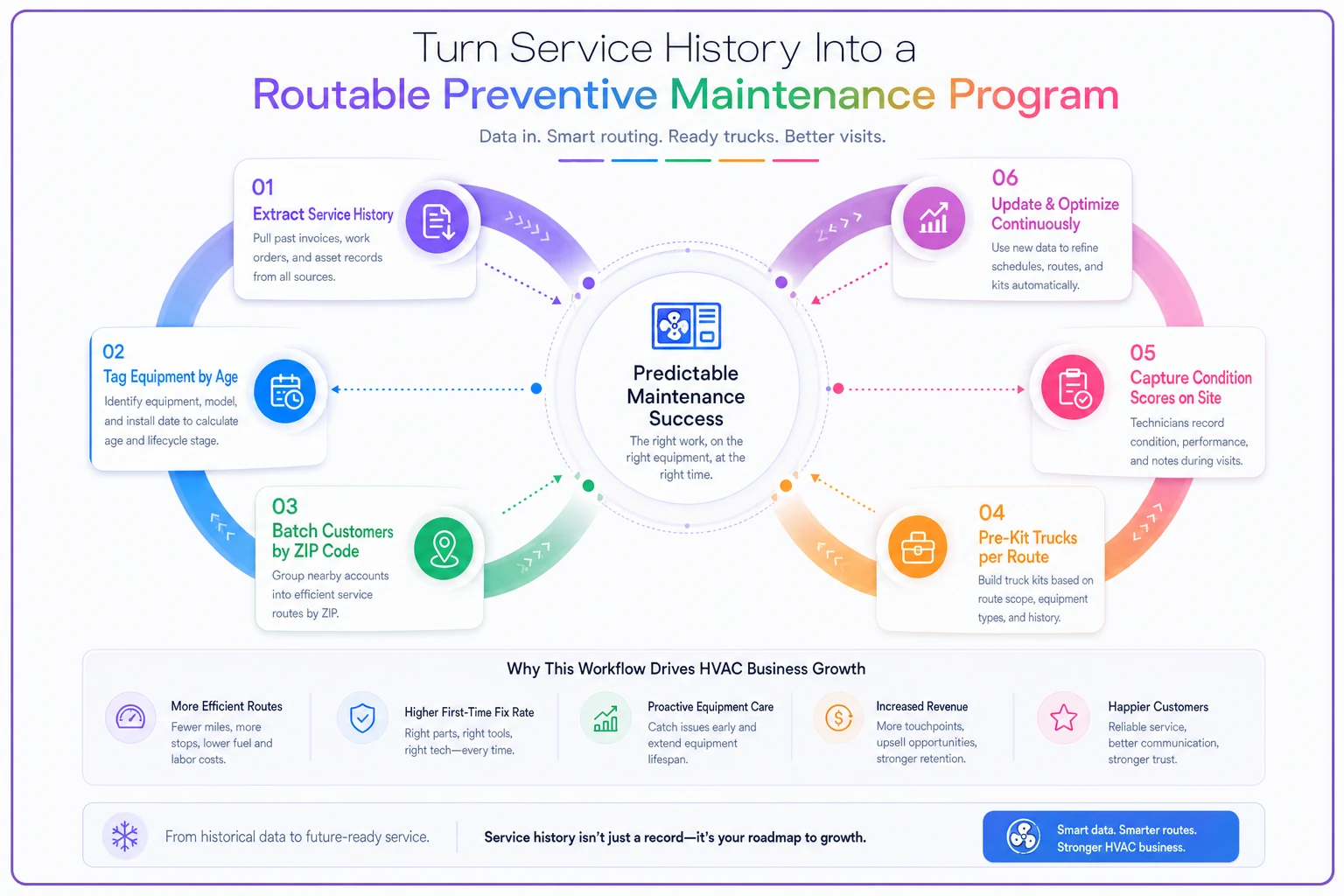
This simple workflow helps visualize the steps field teams and office staff need to coordinate to make PM a durable revenue stream.
The dispatch problem hiding underneath
Shifting crews from installs to service days changes your dispatch math completely. Install scheduling is coarse — you're placing crews on multi-day jobs. Service scheduling is fine-grained, and the difference between a good and bad service day is often just 90 minutes of wasted drive time.
A common pattern during these transitions: a shop moves an install crew to service work, keeps its old scheduling habits, and ends up with techs driving 40+ minutes between stops because jobs were booked in the order calls came in. Two extra stops per day per tech, across a handful of techs, is a real revenue leak — the kind that doesn't show on any single job but hits hard at month-end.
Fixing this doesn't require reinventing anything. It requires booking by geography and time window instead of call order, holding a buffer for same-day emergencies, and stocking trucks for the actual mix of work on each route. Operational software with dispatch and job management built in helps here mostly by removing the manual guesswork — surfacing which overdue customers sit near tomorrow's confirmed jobs so you fill routes with density instead of gaps. But the scheduling discipline matters more than the tool. Software doesn't fix a shop that hasn't decided to route smarter; it just makes the decision easier to act on.
When this pivot makes sense — and when it doesn't
Not every shop should make this move. It fits some operations far better than others.
It makes sense when:
-
You have idle install capacity you can't afford to bench.
-
You already have a service history database, even a messy one.
-
Your service area has enough residential density to route PM visits tightly.
-
You have techs who can handle diagnostics, not just installs.
It's a bad idea when:
-
Your crews are install specialists with weak troubleshooting skills — you'll generate callbacks that eat the margin.
-
Your territory is too spread out for PM routing to ever be efficient.
-
You'd underprice contracts just to keep techs busy, which trains customers to expect cheap service and damages you longer-term.
Who should slow down before pivoting: shops with no clean service records. If you can't quickly answer "which of my past customers have systems over 12 years old," your first move isn't selling maintenance agreements — it's organizing your job data. Selling contracts you can't schedule or route just moves the problem downstream, and that's a worse position to be in when fall demand actually shows up.
A realistic before-and-after
Consider a mid-sized shop running around eight techs, roughly half of them normally on new-install work. When builder orders dropped, they had four techs with thinning schedules and no appetite for layoffs heading into fall.
Instead of waiting it out, they pulled three years of service history and identified a few hundred past customers who were either overdue for maintenance or running equipment past 12 years. They batched outreach by ZIP, booked PM visits in geographic clusters, and pre-staged trucks by route. Retrofit conversations came up organically during those visits — a tech standing in front of a 15-year-old system is a far better retrofit lead than any cold call.
Within about two months, the idle techs were running 6–7 service stops a day at solid density, and a handful of retrofit jobs surfaced from PM visits that wouldn't have come in otherwise. Revenue didn't fully replace the lost install volume, but margin held better than the raw revenue drop implied — crews stayed billable and the retrofit pipeline started feeding itself. The bigger structural win was coming out of it with a recurring PM base that made the next slow stretch far less scary.
The real takeaway
A drop in housing starts is a demand-mix problem, not a demand collapse. The equipment already installed across your service area keeps aging on its own timeline, and that installed base is your buffer against construction cycles — if you've organized your data well enough to reach it deliberately instead of reactively.
The shops that struggle through slow-construction periods usually aren't the ones with less work available. They're the ones who never built the operational muscle to route, stock, and schedule service-dense days, and who treat their service history as archived paperwork instead of the lead list it actually is. Fix the routing, organize the history, and the pivot stops feeling like a downgrade and starts looking like the more durable business you should have been building all along.
Ready to optimize your HVAC operations?
Join hundreds of HVAC businesses using Coolyly to save time, improve technician utilization, and enhance customer satisfaction.