
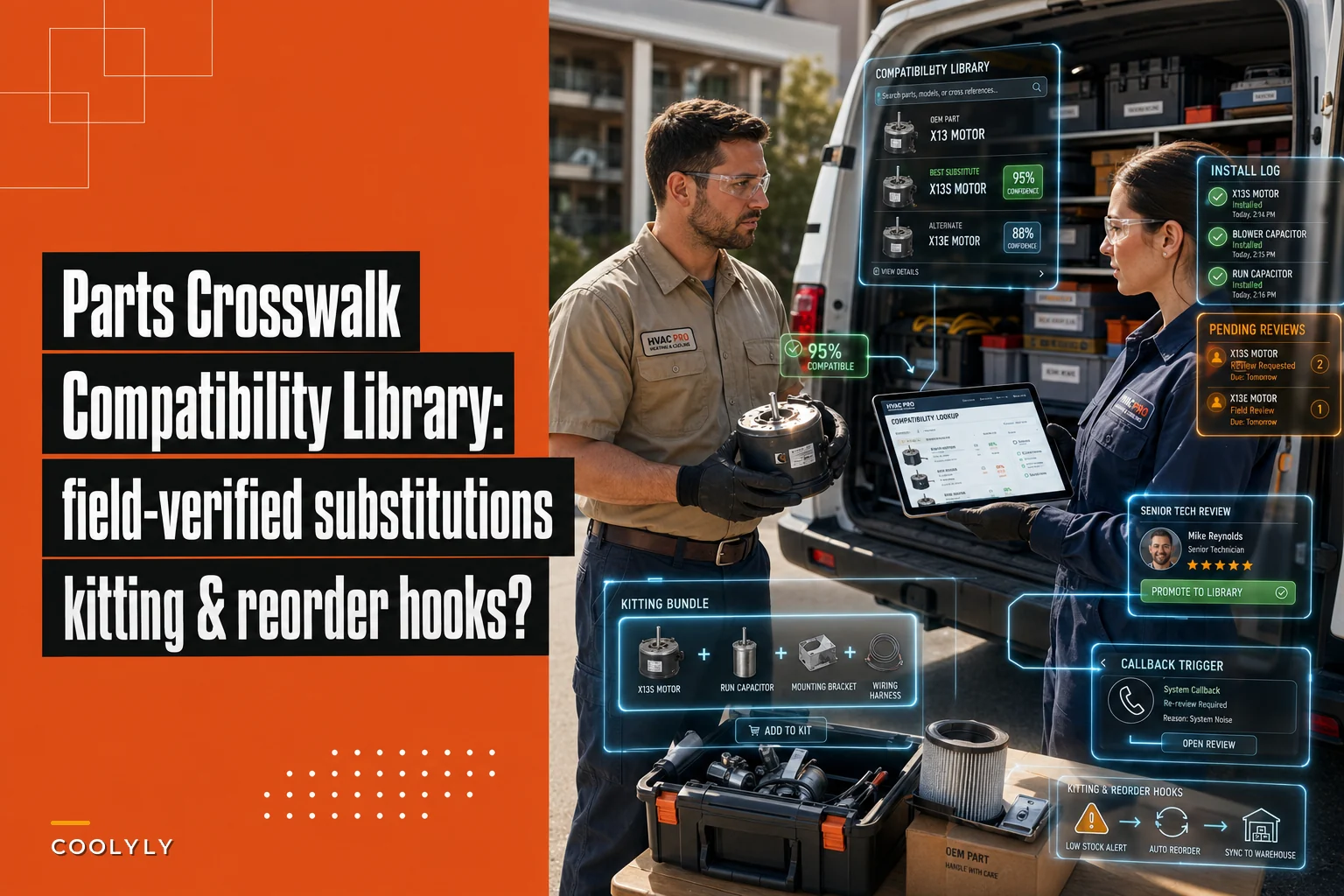

A tech is standing in front of a 12-year-old condensing unit with a dead dual-run capacitor. The OEM part is discontinued. He knows something fits — he replaced one just like it two months ago — but the part number is buried in a text thread with the parts counter guy, who's now on vacation. So he guesses. He grabs a 45/5 µF, 440V unit off the van that's "close enough." It runs. Three weeks later the compressor is short-cycling and you're eating a callback.
That gap — between what the OEM says and what actually works in the field — is where most HVAC parts knowledge lives. In people's heads, in text threads, in the memory of the one senior tech everyone calls when things get weird. An HVAC parts compatibility library is the fix: a searchable, governed record of what substitutes for what, verified by people who've actually installed it, and hooked directly into van kitting and reorder so the right part is already on the truck before it rolls.
This isn't about buying a bigger parts catalog. Distributor catalogs already exist. The problem is that catalogs tell you what's equivalent on paper. They don't tell you that the "equivalent" contactor has a mounting foot that's 3mm off and won't sit in the bracket, or that the substitute blower motor spins the right CFM but the harness plug is different. Your library has to capture the field truth — and that's a different thing entirely.
Why paper equivalence keeps failing you
Manufacturer cross-references are built for procurement, not for the guy on the roof. They answer "what's the closest spec match?" They don't answer "will this actually drop in without a fight?"
-
Spec-match, physical-mismatch. The capacitance and voltage are identical, but the case size or terminal layout differs. It technically works, but the tech has to improvise a mount, and now there's a rattle or a strained wire.
-
Fits-but-derated. A universal condenser fan motor matches horsepower and RPM but runs hotter because the OEM shroud wasn't designed for it. Works for a season, then fails in the next heat wave — right when you're slammed.
-
Fits-once, fails-warranty. The substitute voids the equipment warranty because it's not an approved part. Nobody flagged it, and now the homeowner's compressor claim gets denied and you're caught in the middle.
The reason this keeps happening is that substitution knowledge is tacit. It's earned by installing the wrong thing once and remembering not to do it again. When that knowledge stays in individual heads, every new tech re-learns it the expensive way — through returns, drive-backs, and the occasional very unhappy customer.
The data model: what a real compatibility record needs
Most shops that try to build this start with a spreadsheet with two columns: "OEM part" and "substitute." That collapses within a month because it can't hold the nuance that makes a substitution safe or unsafe.
Eliminate scheduling chaos and missed jobs.
Coolyly helps HVAC companies book, coordinate, and track every service efficiently.
- Unified appointment & dispatch management
- Automated client notifications
- Technician scheduling & job tracking
No credit card required
| Field | Why it matters |
|---|---|
| OEM part number + manufacturer | The anchor everyone searches from |
| Substitute part number + brand | The proposed replacement |
| Substitution type | Direct drop-in / functional-with-mods / emergency-only |
| Equipment models affected | A cap that fits one condenser may not fit another |
| Physical fit notes | Mount, terminal layout, clearance quirks |
| Warranty impact | Approved / voids OEM / neutral |
| Field-verified by | Named tech + date |
| Verification count | How many successful installs recorded |
| Common failure mode if wrong | The thing that turns into a callback |
| Stock/kit status | Whether it's on vans or needs ordering |
The two fields most shops skip are substitution type and verified-by. Those are the ones that matter most. A "direct drop-in" verified across 14 jobs by three different techs is something you trust at 2am. A "functional-with-mods, verified once" is something a senior tech signs off on before a first-year touches it.
Verification count is the quiet workhorse here. It turns a single opinion into a track record. A substitution nobody's logged a success on shouldn't rank the same as one that's worked 20 times — that distinction needs to be visible.
Field-verified substitution rules: the part everyone gets wrong
There's a real difference between "this fits" and "we've proven this works over time." That distinction is what separates a useful library from a liability.
-
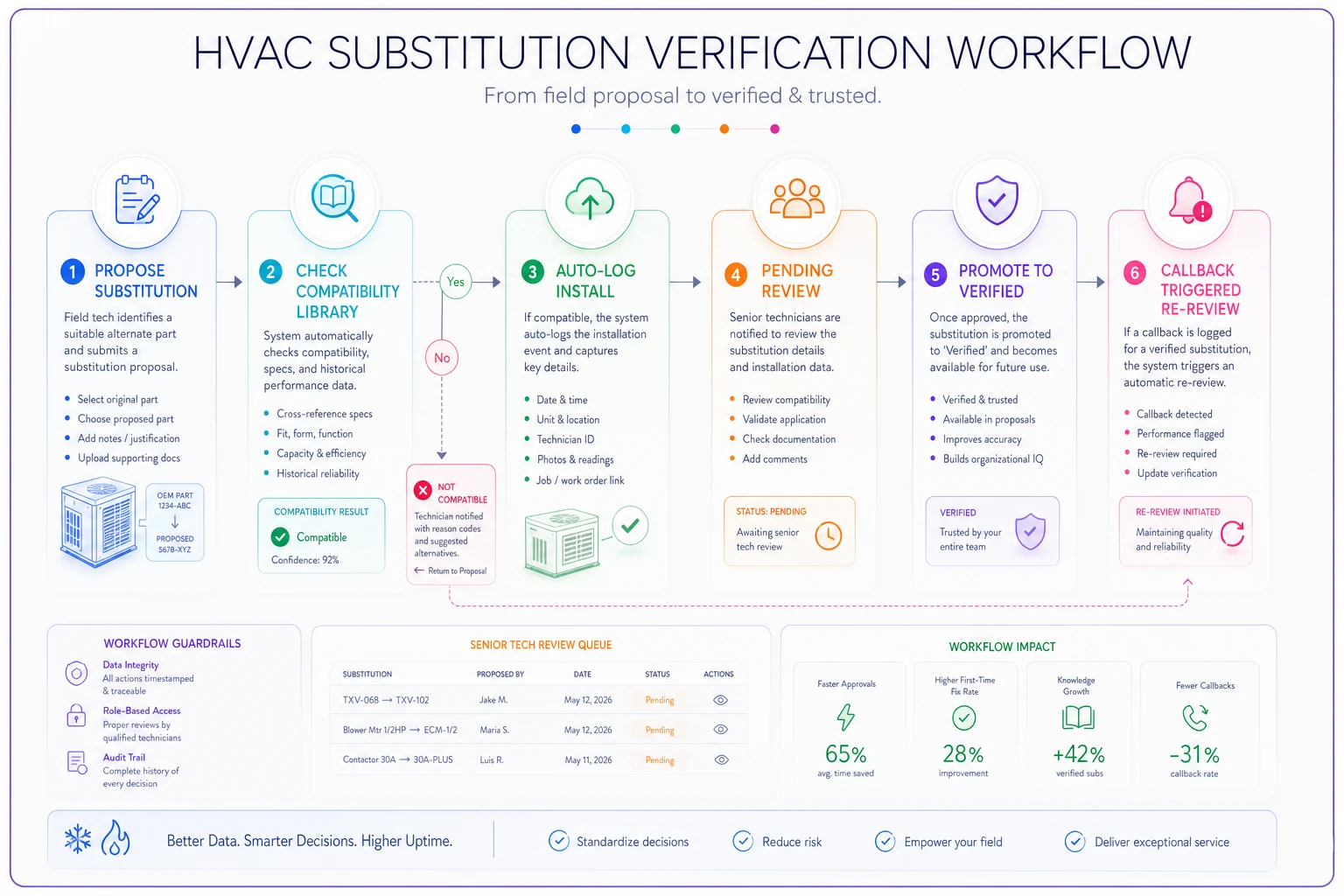
Tech encounters a needed substitution in the field.
-
Before installing, they check the library for an existing verified rule.
-
If one exists and it's rated direct drop-in, they proceed and the install auto-logs against that rule (verification count +1).
-
If no rule exists, they can propose one — but it enters as unverified/pending, not as gospel.
-
A pending rule stays flagged until a senior tech or lead reviews it and either promotes it, downgrades it to emergency-only, or rejects it outright.
-
If a logged substitution later generates a callback, the rule gets flagged for re-review automatically.
That last step is what most libraries never build, and it's probably the most valuable one. A substitution that quietly starts causing failures should lose its verified status. Parts get reformulated, suppliers switch manufacturers — suddenly your "direct drop-in" isn't anymore, and nobody caught it because nobody was watching.
One useful pattern: tie verification count to job outcomes, not just installs. An install still running clean 90 days later is worth more than one logged yesterday. If you're already running any kind of post-job quality sampling, that data feeds this loop naturally.
Edit governance: who gets to say what fits
The fastest way to destroy trust in a parts library is to let anyone edit anything. The second fastest is locking it down so hard that field reality never makes it in.
-
Any tech can propose a substitution and log an install against an existing rule.
-
Leads / senior techs can promote pending rules to verified, downgrade risky ones, and attach fit notes.
-
A parts admin or ops manager owns warranty-impact fields and manufacturer-approved flags, because those carry liability.
-
Nobody can silently delete a rule that has install history. It gets archived with a reason, so you keep the paper trail.
The governance rule that saves the most grief: warranty-impact and "manufacturer-approved" fields require a higher permission level than everything else. These are the fields that turn into denied claims and unhappy customers. A first-year tech guessing that a part is "probably fine warranty-wise" is exactly how you end up eating a compressor replacement you shouldn't have to.
Worth stealing: keep an edit log with who changed what and when. When a substitution goes bad, the first question is "who said this was okay?" If the answer is a named person and a date, you can fix the rule and have an actual conversation. If the answer is a mystery spreadsheet edit from six months ago, you just lose trust in the whole system and start over.
Kitting hooks: where the library actually pays for itself
A compatibility library that only lives on a phone is a reference book. The money shows up when it connects to what's actually on the van and what gets reordered.
The connection works in two directions.
Van → library. When a tech searches for a part, the library should surface what's currently on their truck first — including verified substitutes already in van inventory. Instead of "here's the OEM part you don't have," the answer becomes "you don't have the OEM, but you have a verified direct drop-in in bin 4." That single change kills a significant share of drive-backs before they happen.
Library → reorder. When a substitution gets used, it should decrement the right stock and feed the reorder logic. If techs keep substituting Part B for discontinued Part A, your reorder math should notice and start stocking Part B as the primary. This ties directly into how you optimize service-van inventory with kitting rules and reorder math — the compatibility library is what makes those kitting rules smart instead of static.
The mistake is treating the library and the inventory system as separate tools that occasionally talk. They need to share the same part identity. If your library calls it "45/5 dual cap" and your inventory calls it "CAP-DUAL-455-440," nothing lines up. Getting these systems speaking the same language is exactly the kind of thing covered in an integrations and data-architecture playbook — part identity has to be consistent across dispatch, inventory, and the library, or the whole crosswalk falls apart regardless of how good the rules are.
A real scenario: mid-size residential shop
A residential shop running seven trucks, doing roughly 60–75 service calls a week, was getting hammered on two things: parts returns and drive-backs.
-
Roughly 18–22 parts returns a month, mostly "close enough" substitutes that didn't fit and got swapped out at the customer's expense or theirs.
-
Around 30 drive-backs a month where a tech had to leave the job and come back with the right part.
-
Each drive-back running somewhere in the $85–$120 range in lost billable time and fuel, plus the customer-satisfaction hit that's hard to quantify but very real.
They spent about six weeks building a compatibility library seeded from their most common repairs — capacitors, contactors, fan motors, igniters, control boards. They didn't try to catalog everything. Just the 40 or so parts that drove most of their substitution headaches.
Once verified substitutes were tied to what was actually on each van, drive-backs dropped to roughly 12–15 a month within two months. Returns fell too, because techs stopped grabbing random "close enough" parts and started grabbing verified ones. Rough math on the drive-back reduction alone put savings somewhere north of $1,500 a month — before touching the customer-satisfaction side.
The part the owner didn't expect: onboarding got faster. New techs could search the library instead of calling the one senior guy every time they hit an unfamiliar substitution. That senior tech got a meaningful chunk of his day back, which was its own kind of ROI.
When this makes sense — and when it doesn't
Worth building if:
-
You service a wide range of equipment ages and brands, so substitutions are routine rather than occasional.
-
You have more than a couple of trucks and substitution knowledge is scattered across different people.
-
Returns and drive-backs are a recurring line item you can actually feel in the numbers.
Probably overkill if:
-
You're a one- or two-person shop and all the substitution knowledge lives in one head that's always reachable.
-
You install almost exclusively new equipment under warranty, where substitutions are rare and mostly off-limits anyway.
Who should not rush this:
Shops that haven't standardized part naming across their systems. If your inventory, invoices, and techs all call the same part three different things, fix that first. A compatibility library built on inconsistent part identity produces confident, wrong answers — and that's worse than no library at all.
Getting started without boiling the ocean
Don't try to catalog your entire parts universe on day one. That project dies from its own weight every time.
-
Pull your last 90 days of parts returns and drive-back records. The parts on those lists are your priority list.
-
For each recurring problem part, document the substitution your senior techs actually use — with fit notes and warranty impact written down, not just remembered.
-
Mark each rule with a substitution type and a verified-by name. Be honest about which ones are "we've done this 20 times" versus "we did this once in a pinch."
-
Connect the library to van inventory so verified substitutes show up as available options at the job.
-
Let field use build verification counts over time, and set up callback-triggered re-review so bad rules get caught before they become a pattern.
The library gets more valuable the longer it runs, because verification counts and failure history accumulate. Year one it's a helpful reference. Year three it's institutional memory that doesn't quit when your best tech does.
The whole point of a parts crosswalk isn't to make substitution decisions for your techs — it's to make sure the hard-won knowledge one person earned doesn't get re-learned through a returned part and an angry customer call. Capture what fits, prove it in the field, govern who can change it, and wire it into the van. Do that, and the guy standing in front of the discontinued capacitor stops guessing.
Ready to optimize your HVAC operations?
Join hundreds of HVAC businesses using Coolyly to save time, improve technician utilization, and enhance customer satisfaction.