

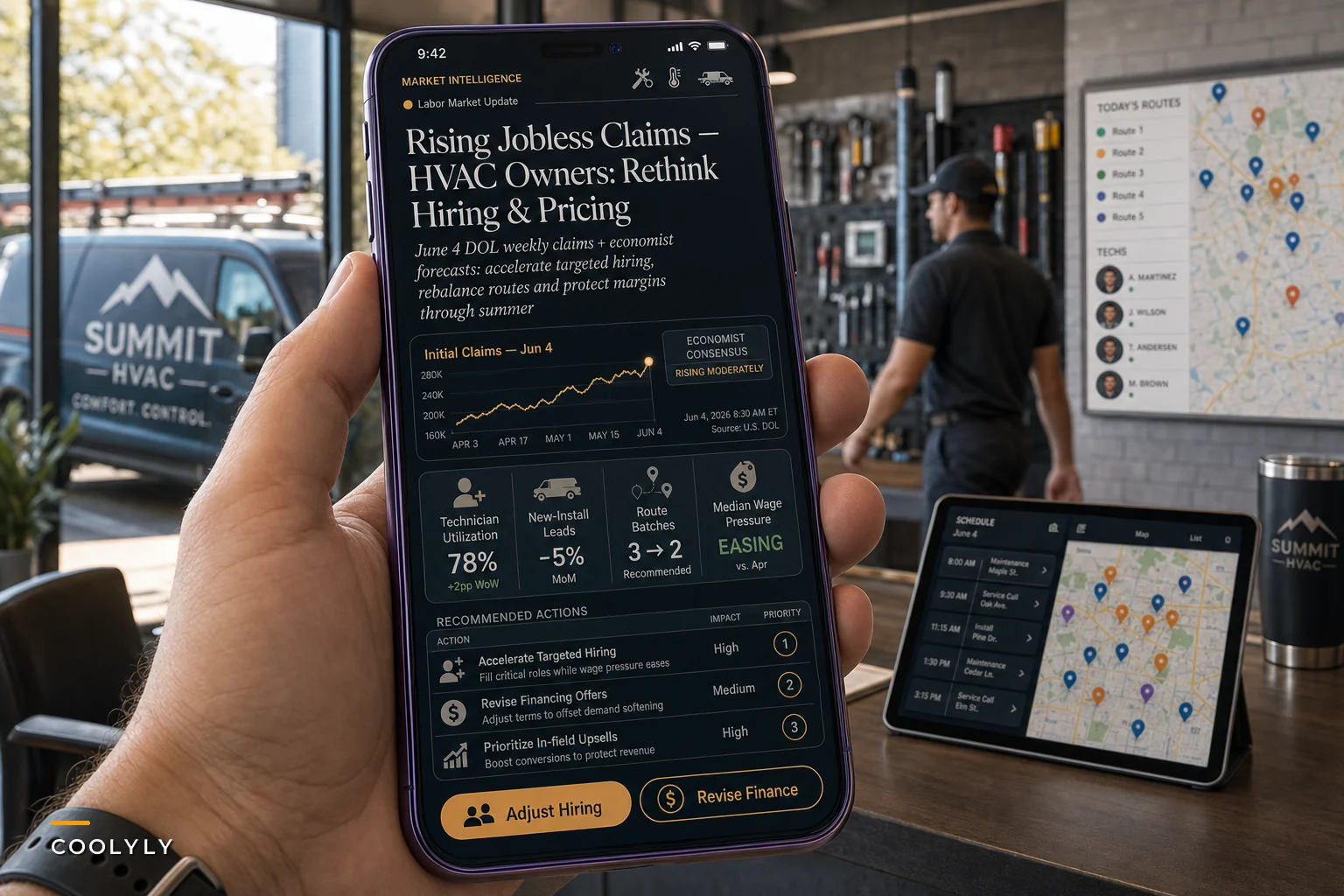

Last Thursday morning, I got three texts within an hour. Two from HVAC owners who'd been struggling to find techs for months, one from a friend who runs a commercial outfit in Phoenix. All asking the same thing: did you see the jobless numbers?
Initial jobless claims hit 225,000 for the week ending May 30—highest we've seen in four months. For HVAC businesses that spent the last two years throwing money at anyone with a EPA certification, this shift changes everything about how you prep for summer.
The timing couldn't be weirder. We're literally weeks away from peak AC season, when most shops are desperately trying to add bodies. But this cooling labor market creates a narrow window where smart operators can completely reset their hiring, pricing, and capacity planning before the heat really kicks in.
What this actually means for your shop floor
Most HVAC hiring happens in panic mode. Tech quits on Tuesday, you're posting on Indeed by Wednesday, offering $5/hour more than you planned by Friday. I watched a shop in Dallas go from paying $28/hour to $41/hour for the same role over eighteen months. Not because the work changed—because they kept losing bidding wars.
Now we're seeing something different. More applications per posting. Candidates actually showing up for interviews. People willing to discuss compensation instead of demanding top dollar upfront.
But this isn't just about filling empty slots cheaper. The whole operational math changes when you can actually choose who to hire instead of taking whoever shows up.
A residential shop I know in Atlanta just pulled off something they couldn't have done six months ago. They hired four techs in two weeks—all with 3+ years experience—without touching their wage ceiling. More importantly, they could actually be selective. They picked people who fit their routing zones, had experience with their equipment brands, and didn't need three months of training.
That selectivity matters more than the wage savings. When you can hire someone who already knows Carrier systems and lives near your Tuesday route cluster, you're not just saving on payroll. You're cutting training time, reducing callbacks, and avoiding the chaos of constantly reshuffling territories.
The summer capacity trap nobody talks about
Every HVAC owner knows the basic summer math: more calls than techs equals lost revenue. So we overhire in spring, pray they stick around, and eat the overhead in fall.
Eliminate scheduling chaos and missed jobs.
Coolyly helps HVAC companies book, coordinate, and track every service efficiently.
- Unified appointment & dispatch management
- Automated client notifications
- Technician scheduling & job tracking
No credit card required
That formula assumes you're playing defense—grabbing whoever you can before competitors do. When the labor market loosens even slightly, you can flip to offense.
Think about your current team structure. You probably have a mix of skill levels scattered across territories. Senior techs driving forty minutes to jobs while green guys handle complex calls nearby. Not because it makes sense—because that's how the hiring timeline worked out.
With more candidates available, you can actually build logical teams. Pair experienced techs with specific neighborhoods. Create specialized crews for commercial versus residential. Build your schedule around your people instead of forcing your people into a broken schedule.
One contractor in Houston restructured their entire operation when they suddenly had hiring options. Instead of everyone doing everything, they created three distinct teams: new installs, service/repair, and maintenance contracts. Each team got dedicated scheduling blocks and territories. First month after the change, they handled 23% more calls with the same headcount.
Pricing decisions when labor costs finally plateau
For two years, the only pricing strategy was "raise everything to cover wages." Labor went up 30%, prices followed. Customers grumbled but paid because everyone else charged similar rates.
Now you're in a weird spot. Labor costs stopped climbing, but customers still expect price increases. Meanwhile, if demand softens even slightly, you might need to compete on price for the first time in years.
The shops that win won't just hold prices flat or cut across the board. They'll get surgical.
Start with your service tiers. That basic tune-up you price at $89? Maybe keep it there as a loss leader. But the comprehensive maintenance package at $349? There's probably room to move up while adding a few digital touchpoints that cost you nothing—automated reminders, priority scheduling, seasonal tips via email.
Installation pricing gets trickier. Homeowners are already stretching budgets with higher interest rates. But you can restructure deals without cutting margins. Extended warranties, maintenance bundles, even creative financing partnerships. A company in Orlando started offering "summer prep packages"—install in May, first payment in September. Conversion rate jumped without touching the actual price.
The real opportunity is in your middle-tier services. Those $400-800 repairs where customers waffle between fixing and replacing. With stable labor costs, you can actually calculate real margins instead of guessing. Maybe you discover you've been underpricing commercial coil cleanings by $200. Or overpricing residential capacitor replacements to the point where you're losing easy jobs to Chuck-in-a-truck operations.
Converting your existing base while everyone else fights for new installs
When new construction slows and installation demand drops, everyone scrambles for the same shrinking pie. You're sitting on a goldmine of past service data though.
Pull your service records from last summer. Every AC that limped through August, every system over 12 years old, every customer who asked about upgrades but balked at the price. That's your real pipeline.
The math here is straightforward. You already know these houses. Your techs have been in their mechanical rooms. You have their service history showing declining efficiency. More importantly, they trust you enough to let you in their homes.
A shop in Tampa ran an interesting experiment. Instead of cold-calling for new installs, they had their office team call every customer whose system was 10+ years old. Not a sales pitch—a "pre-summer system review" at no charge. Tech goes out, does a real evaluation, provides three options: minor fixes to get through summer, major repair to extend life 2-3 years, or replacement with current rebates and financing.
Forty percent scheduled the review. Of those, about half did some level of work. The key was timing—catching people before their system actually died, when they could make a calm decision instead of a panic purchase.
The hiring playbook when you actually have options
Having more candidates doesn't mean hiring everyone who applies. It means you can finally build the team structure you actually want.
Start with geographic clustering. Plot where your techs live versus where your calls concentrate. I saw a shop in Phoenix cut average drive time by 35 minutes per day per tech just by hiring specifically for underserved zones. That's basically adding an extra call per tech per day without changing anything else.
-
Next, think about skill progression. Instead of hiring only experienced techs or only helpers, you can build a ladder. Experienced lead tech, mid-level tech who can handle most calls, helper who's learning. They work as a pod, sharing a territory. The lead trains the others while maintaining quality. The helper gradually takes simple calls. Everyone has a growth path.
-
Don't ignore part-timers and semi-retired techs either. That 58-year-old who doesn't want to crawl through attics anymore? Perfect for maintenance contracts and diagnostic work. The guy who only wants three days a week? Great for covering your Monday-Wednesday peak. When you're not desperate, you can get creative with scheduling.
-
Background checks and reference calls actually matter again too. When you have ten qualified candidates instead of two, you can afford to dig deeper. That tech with amazing experience but three shops in two years? Maybe pass. The one with steady employment but a DUI from five years ago? Could be worth a conversation.
Plot candidate addresses against route clusters to spot underserved zones before hiring.
When you're not desperate, you can get creative with scheduling.
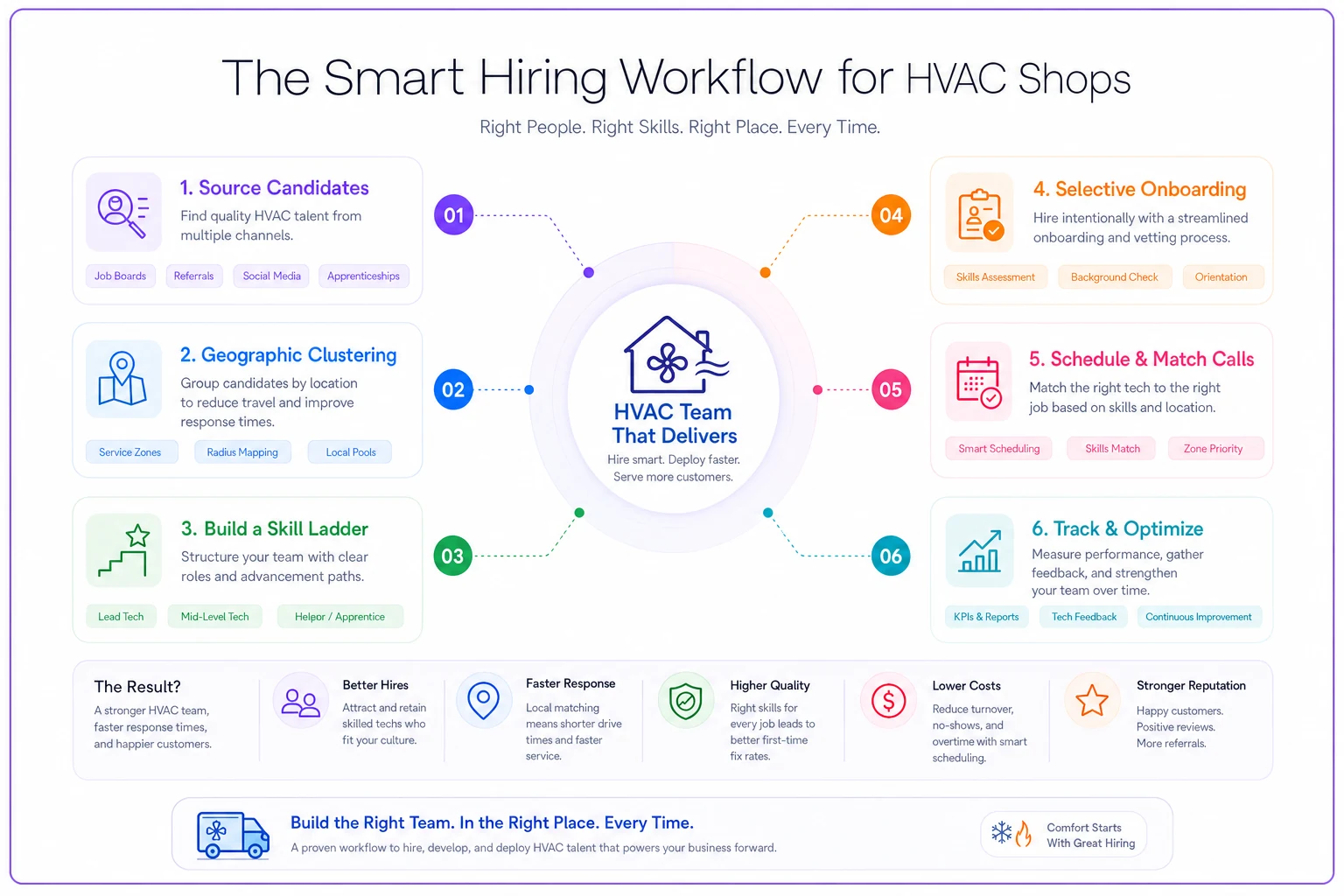
This visual maps the steps from sourcing candidates to matching them with routes and roles.
Building in flexibility before demand patterns shift
Nobody knows if this economic cooling turns into something bigger. Could be a blip, could be a real slowdown. The shops that survive either scenario are building flexibility now.
Look at your fixed costs versus variable capacity. How many full-time techs do you really need year-round? Could some positions be seasonal contracts? Can you create an on-call pool of qualified techs who work elsewhere but pick up weekend shifts?
Cross-training becomes crucial. That install crew that only does installs? Teach them basic service calls. Your maintenance tech who only does tune-ups? Train them on simple repairs. When demand shifts, you can redeploy instead of laying off or panic hiring.
Technology infrastructure matters here too. If you're still running on paper schedules and Excel, you can't adapt quickly. Modern operational software lets you reshuffle routes in minutes, track tech certifications and skills, automatically match calls to the right tech based on location and expertise. When market conditions change weekly instead of yearly, manual systems will bury you.
The territorial and staffing strategies we've covered before become even more critical when you need to scale up or down quickly. Rigid zones and fixed teams work in stable times. Flexible territories with cross-trained staff let you respond to whatever comes next.
The uncomfortable conversation about retention
Some of your current techs are only there because they couldn't find anything better. Now they might.
That journeyman who's been grumbling about pay, even after two raises? He's probably already interviewing. The installer who complains about drive times? He just saw three companies hiring in his neighborhood.
But retention isn't really about matching every outside offer. It's about making your shop the place good techs want to stay. And that's easier when you can hire strategically instead of desperately.
Start with schedule flexibility. That senior tech who wants every Friday off to coach his kid's baseball? When you have adequate coverage, you can say yes. The installer who wants four tens instead of five eights? Doable when you're fully staffed.
Career advancement paths matter more when techs have options. Create clear progression from helper to lead tech. Offer manufacturer certifications and actually give raises when they complete them. Build specialization paths—some techs love complex diagnostics, others prefer customer interaction, some want to move into sales or management.
Small quality-of-life improvements compound. Take-home vehicles for senior techs. Quarterly tool allowances. Company-paid cell phones. A proper break room with actual AC. These things cost less than constantly recruiting and training replacements.
One shop owner in Atlanta told me something interesting: "When we stopped hiring in panic mode, our retention got better, not worse. Techs want to work with competent teammates. They hate carrying dead weight or training someone new every month."
Real numbers from a shop that moved early
Mid-sized residential/light commercial operation in Charlotte. Eighteen techs in March, constant turnover, averaging two open positions at any time.
When they saw labor market indicators shifting in April, they moved fast. Posted aggressive job ads with good but not desperate wages. Hired six techs in three weeks—four to fill gaps, two as summer surge capacity.
They hired strategically. Two guys from a competitor who lived in their underserved south territory. A semi-retired commercial specialist for their growing office building contracts. Three younger techs with 2-3 years experience, trainable but not green.
By standardizing some operations through their scheduling platform—automatic dispatch based on location and skills, digital documentation instead of paper, automated customer communications—they onboarded everyone in half the usual time.
Results by end of May:
| Result |
|---|
| Drive time down roughly 25 minutes per tech per day |
| Callbacks dropped from around 12% to 7% |
| Overtime costs reduced by about $11,000 monthly |
| Customer satisfaction scores up (mostly from faster response times) |
They're heading into summer with 24 techs, knowing they'll probably lose two or three naturally. But they have a bench. They have coverage. They can handle the surge without breaking their existing team.
Making moves before the window closes
This labor market shift might last three months or three years. Nobody knows. But right now, today, you have opportunities that didn't exist in January.
Audit your current team structure first. Where are the gaps? Which territories are underserved? What skills are you missing? Don't hire just to hire—hire to fix specific operational problems.
Review your pricing architecture. With stable labor costs, you can actually price based on value instead of just covering increasing expenses. Find the services where you're leaving money on the table. Identify where you're pricing yourself out of easy work.
Lock in your summer capacity now. Whether that's hiring full-time techs, building a pool of part-timers, or partnering with other shops for overflow. Waiting until June means you're back to competing with everyone else.
Most importantly, use this breathing room to build operational systems that work regardless of labor market conditions. Proper territories, clear scheduling rules, documented processes, performance tracking. The infrastructure that lets you scale up or down without chaos.
The HVAC owners who thrive aren't the ones who pay the most or work their teams the hardest. They're the ones who build sustainable operations that can adapt to changing conditions. This moment—where you can actually choose who to hire and how to structure your team—doesn't come often.
Summer's coming whether you're ready or not. But for the first time in years, you might actually be able to build the team you want instead of settling for whoever shows up.
Ready to optimize your HVAC operations?
Join hundreds of HVAC businesses using Coolyly to save time, improve technician utilization, and enhance customer satisfaction.