

Most HVAC companies don't lose money on compensation because customers are dishonest. They lose it because there's no rule. When a commercial freezer loses cooling on a Saturday, or a homeowner sits three hours past a promised window in July, somebody on your team has to make a fast decision under pressure. With no framework, that decision falls to whoever's on the phone — usually generous, usually inconsistent, and almost never documented.
The result is a slow bleed. One CSR waives a $189 diagnostic fee. A dispatcher promises a free next PM visit to calm someone down. A tech hands over a $75 gift card out of guilt. None of it gets tracked, none of it is capped, and none of it has anything to do with how bad the failure actually was. Over a year, a mid-size shop can quietly give away tens of thousands in credits and freebies that nobody ever approved.
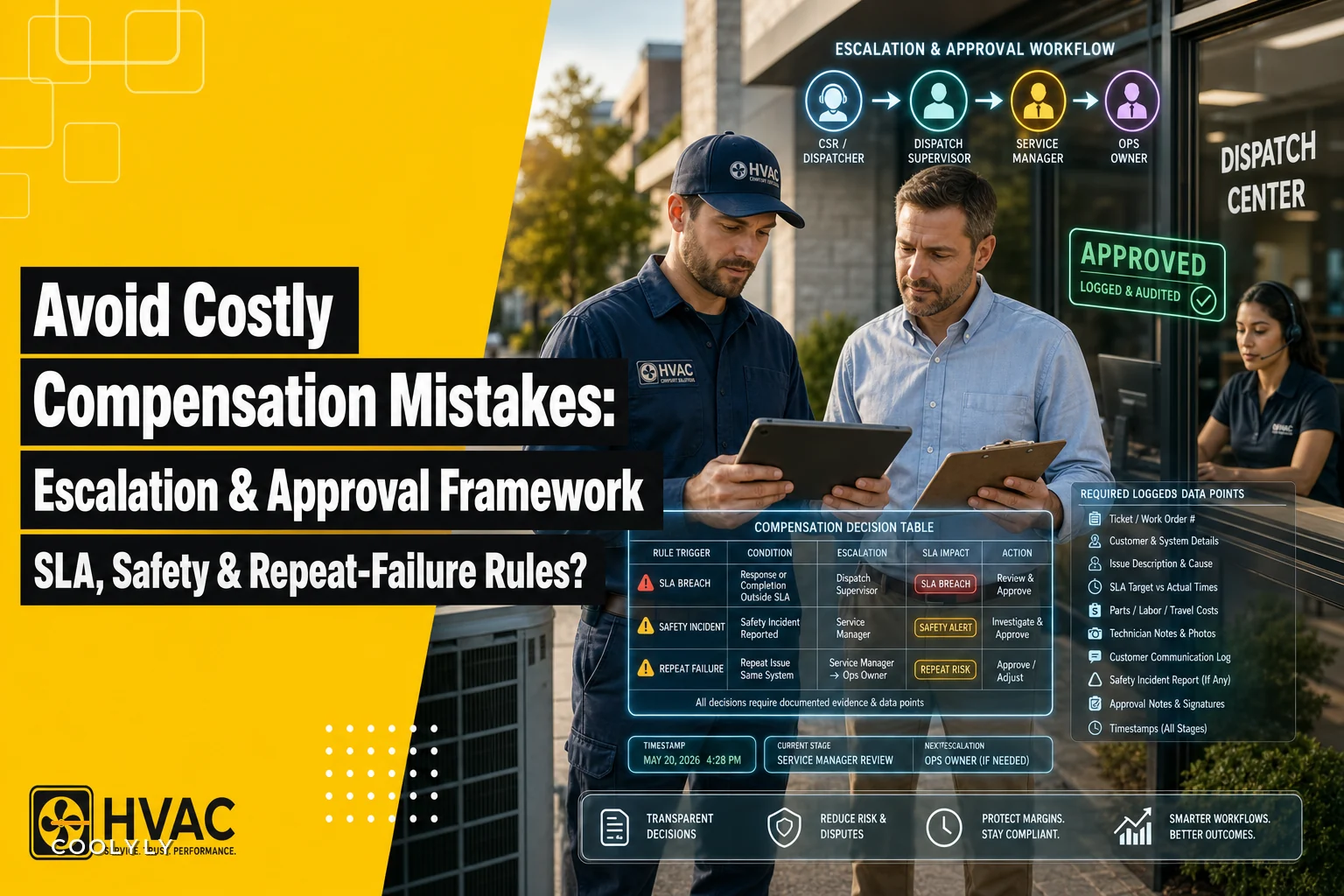
This post is about building an HVAC escalation compensation framework — a tiered set of decision tables that tells your team exactly what to offer, based on what actually went wrong, with approval gates that stop small gestures from becoming a habit.
Why compensation decisions go sideways in the field
The core problem is that "make the customer happy" is a value, not a procedure. Works fine until you scale past two or three people making those calls.
The bad call usually happens when three things collide at once: an upset customer, an employee who wants the call to end, and no reference for what's reasonable. The employee reaches for whatever ends the tension fastest. That's human. But it means your most expensive decisions are being made by whoever has the lowest tolerance for conflict.
There's also a quieter version of this problem. Customers learn. If a certain account figured out that complaining loudly gets the trip charge waived, they'll do it again. Repeat compensation without tracking is how you train your best customers to become your least profitable ones. Across a lot of service businesses, a small handful of accounts — often under 5% — absorb a wildly disproportionate share of the credits being handed out.
And then there's the opposite mistake: under-compensating on something serious. A tech leaves a job where a refrigerant leak wasn't caught, the customer's family reports headaches, and someone offers them a $50 credit like it's a late arrival. That's not a compensation mistake — that's a liability event being handled by the wrong playbook. Safety incidents should never route through the same decision path as a missed appointment window.
The three triggers that should drive every compensation decision
Before building any tables, you need to separate what kind of failure you're responding to. Mixing these together is the root cause of most bad calls.
Eliminate scheduling chaos and missed jobs.
Coolyly helps HVAC companies book, coordinate, and track every service efficiently.
- Unified appointment & dispatch management
- Automated client notifications
- Technician scheduling & job tracking
No credit card required
1. SLA breaches. You promised something measurable and missed it. Arrival windows, response times on a contracted commercial account, restore-by commitments on emergency service. These are objective — either you hit the two-hour response or you didn't.
2. Safety incidents. Anything involving gas, carbon monoxide, electrical hazards, refrigerant exposure, or a customer or property harmed by work performed — or not performed. These don't get "compensated" in the casual sense. They get escalated, documented, and often routed to management or legal before a dollar figure is ever discussed. Your field safety and incident-management framework should be the front door here, not your refund policy.
3. Repeat failures. Same system, same issue, multiple visits. A second callback on the same problem is a different animal than a first-time complaint. Repeat failures signal a diagnostic or quality problem on your end, and the compensation logic needs to reflect that you've now cost the customer their time twice.
The mistake most shops make is treating all three as "an unhappy customer." A repeat no-cool callback and a suspected CO exposure are not the same conversation, and they should never share a decision path.
Building the decision tables
The point of a decision table is to remove judgment from the front line for common cases, and reserve it for the rare ones. Your CSR shouldn't be deciding whether a missed window is worth $50 or $150. The table decides. They execute.
Here's a working structure for the SLA and repeat-failure tables. Safety, as noted, sits outside this — it escalates by definition.
| Trigger | Severity | Default remedy | Approval needed |
|---|---|---|---|
| Missed arrival window (residential, <2 hrs late) | Low | Sincere apology, no monetary comp | None (CSR handles) |
| Missed arrival window (>2 hrs, no proactive call) | Medium | Waive diagnostic fee OR ~$50 credit | CSR, logged |
| Emergency no-cool, contracted SLA missed | High | Waive trip + priority reschedule | Dispatch supervisor |
| Commercial SLA breach (restore-by missed) | High | Per-contract penalty + written follow-up | Account manager |
| Second callback, same issue, <30 days | Medium | Free return visit, no charge | Service manager |
| Third+ callback, same issue | High | Free repair + partial refund of prior invoice | Ops manager |
| Any safety-related concern | Critical | Stop. Escalate. Do not offer comp on the spot. | Management + documented |
The dollar figures and thresholds are yours to set. What matters is that every row has a default remedy and an approval gate. The default is what the customer gets without escalation. The gate is who has to sign off before you go beyond it.
Notice the pattern: low-severity items get resolved on the spot with no money, which keeps your front line moving. Money-out decisions climb a ladder. And the ceiling on what any single role can approve is fixed — a CSR can't approve a full refund no matter how persuasive the caller is.
Approval gates: the part everyone skips
The table is only half the system. The other half is who can approve what, and how it gets recorded.
-
CSR / dispatcher — can apply any "no monetary" remedy and log it. Waived diagnostic fee up to a set cap.
-
Service or dispatch supervisor — can approve credits up to a defined ceiling (say, one trip charge or a single visit's value).
-
Service manager — repeat-failure remedies, partial refunds up to a set percentage of the invoice.
-
Ops manager / owner — full refunds, anything on a commercial contract, anything touching a safety event.
Every level requires the same three data points logged before the remedy is applied: what was promised, what actually happened, and which table row it maps to. If someone can't name the table row, the situation probably belongs one level up.
Quick visual of the approval workflow:
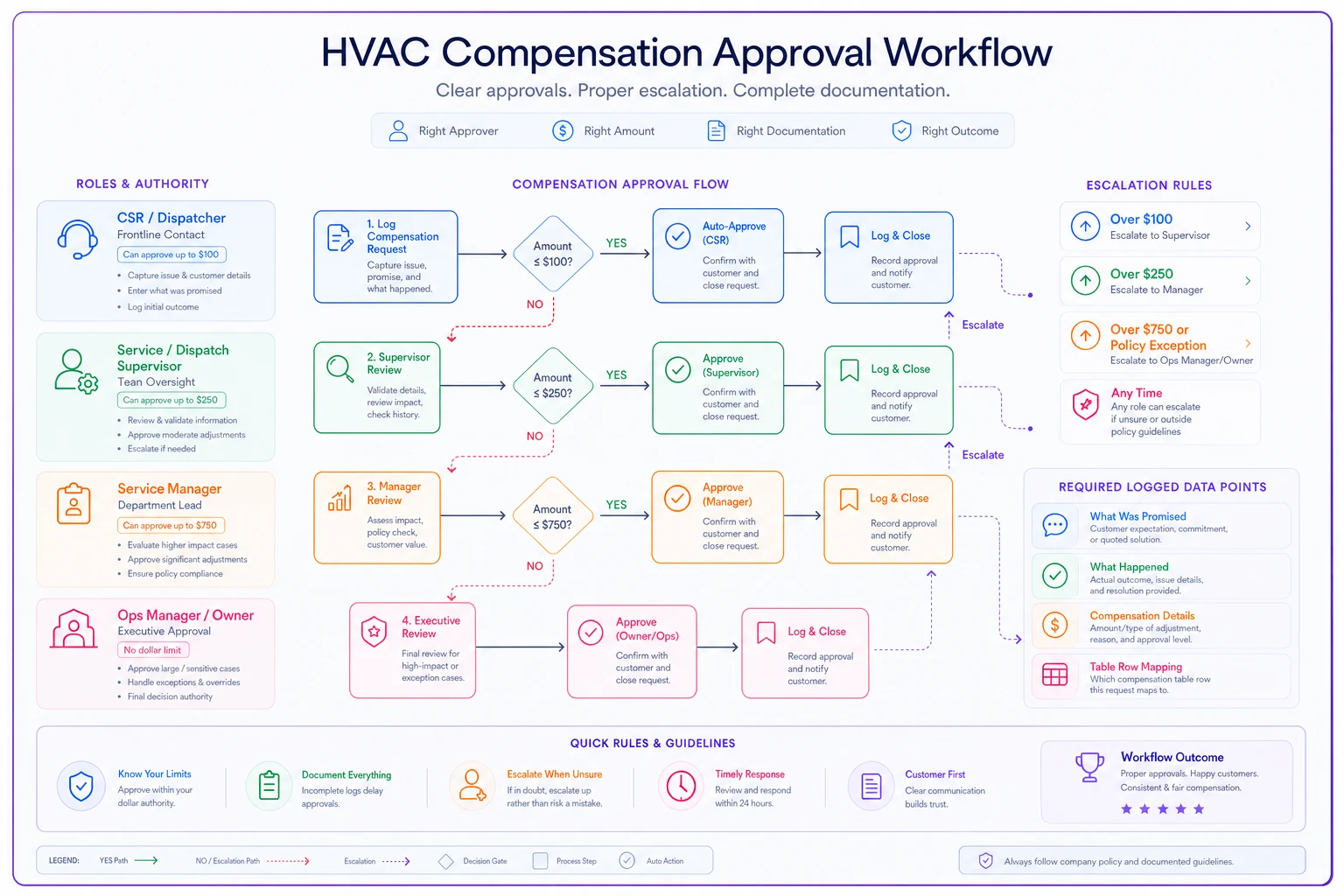
Gates get skipped because of speed. In the moment, escalating feels like it'll make an already-angry customer worse. The fix is fairly simple: give the front line a generous automatic zone for cheap resolutions so they rarely need to escalate, and make escalation for expensive decisions non-negotiable. When the majority of complaints resolve inside the CSR's authority, the gate stops feeling like a bottleneck.
Templated communications that limit abuse
This part quietly protects margin — and it's the piece most shops skip entirely.
When compensation gets offered verbally and off-script, two things happen. The offer inflates — people over-apologize and over-give. And there's no record of what was promised, so the customer's version becomes the truth in the next conversation.
Templated communications fix both. Each remedy tier gets a matching message — for the CSR to read, and to send in writing. A missed-window credit gets a short, warm confirmation email that states exactly what was applied and closes the loop. A repeat-failure remedy gets language that acknowledges the second visit without admitting broad fault or opening the door to further demands.
The subtle benefit: templates cap the offer. A rep can't casually add "and we'll throw in a free maintenance visit" if it's not in the template. The written record also breaks the repeat-abuse cycle, because now there's a paper trail showing this account was already compensated last month for the same complaint. That's what lets an account manager say — kindly but firmly — that this has already been addressed.
A basic checklist for a solid templated-comms setup:
-
Every remedy tier has a matching customer-facing script
-
Every monetary remedy generates a written confirmation
-
Confirmations state the specific remedy, nothing extra
-
Safety-related communications route to a manager before anything is sent
-
Repeat-account history is visible to whoever's handling the call
Keep the templates in a shared doc so CSRs can paste confirmations instead of improvising.
Getting this into practice doesn't require fancy software. Even a shared doc with five templates beats nothing. The goal is that your CSR never has to improvise what gets promised in writing.
When a firm framework actually makes sense — and when it doesn't
This kind of structure earns its keep once you have more than a couple of people making customer-facing decisions and you're running contracted or emergency work. If you're a two-person shop where the owner takes every complaint call, you don't need decision tables — you need a notebook and a decent memory.
It's also genuinely valuable for commercial accounts with real SLAs. Those contracts often carry penalty clauses, and improvising on them is how you either overpay or breach terms without realizing it.
Where it becomes a problem is if the framework turns into a wall. Tables that make customers feel processed rather than heard will cost you more in churn than you save in credits. The point is to speed up the easy calls and make the hard ones consistent — not to turn CSRs into people reading denial scripts. If a genuinely reasonable request falls just outside a table, the answer is escalate, not refuse.
A real scenario
A regional shop running both residential emergency service and around 40 light-commercial maintenance contracts had no formal comp policy. Complaints were handled case by case. When they actually tallied a quarter's worth of credits, waived fees, and comped visits, it came to somewhere between $9k and $11k — and nobody could explain most of it. Three commercial accounts were responsible for a big chunk of that, having figured out that escalating loudly got them free return visits.
They built out tiered tables, set approval ceilings by role, and standardized the confirmation emails. Nothing complicated. Within a couple of quarters, tracked compensation dropped by somewhere around 35–40%, mostly because the "free maintenance visit" reflex disappeared and those three accounts stopped getting automatic freebies. Customer satisfaction didn't drop — a few managers said it actually improved, because responses got faster and more confident. The team stopped freezing on hard calls.
The more interesting outcome wasn't the savings. The tables surfaced a diagnostic problem on one specific system model that was generating a cluster of repeat callbacks. Once the compensation data was actually tracked, the pattern became obvious. That's the same reason a solid triage-and-prestage playbook pays off — structure doesn't just control cost, it shows you where the real failures are.
Getting started without overbuilding it
Don't try to map every possible scenario on day one. Start with the three or four complaints you actually get most often — missed windows, first callbacks, repeat callbacks, and contracted SLA misses. Write the default remedy and approval gate for each. Draft one confirmation template per tier. Put it in front of your CSRs and dispatchers and let real calls tell you what's missing.
Then keep the log. The most valuable output of this whole system isn't the caps or the templates — it's finally knowing where your compensation dollars go, which accounts absorb them, and which recurring failures are quietly generating the complaints in the first place.
Once that's visible, you're not just controlling a cost. You're fixing the thing that created it.
Ready to optimize your HVAC operations?
Join hundreds of HVAC businesses using Coolyly to save time, improve technician utilization, and enhance customer satisfaction.