
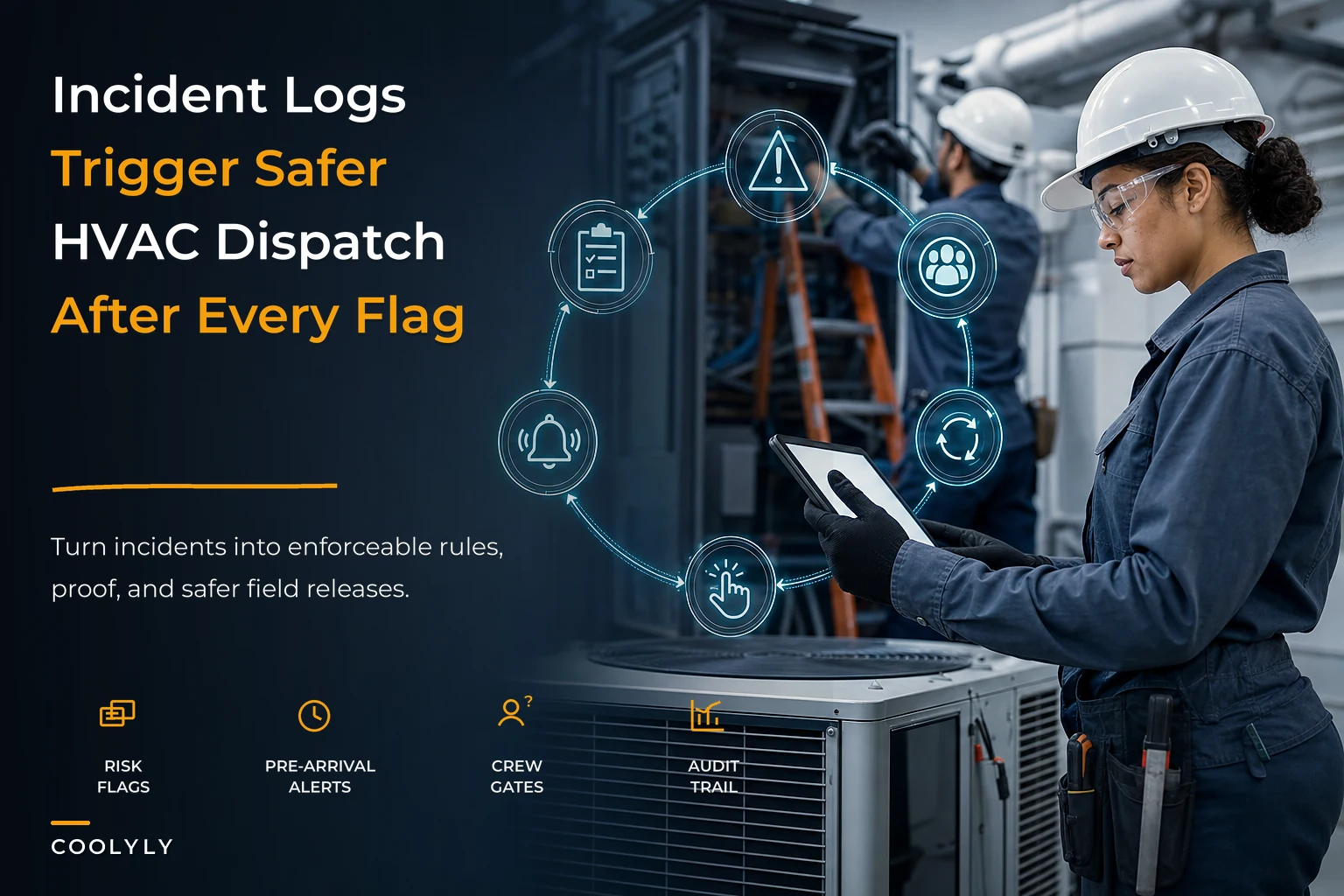

Most HVAC companies assume their safety problems come from techs cutting corners. After watching a lot of operations scale from 3 techs to 30+, the pattern is pretty clear: safety incidents spike not because people ignore protocols, but because the framework connecting safety practices to insurance requirements and dispatch decisions doesn't exist.
Why safety programs break down even when techs follow the rules
Your tech might wear fall protection on every roof. Great. But when an adjuster asks for evidence that the same tech completed height-work certification within the past 12 months—or when OSHA wants proof that dispatch verified site hazards before sending a junior tech solo—that's where companies fall apart.
The disconnect between field safety and back-office governance creates a specific type of operational mess. Techs follow safety protocols that don't match insurance requirements. Dispatch sends crews without checking competency gates. Incident reports get filed and forgotten. Nobody catches it until something goes wrong.
The insurance audit that exposes everything
Your workers' comp provider schedules their annual audit. They ask for documentation showing:
Eliminate scheduling chaos and missed jobs.
Coolyly helps HVAC companies book, coordinate, and track every service efficiently.
- Unified appointment & dispatch management
- Automated client notifications
- Technician scheduling & job tracking
No credit card required
-
Competency verification for each tech performing specific job types
-
Digital evidence of safety equipment checks before high-risk calls
-
Incident-to-resolution workflows with timestamps
-
KPI tracking for safety metrics by territory and crew
You scramble through paper forms, text messages, and maybe some Excel sheets. The auditor finds gaps. Your mod rate jumps. Insurance costs spike by $18,000–$25,000 annually for a 15-tech operation.
The frustrating part? Your techs probably were following safety protocols. You just couldn't prove it systematically.
What breaks this pattern is understanding that HVAC field safety isn't about more rules—it's about building evidence capture into everyday workflows. When operational software tracks safety compliance automatically through normal dispatch and job completion processes, you stop scrambling for documentation every time an auditor shows up.
Building competency gates that actually prevent incidents
Traditional safety training treats all techs the same. Complete the annual training, sign the form, back to work. But real risk management means matching tech competencies to specific job hazards.
Start with job-type risk scoring. Not every service call carries equal hazard exposure:
| Job Type | Primary Hazards | Required Competencies | Verification Frequency |
|---|---|---|---|
| Rooftop unit service | Fall risk, electrical | Height certification, lockout/tagout | Every 6 months |
| Refrigerant handling | Chemical exposure | EPA certification, PPE protocol | Annual + spot checks |
| Confined space (attics) | Respiratory, heat stress | Confined space entry, heat illness prevention | Quarterly |
| Emergency gas leak | Explosion risk | Gas detection, evacuation protocol | Monthly drill |
| New construction rough-in | Multiple trades onsite | Site coordination, hard hat zones | Per project |
The key isn't just categorizing—it's enforcing these gates through dispatch workflows. When a rooftop unit call comes in, dispatch should automatically check: Does the assigned tech have current height certification? Has this tech completed a rooftop job in the past 30 days? Is this a two-person requirement based on equipment weight?
Without that automation, these checks become suggestions. Dispatchers skip them during busy periods. That's when a green tech ends up alone on a commercial roof with a 400-pound condensing unit.
Evidence capture that satisfies auditors and lawyers
Paper safety forms create false confidence. They exist, technically. But when you need to prove that Tech A performed a ladder inspection before the job where Tech B got injured—good luck finding that specific form from seven months ago.
Modern HVAC operations need timestamp-verified digital evidence trails. Not complicated—just systematic. Here's what actually moves the needle:
Pre-job safety verification: Before dispatch releases the work order, the tech confirms an equipment check via mobile app. Takes about 45 seconds. Creates a timestamped record with GPS verification.
Photo documentation requirements: For specific job types, require photos of:
-
Ladder placement and securing
-
Lockout/tagout implementation
-
Fall protection attachment points
-
Confined space ventilation setup
Environmental hazard logging: Tech notes site-specific risks discovered on arrival—aggressive dog, unstable attic flooring, electrical panel issues. This data feeds back to dispatch for future calls to that address.
The genuinely useful part is when these captures connect to actual dispatch decisions. If three techs report unstable attic structures at addresses in the same subdivision, dispatch starts automatically assigning two-person crews for attic work in that area. The system learns from the field.
Converting incidents into dispatch intelligence
Most companies treat incident reports as paperwork endpoints. Tech gets a minor electrical shock, files a report, safety manager reviews it, maybe sends a reminder email about testing circuits. Then nothing changes operationally.
Companies with strong safety records do something different. They build incident-to-dispatch workflows that prevent repeat scenarios.
Below is a workflow from a 22-tech HVAC operation in Phoenix that dropped their incident rate by roughly 70% over 18 months:
Incident triggers dispatch rule changes:
-
Any electrical incident at a property triggers a "high electrical risk" flag
-
Future dispatches to that address require a senior tech or two-person crew
-
Pre-arrival notification includes the specific electrical hazard warning
-
Tech must confirm electrical safety protocol review before job release
The non-obvious part: they also track near-misses with equal weight. Tech reports a loose railing on an apartment building stairway—that address gets flagged for fall risk. No incident occurred, but the system learned.
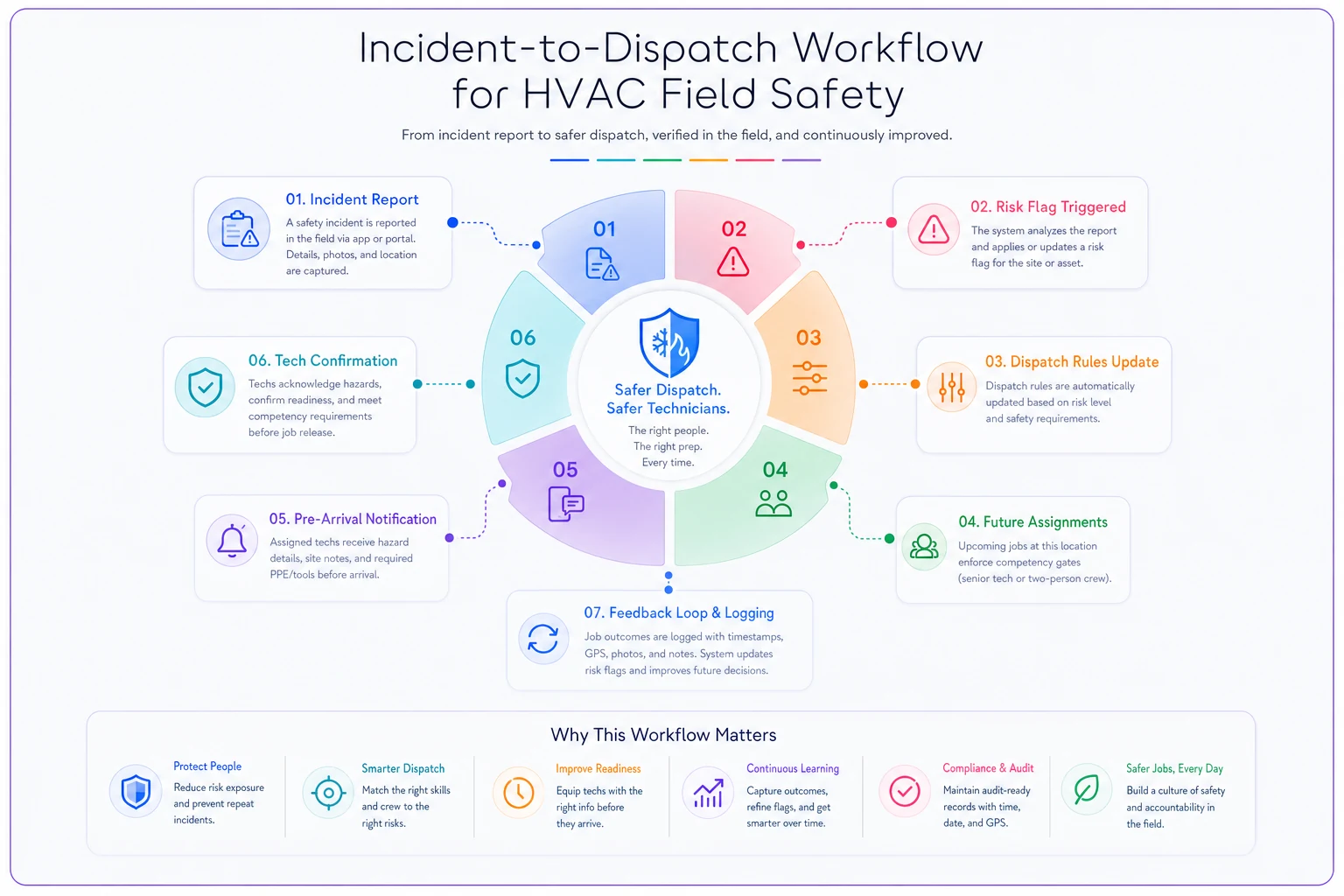
This sketch shows the steps from an incident report to an enforced dispatch rule and the feedback loop that updates future assignments.
KPI gates that predict problems before incidents happen
Lagging indicators tell you someone already got hurt. Leading indicators help you prevent the next injury. Most HVAC companies only track workers' comp claims and OSHA recordables—purely reactive.
The companies avoiding safety disasters track pattern-based KPIs:
-
Job duration creep
When routine maintenance calls start taking 20% longer, it often signals techs are fatigued or dealing with equipment issues
-
Safety checkpoint skip rate
What percentage of high-risk jobs complete without required photo documentation?
-
New tech solo assignment rate
How often are techs with less than 6 months experience sent alone to complex calls?
-
Territory incident clustering
Are specific geographic areas showing higher near-miss reports?
Set gates based on these metrics. If the safety checkpoint skip rate exceeds 15% in a week, trigger a mandatory safety stand-down. If new tech solo assignments hit 30%, require supervisor review of dispatch assignments.
One Dallas operation tracks "overtime incident correlation"—they found injury rates spike roughly 3x when techs work beyond 55 hours weekly. Their system now automatically flags schedulers when any tech approaches 50 hours, prompting workload redistribution.
The pattern across successful operations: they catch problems while they're still scheduling issues or training gaps, not after they've become injury statistics.
Audit-ready reporting without the scramble
Insurance audits and OSHA inspections create panic because companies can't quickly produce comprehensive safety documentation. You know the drill—three people spending two days pulling reports, scanning forms, and building spreadsheets from scratch.
The solution isn't better filing. It's building audit requirements into operational workflows from the start. Every safety-critical data point should live in your operational database, not scattered across filing cabinets and supervisor laptops.
Essential audit-ready reports:
Competency Matrix: Every tech's current certifications, training completions, and expiration dates. One query, complete picture.
Incident Analysis Dashboard: Categorizes all incidents and near-misses by type, location, time of day, tech experience level, and job category. Patterns become obvious quickly.
Equipment Inspection Log: Digital record of every ladder inspection, gas detector calibration, and PPE replacement. Searchable by date, tech, or equipment ID.
Territory Risk Assessment: Maps incident history by service area, highlighting zones requiring additional precautions.
Training Effectiveness Tracking: Correlates safety training completion with incident reduction by category. Proves your training actually works—or shows you where it doesn't.
Having these reports auto-generate monthly for internal review changes things. Don't wait for audit season to discover gaps. One operation in Tampa runs monthly mock audits using their automated reports—they haven't had a significant audit finding in three years. That's not luck; that's a system that actually works.
The dispatch intelligence feedback loop
What separates companies with improving safety records from those repeating the same incidents is systematic learning encoded into dispatch rules.
Traditional approach: Incident happens → investigation → safety meeting → hope people remember.
Intelligent approach: Incident happens → investigation → dispatch rule update → system enforces new protocol automatically.
A real example from a 17-tech operation: a tech fell through deteriorated decking on a flat commercial roof. Investigation revealed the building was 40+ years old with original decking.
Old response: safety meeting about checking roof integrity.
New response: dispatch system automatically flags all commercial properties over 30 years old for "structural assessment required" before rooftop work. Tech must confirm visual deck inspection and probe test before proceeding.
This scales because it doesn't rely on human memory. The rule exists in the dispatch logic going forward, protecting every future tech who services that category of building.
Making safety compliance easier than non-compliance
The biggest mistake in safety program design is making compliance harder than cutting corners. When following safety protocols adds 20 minutes of paperwork to every job, techs find workarounds. That's just how it goes.
-
Pre-job safety checklist integrated into the job release screen (can't access job details without completing it)
-
Voice-to-text incident reporting while driving between calls
-
Photo documentation uploads automatically to the job record
-
Safety equipment checks that trigger automated reorder when supplies run low
One operation tied safety verification to payroll processing. Jobs missing required safety documentation get flagged for review before commission calculation. Photo documentation compliance hit 94% pretty quickly after that change.
The principle: don't fight human nature with willpower. Design systems where the safe behavior is also the most convenient behavior.
The principle: don't fight human nature with willpower. Design systems where the safe behavior is also the most convenient behavior.
Building your implementation sequence
Rolling out comprehensive HVAC field safety and incident management doesn't happen overnight. The companies that do it well follow a specific sequence:
Phase 1 (Months 1-2): Evidence Capture Foundation
-
Deploy mobile photo documentation for high-risk job types
-
Establish digital pre-job safety checklists
-
Create basic incident reporting workflow
Phase 2 (Months 3-4): Competency Tracking
-
Build certification and training database
-
Implement dispatch competency gates for highest-risk categories
-
Set up expiration alerts for critical certifications
Phase 3 (Months 5-6): Incident Intelligence
-
Create incident-to-dispatch rule workflows
-
Establish near-miss reporting culture
-
Build address-specific hazard flagging
Phase 4 (Months 7-8): Predictive KPIs
-
Deploy leading indicator tracking
-
Set up automated alerts for KPI gates
-
Create pattern analysis reporting
Phase 5 (Months 9-12): Audit Optimization
-
Generate automated audit reports
-
Run quarterly mock audits
-
Refine based on actual audit findings
Notice what's missing: massive training programs and policy manual rewrites. Those don't create sustainable safety improvements. Systematic evidence capture and intelligent dispatch rules do.
The technology layer that makes this possible
Manual tracking breaks at scale. A 5-tech operation might manage with spreadsheets and diligent communication. By 15 techs, you're drowning in paper trails and verbal updates that never make it to dispatch.
This is where AI-powered operational software becomes essential—not as a magic solution, but as the infrastructure that actually makes these workflows run. When your platform automatically tracks certifications, enforces competency gates, and converts incident reports into dispatch rules, safety management shifts from reactive scrambling to something closer to proactive prevention.
Modern platforms handle the complex connections: pulling tech competencies during dispatch assignment, flagging addresses with previous incidents, tracking safety KPIs in real time, and generating audit reports from operational data. The safety intelligence builds continuously through normal operations rather than requiring a separate safety management process running alongside everything else.
If you're still coordinating safety through email chains and Excel while dispatch runs from a different system, you're fighting an uphill battle every single day. Integrating safety governance with dispatch operations is what separates companies with improving safety metrics from those explaining incidents to insurance adjusters.
Bottom line
HVAC field safety and incident management isn't about more rules or bigger safety manuals. It's about building evidence capture, competency verification, and incident learning directly into dispatch workflows. When safety compliance happens through normal operations, when incidents trigger systematic dispatch rule updates, when audit reports pull themselves from operational data—that's when safety metrics actually move.
The companies cutting workers' comp costs by 30–40% aren't running more safety meetings. They're building operational systems where the safe choice is the easy choice, where competency gaps get caught before dispatch, and where every incident makes the entire operation a little smarter going forward.
Start with evidence capture. Add competency gates. Build incident intelligence. Track predictive KPIs. Make audit readiness automatic. This sequence, properly implemented with the right operational platform, transforms safety from a compliance burden into a real competitive advantage.
Your techs want to go home safe. Your insurance company wants fewer claims. Your business needs predictable costs. The framework connecting all three exists—you just need to build it into your operations systematically.
For related insights on building scalable HVAC operations, check out our guides on scaling field operations without chaos, reducing emergency truck rolls, and turning service data into predictable revenue.
HVAC field safety and incident management isn't about more rules or bigger safety manuals. It's about building evidence capture, competency verification, and incident learning directly into dispatch workflows. When safety compliance happens through normal operations, when incidents trigger systematic dispatch rule updates, when audit reports pull themselves from operational data—that's when safety metrics actually move.
Ready to optimize your HVAC operations?
Join hundreds of HVAC businesses using Coolyly to save time, improve technician utilization, and enhance customer satisfaction.