


Most HVAC system rollouts don't fail at the software level. They fail at the field level, three weeks after launch, when a senior tech in your busiest branch quietly goes back to writing job notes on a clipboard because the new mobile flow "takes too long during a surge." Nobody flags it. Dispatch assumes everyone's using the system. The dashboard looks fine until month-end, when you realize two branches never actually adopted the new SOP at all.
That gap — between "we deployed it" and "people actually use it the way we intended" — is where most of the money leaks. And across multi-branch operations, that gap gets wider with every location you add, because each branch has its own informal workarounds, its own alpha technician who sets the tone, and its own version of "how we really do things here."
This playbook is built specifically for that problem: getting a new field system or SOP to stick across multiple branches, measurably, without burning out your best people or confusing compliance with actual adoption.
Why multi-branch rollouts drift instead of fail loudly
A single-shop rollout is easy to monitor. You walk the bays, you see who's using the tablet, you course-correct in real time. At four, six, or ten branches, you lose that line of sight. What you get instead is drift — slow, uneven, hard to detect.
The pattern that shows up repeatedly goes something like this. Branch A, where the regional manager is based, adopts quickly because leadership is physically present. Branch C, two hours away, adopts on paper. Techs log in, tap through the minimum required fields, and keep running their real workflow on the side. By the time you notice the numbers don't match, you've got three months of inconsistent data and a culture problem instead of a training problem.
-
The rollout assumed every branch starts from the same baseline. They don't. One branch may already have strong job-documentation habits; another may be starting from near zero.
-
There was a launch event but no reinforcement after week two. Attention faded, old habits came back.
-
Nobody owned adoption at the branch level. The project had a sponsor at HQ and a vendor contact, but no accountable person standing in each bay.
-
"Success" was defined as "it's live," not "it's producing the behavior we wanted."
The fix isn't more training. It's designing the rollout as a controlled sequence with clear ownership, honest success metrics, and a reinforcement rhythm that outlasts the initial excitement.
Start with a pilot that's designed to teach you something
Teams love to skip the pilot or run a fake one — flip the system on for one branch, call it a pilot, and roll out everywhere two weeks later regardless of what happened. That's not a pilot. That's a soft launch with extra steps.
Eliminate scheduling chaos and missed jobs.
Coolyly helps HVAC companies book, coordinate, and track every service efficiently.
- Unified appointment & dispatch management
- Automated client notifications
- Technician scheduling & job tracking
No credit card required
A real pilot surfaces friction you can't predict from a conference room. The goal isn't to prove the system works. The goal is to find out exactly where it breaks under your actual field conditions, so you can fix the SOP before ten branches inherit the same problem.
Pick the pilot branch deliberately, not conveniently. The most useful pilot branch is a middle-of-the-road one — not your strongest, not your weakest. Your strongest branch will make anything look good and hide flaws through sheer competence. Your weakest will mix system problems with capability problems. A median branch gives you the cleanest read.
Scope the pilot to one workflow, not the whole platform. If you're rolling out a new field system that touches scheduling, job documentation, parts, and invoicing, don't test all four at once. Pick the one with the highest daily volume — usually job documentation — and get that right first. You learn faster and the techs aren't drowning.
Run it long enough to hit a full cycle. Two weeks is too short; you'll only capture the honeymoon period. Four to six weeks lets you see what happens after the novelty wears off and during at least one genuinely busy stretch. The behaviors that survive a hectic week are the ones that'll survive the broader rollout.
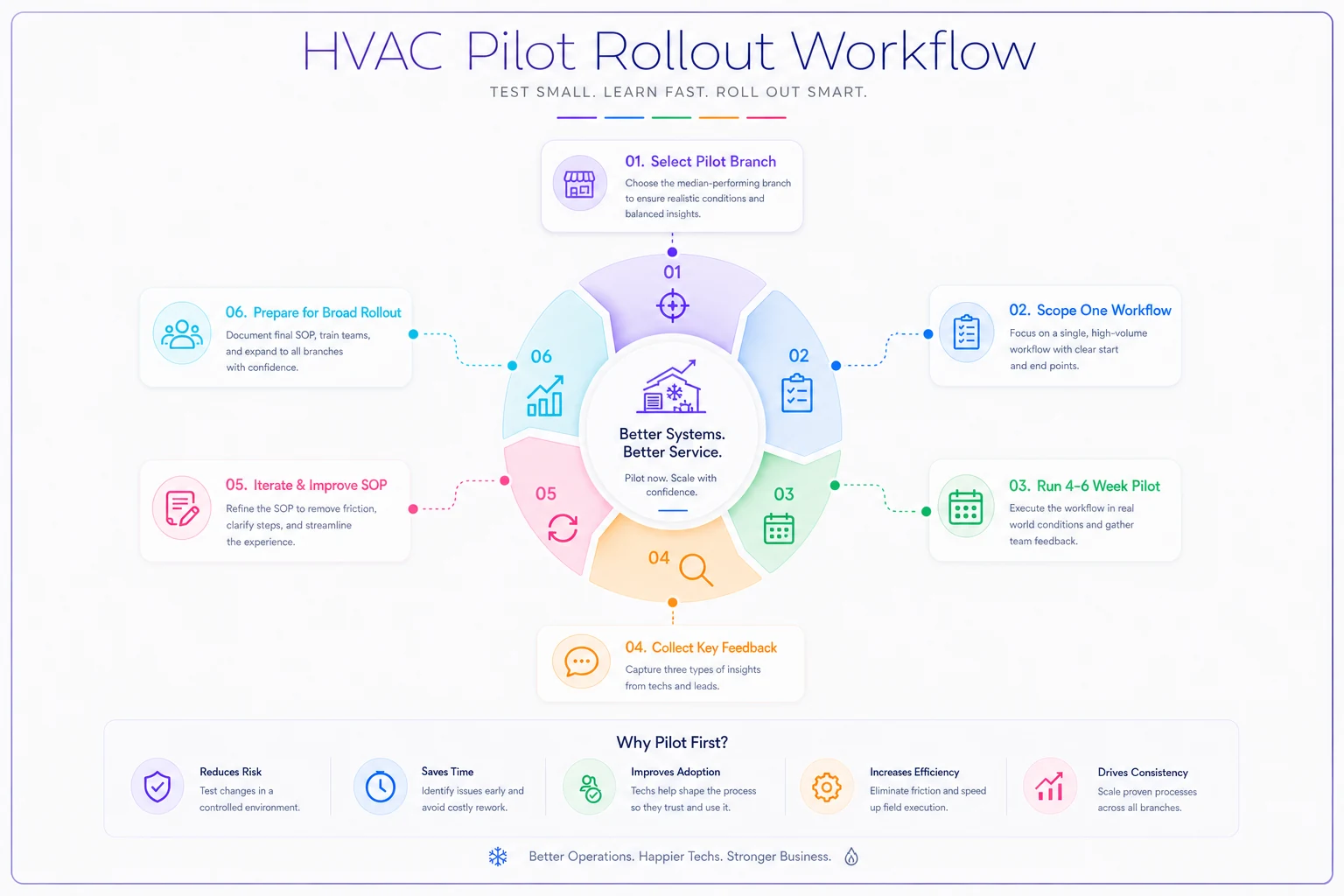
A simple visual of the pilot workflow makes it easier to align stakeholders on scope and the feedback loop.
During the pilot, you're collecting three things: where techs hesitate or stop, which SOP steps get skipped and why, and which parts of the new flow are genuinely slower than the old way. That last one matters — if a step adds 90 seconds per job and delivers no visible value to the tech, it will get abandoned. No amount of mandate changes that.
Assign ownership with a RACI that names actual people
"Everyone owns adoption" means nobody does. Multi-branch rollouts need a RACI that assigns every part of the change to a specific role — and in a rollout, that means a specific human, not a department.
The mistake is making the RACI too abstract. "Operations is Accountable" tells you nothing when adoption stalls in Branch C. You need to know whose phone rings.
| Activity | Responsible | Accountable | Consulted | Informed |
|---|---|---|---|---|
| Pilot design & scope | Ops project lead | VP Operations | Branch managers, lead techs | All branch staff |
| Branch-level adoption | Branch manager | Regional manager | Ops project lead | VP Operations |
| In-bay coaching | Branch "champion" tech | Branch manager | Ops project lead | Regional manager |
| SOP revisions | Ops project lead | VP Operations | Field techs, dispatch | All branches |
| Success metric tracking | Ops analyst / project lead | VP Operations | Branch managers | Leadership |
| Reinforcement cadence | Regional manager | VP Operations | Branch champions | All branch staff |
The single most important row in that table is the branch champion — a respected field tech, not a manager, who runs the new workflow fluently and coaches peers in the bay. Adoption lives or dies on whether you have a credible person demonstrating the new way during real jobs. When the alpha tech buys in, the branch tends to follow. When they resist, you've already got a problem at that location.
Pay the champion for the extra load, even if it's a small stipend or a reduced job quota during the rollout window. Asking your best tech to coach six peers on top of a full schedule and expecting it for free is how you lose both the rollout and the tech.
Define success metrics that measure behavior, not logins
The weakest part of most rollouts is how success gets measured. "90% of techs have logged in" tells you people opened the app once. It tells you nothing about whether the SOP is actually being followed on real jobs.
Good adoption metrics measure the behavior you were trying to change. A few that actually mean something:
-
SOP step completion rate — of jobs that should include the new step, what percentage actually did? Not "was the field filled in," but "was it filled in correctly."
-
Time-to-first-correct-use per tech — how many days from training until a tech independently completes the full workflow without help. Long tails here point to specific people who need targeted coaching.
-
Rework / correction rate — how often dispatch or admin has to go back and fix or chase missing information. This usually drops as real adoption rises, and it's harder to game than login data.
-
Branch variance — the spread between your best and worst branch on the above metrics. Tight variance means the rollout is consistent; wide variance means drift is forming.
Watch branch variance most closely. A company-wide average of 85% completion can hide the fact that four branches are at 97% and one is at 40%. The average looks healthy; the reality is one branch quietly opted out.
Set a realistic target. Pushing SOP step completion from somewhere around 50–60% in the first two weeks to the mid-90s by day 90 is a strong, achievable curve for a well-run rollout. Expecting 100% by week two is fantasy, and chasing it just teaches people to fake compliance.
Use micro-certifications instead of one big training day
The classic rollout training is a two-hour group session, a slide deck, and a "you'll figure out the rest in the field" handoff. People retain almost none of it, and the techs who were on a job that day miss it entirely.
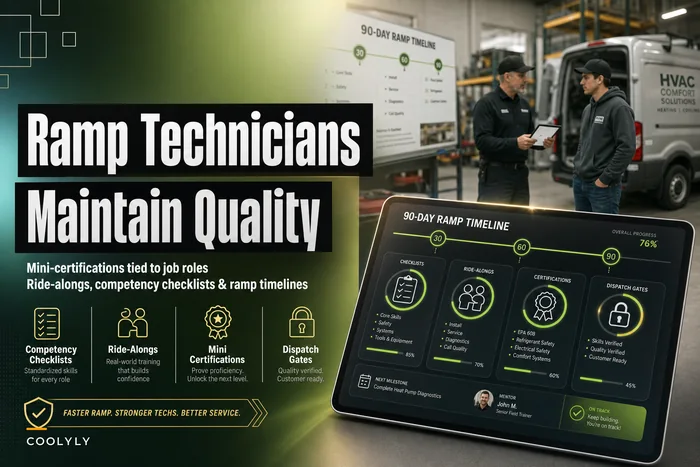
Breaking competency into small, verifiable checkpoints works far better — the same logic behind using micro-certifications and competency checklists to ramp technicians faster. Instead of one big event, each tech earns a short series of certifications that prove they can actually perform the new workflow, not just that they attended.
A micro-certification set for a new field documentation SOP might look like:
-
Cert 1 — Basic flow Tech completes a full job entry under observation, start to finish, no prompting. Takes 10–15 minutes to verify.
-
Cert 2 — Edge cases Tech handles the messy scenarios — partial jobs, callbacks, parts added mid-visit — correctly.
-
Cert 3 — Speed under load Tech completes the workflow at acceptable pace during a normal-volume day, not just a slow Tuesday.
-
Cert 4 — Peer check Tech demonstrates the flow to the branch champion, who signs off.
The value here is diagnostic. When a tech can't pass Cert 2, you know exactly where the gap is and can coach that specific thing instead of re-running the whole training. And because each cert is small, techs can earn them between jobs rather than losing a full day off the schedule.
One warning: don't let certifications become bureaucratic theater. If the sign-off is a rubber stamp, you're back to measuring attendance. The champion has to actually watch the tech do the work.
The 90-day reinforcement cadence
This is the part almost everyone skips, and it's the part that determines whether adoption holds or decays. The launch gets all the energy; the 90 days after launch get none. That's backwards. Adoption is built in the reinforcement window, not the launch event.
Days 1–14 — High-touch. Daily quick check-ins at each branch, led by the champion. Dispatch flags any job that came in without the new SOP step and routes it back same-day while it's fresh. The point is immediate, low-stakes correction so bad habits never take hold.
Days 15–45 — Weekly rhythm. Weekly 15-minute branch huddles reviewing completion and variance numbers openly. Branches see their own data and each other's. Nothing motivates a lagging branch like seeing a peer branch sitting at 94% while they're at 61%. This is also where you revise the SOP based on real friction — if everyone's skipping the same step, the step may be the problem, not the people.
Days 46–90 — Monthly plus spot checks. The cadence drops to monthly reviews with random in-bay spot checks. You're transitioning from active reinforcement to steady-state monitoring. By day 90, the new way should be the default way, and the metric you're watching is whether numbers hold without constant attention.
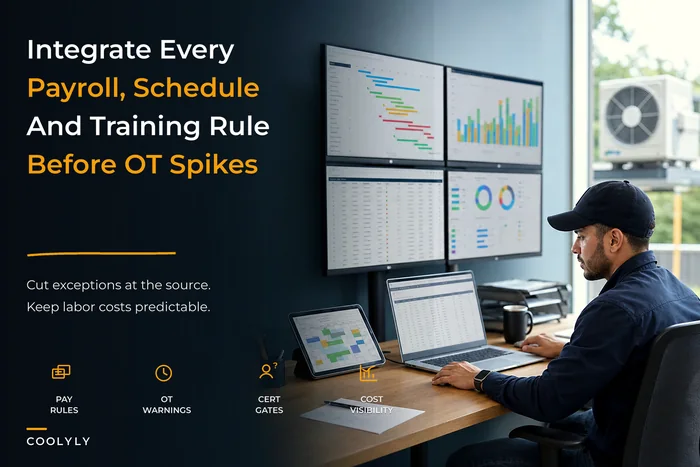
What makes a cadence actually work is tying it into systems people already touch daily rather than bolting on a separate compliance ritual. When the reinforcement lives inside scheduling, dispatch, and the tools techs already open every morning, it doesn't feel like overhead. This is one reason rollouts land better when the new system is connected to the broader operational stack — the same thinking behind integrating scheduling, payroll, and training into one workforce blueprint rather than running training as a disconnected event.
A real-world scenario
A regional HVAC company running five branches rolled out a new mobile job-documentation flow tied to a stricter close-out SOP. Their first attempt — all branches at once, one training day, no champions — stalled fast. Within a month, completion ranged from near-full compliance at the HQ branch down to roughly 40% at their two farthest locations. Month-end reconciliation became a mess because half the jobs were missing the parts and labor detail the new SOP required.
They reset using the approach above. One pilot branch first, a named champion at each location, micro-certifications instead of the big training day, and a 90-day cadence with weekly variance reviews shown openly to everyone.
The curve was uneven but real. SOP step completion across all five branches went from somewhere in the low 50s in week two to the low-to-mid 90s by day 90. Branch variance — the gap between best and worst location — shrank from more than 50 points to under 10. The practical payoff showed up at month-end: the admin team cut the time spent chasing missing job detail by a noticeable margin, and reconciliation stopped being a two-day fire drill. Nothing dramatic happened overnight. It compounded, week over week, because the reinforcement never let up.
When this full playbook makes sense — and when it's overkill
The complete sequence — pilot, RACI, micro-certs, 90-day cadence — is worth running when the change is high-stakes and multi-branch: a new field system, a close-out SOP that feeds billing, anything where inconsistent adoption directly costs money or corrupts your data.
It's overkill for small changes. If you're adding one optional field or tweaking a checklist, running a formal pilot and a RACI matrix will annoy everyone and make future real rollouts harder because people stop taking the process seriously. Save the heavy machinery for changes that genuinely warrant it.
A note for single-location shops: if you've got one bay and ten techs, you don't need branch variance tracking or regional managers in the RACI. You need the champion concept, the micro-certs, and a lighter version of the cadence. Scale the rigor to the size of the problem.
The uncomfortable truth about field-system rollouts is that the technology is rarely the hard part. The hard part is human — getting dozens of techs across multiple branches to change how they work every day, after the launch excitement fades and the busy season hits. A rollout that treats adoption as an event will drift. A rollout that treats it as a designed sequence with clear owners, honest behavior-based metrics, and a reinforcement rhythm that runs a full 90 days will actually stick.
Start with a pilot built to teach you where things break. Name the people accountable, especially the champion in each bay. Measure the behavior you wanted to change, not the login count. And protect the 90 days after launch as fiercely as you protected launch day itself — because that's where adoption is really won.
Ready to optimize your HVAC operations?
Join hundreds of HVAC businesses using Coolyly to save time, improve technician utilization, and enhance customer satisfaction.