

Most HVAC owners don't lose money on payroll because someone is stealing time. They lose it because scheduling, timekeeping, payroll, and training all live in separate places and never talk to each other. A tech clocks in on a paper sheet or a punch app. Dispatch runs on something else. Payroll gets keyed in Thursday night by whoever's least busy. Training records sit in a binder or a spreadsheet nobody's opened since the last insurance audit.
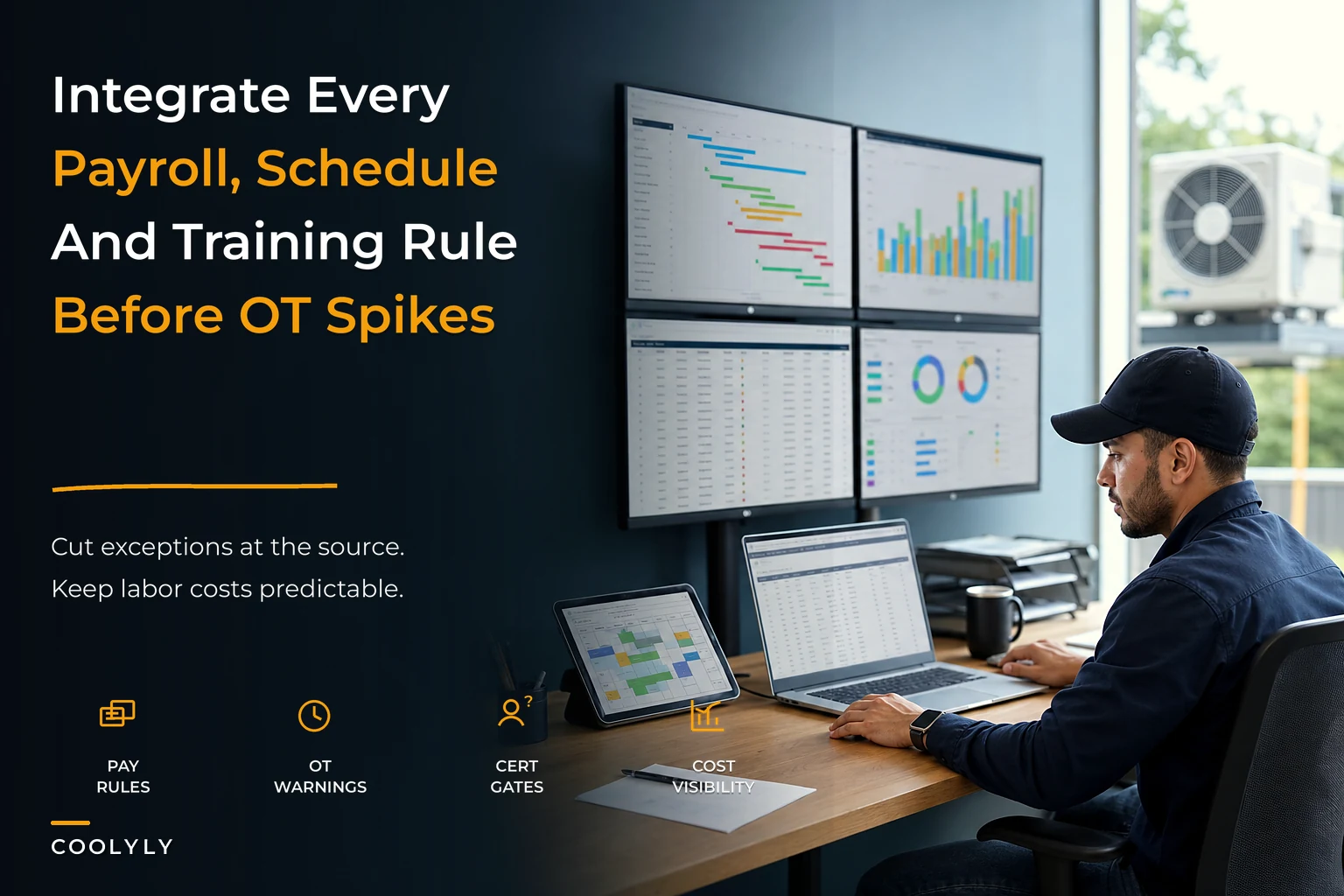
Each system works fine on its own. The damage happens in the gaps between them — that's where overtime spikes hide, where a tech gets paid a journeyman rate for apprentice work, where someone's OT gets miscoded and nobody catches it for three pay periods. HVAC workforce payroll integration isn't about buying one more app. It's about making sure the same numbers flow cleanly from the schedule all the way to the paycheck, and that pay actually reflects what someone is trained and certified to do.
Why these four systems drift apart in the first place
Nobody decides to disconnect scheduling from payroll. It happens by accident, one tool at a time.
You start with a scheduling whiteboard or a basic dispatch tool because that's the fire you needed to put out first. Timekeeping shows up later, usually after a payroll dispute — someone swears they worked 46 hours, the office says 42, and now you need a paper trail. Payroll is often the oldest system, sometimes an outside bookkeeper who's been handling it since you had three techs. Training documentation comes last, and it's almost always reactive — driven by a warranty claim, a manufacturer requirement, or an insurance renewal.
So by the time you're running eight or ten techs, you've got four systems that were each adopted for a different reason, at a different time, by a different person. They don't share data because they were never designed to. The office manager becomes the integration layer, manually copying hours from one screen into another. That works until it doesn't.
The pattern across service businesses is pretty consistent — the manual bridge holds up to around six or seven field employees. Past that, the re-keying volume gets high enough that mistakes become routine instead of rare.
What actually breaks as you scale
The failures aren't random. They cluster around predictable points and compound.
Eliminate scheduling chaos and missed jobs.
Coolyly helps HVAC companies book, coordinate, and track every service efficiently.
- Unified appointment & dispatch management
- Automated client notifications
- Technician scheduling & job tracking
No credit card required
Overtime becomes invisible until Friday. With a handful of techs, an owner just knows who's pushing hours. At fifteen techs across two or three territories, nobody knows until the timesheets land. By then the overtime is already earned — you can't un-work it. A tech who hit 44 hours by Wednesday should have been rescheduled Thursday. Nobody caught it because the schedule didn't know what the time clock knew.
Pay rates lag behind competency. A tech passes their EPA 608 or finishes brazing certification, and their pay is supposed to bump. But the training record lives in one place and the payroll rate lives in another. So either the raise happens late — and the tech is quietly resentful — or it happens on time but dispatch still routes them like an apprentice. Now you're paying journeyman wages for apprentice-margin work.
Job costing gets fuzzy. If timekeeping isn't tied to specific jobs, you can't tell which job types are eating labor. You feel the margin compression but can't locate it. This connects directly into how you scope and route work — something covered more in the field tooling and mobile UX guidelines for HVAC teams, because friction in the field is where clean time data goes to die.
Payroll corrections eat management hours. Every miskeyed hour becomes a correction, and corrections take longer than the original entry because now you're reconciling backward. A shop running manual reconciliation on twelve techs can burn most of a day per pay period just chasing discrepancies.
None of these are payroll errors in the traditional sense. They're integration failures that show up on the paycheck.
The four-system model, and where the wires need to run
Before fixing anything, it helps to see how these systems should connect — data flowing in one direction with a couple of feedback loops running back.
| System | Feeds Forward Into | What It Needs Back |
|---|---|---|
| Scheduling / Dispatch | Timekeeping (expected hours, job assignments) | Real-time OT status, tech availability, competency tags |
| Timekeeping | Payroll (actual hours, job codes, OT) | Approved schedule as the baseline to check against |
| Payroll | Job costing & reporting | Verified competency-based pay rates |
| Training / Certifications | Payroll (pay tier) + Dispatch (who can do what) | Coaching signals from completed-job data |
Read that table top to bottom and you see the forward flow: schedule → hours → pay. Read the right column and you see the loops most shops are missing — dispatch needs to know overtime status while it's assigning work, and training needs to feed both pay tiers and job routing.
If you've worked through the HVAC integrations and data-architecture playbook, this is the workforce-specific version of that same principle: define which system owns each piece of data, and make sure it flows instead of getting copied.
Below is how that full workflow moves through each system before landing on the paycheck:
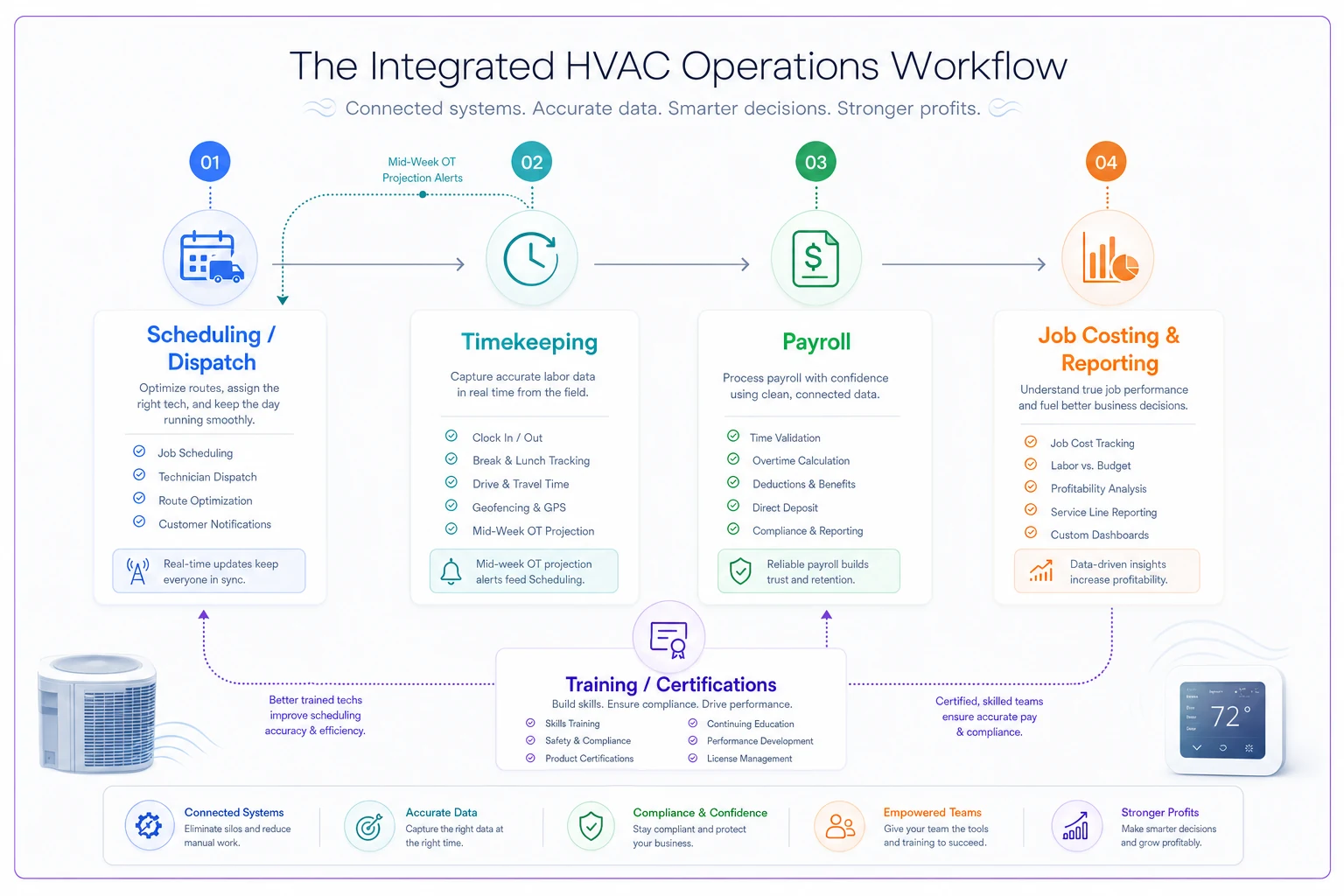
This diagram maps the flow and feedback loops described above.
An integration checklist you can actually work through
You don't need to overhaul everything at once. You need the connections in the right order. Here's the sequence that tends to hold up:
-
Pick the source of truth for hours. It should be timekeeping, tied to actual job assignments — not the schedule (which is a plan) and not payroll (which is a result). Everything reconciles against this.
-
Connect the schedule to timekeeping so variances surface automatically. Scheduled 8 hours, clocked 11? That should flag before it becomes a payroll line item, not after.
-
Tag every time entry with a job and a job type. This is what makes labor costing possible later. Skip it and you'll be guessing forever.
-
Map competencies to pay tiers explicitly. Write down which certifications and skill checks correspond to which rate. Ambiguity here is where favoritism accusations and pay disputes start.
-
Wire training/cert status into both payroll and dispatch. A cert expiring should block certain job assignments and trigger a pay review — same event, two consequences.
-
Build the overtime safeguard before you need it. More on this below, but it belongs in the setup, not bolted on after your first bad week.
-
Set a reconciliation cadence and a person who owns it. Even automated systems need a human sign-off gate. Someone approves; the system enforces.
Work top to bottom. Most shops try to start at step 4 — pay fairness — without doing steps 1–3 first, then wonder why the tiers don't line up with reality.
Automated overtime safeguards: catching it while you can still act
Overtime is the clearest example of why real-time integration beats end-of-week reconciliation. Once the hours are worked, the money's gone. The only leverage you have is before Thursday.
A useful safeguard has three layers:
-
A soft flag when a tech crosses roughly 32–34 hours mid-week, so dispatch sees it while assigning the rest of the week.
-
A hard alert to the manager when someone's projected to cross 40 given their remaining scheduled jobs.
-
An approval gate that requires a manager to actively approve overtime instead of it accruing silently.
The projection piece is what most manual systems can't do. Knowing a tech is at 38 hours is useful. Knowing they're going to hit 47 based on the three jobs still on their board — that's what lets you move a call to someone under 30 hours before the money's committed.
The connection to routing and staffing matters here. Balancing hours across a team is really a capacity problem, and the logic overlaps heavily with what's covered in scaling HVAC field operations without chaos. Overtime isn't just a payroll number — it's a signal that capacity planning has a gap somewhere upstream.
When aggressive OT controls backfire
One honest caveat: during genuine surge periods, hard-blocking overtime can cost you more than it saves. If you're turning away emergency calls in July to avoid a few OT hours, you've optimized the wrong thing. The safeguard should surface the decision to a human, not make it automatically. Reserve hard blocks for chronic, avoidable overtime — not seasonal spikes where the revenue clearly justifies the premium.
Competency-to-pay promotion rules: making raises a system, not a negotiation
Most pay disputes in HVAC shops aren't really about the dollar amount. They're about the process feeling arbitrary. One tech got bumped after a cert; another did the same cert and waited three months because it slipped through. That inconsistency is what erodes trust.
The fix is to make pay progression rule-driven and visible. Define it once:
-
Tier 1 (Apprentice) entry rate, works under supervision, limited job-type access.
-
Tier 2 (Installer / Junior Service) achieved after specific certs plus a set number of clean completed jobs of a given type.
-
Tier 3 (Journeyman / Lead) full cert stack, independent diagnostics, can be routed to complex calls.
The key move is tying the pay tier and the dispatch routing to the same competency record. When a tech reaches Tier 2, two things happen from one event: their rate updates in payroll, and dispatch starts routing them Tier-2 work. No lag, no "the office forgot," no paying journeyman wages while the schedule still treats them as green.
A shop with a documented tier system sees far fewer "why didn't I get my raise" conversations, because the tech can see exactly what's between them and the next tier. It turns a negotiation into a checklist.
The coach-to-pay feedback loop
This is the piece almost nobody builds, and it's the one that separates a shop that just tracks hours from one that actually develops people.
Completed jobs → performance signals → targeted coaching → competency verification → pay tier progression → routing changes.
Walk it through concretely. A Tier-2 tech is consistently running about 25% over on estimated time for heat-pump diagnostics but is clean on standard service calls. That's not a discipline issue — it's a training gap with a specific shape. The signal routes to whoever coaches. A few ride-alongs or a manufacturer training module later, the tech's diagnostic times normalize. That improvement feeds the competency record, which unlocks the next tier, which changes both their pay and the jobs they get routed.
Without the loop, that same tech either plateaus quietly or gets promoted on tenure rather than demonstrated skill. Most shops have all this data already — the completed-job records exist. The problem isn't collection. It's that nothing connects the signal to a coaching action to a pay consequence. Four disconnected facts instead of one loop.
A real scenario: what integration actually changed
A residential-and-light-commercial shop running 11 field techs across two territories. Before wiring things together, the pattern looked like this:
-
Payroll reconciliation ate roughly a full day every pay period chasing timesheet discrepancies.
-
Overtime ran hot in summer with no early warning — some weeks a couple of techs would land near 50 hours and nobody knew until Friday.
-
Two techs finished certifications and their pay bumps lagged by six to eight weeks each, which caused exactly the kind of quiet resentment that eventually walks out the door.
After connecting timekeeping to the schedule with mid-week OT projection, and tying competency records to both pay tiers and dispatch routing:
-
Reconciliation dropped to a couple of hours per pay period, mostly just approvals.
-
Avoidable overtime came down noticeably — the projection alerts let dispatch rebalance before hours were committed. They still ran OT during genuine surge periods, and that was fine.
-
Cert-driven raises now fire within the same pay period, and pay-dispute conversations mostly stopped.
The dollar impact wasn't dramatic in any single category. It was the combination — a few thousand a month in recovered OT and admin time, plus retention improvements that are harder to quantify but real. Four small leaks in the same system add up, and closing them together is worth more than closing any one in isolation.
Who should hold off on this
Not every shop needs full integration yet. If you're running three or four techs and the owner still knows everyone's hours in their head, the manual bridge is genuinely fine — building formal systems too early just adds overhead you'll resent.
The signal that it's time is usually one of these: reconciliation is eating a meaningful chunk of someone's week, overtime keeps surprising you, or pay disputes are becoming a pattern. If none of those are happening, don't over-engineer it.
The shops that shouldn't do this are the ones trying to fix a management problem with software. If your competency tiers aren't defined, if nobody owns reconciliation, if the schedule is chaos to begin with — integration will just move that chaos faster. Get the rules straight on paper first. The wiring only helps once you know what you're wiring together.
Bringing it together
Scheduling, timekeeping, payroll, and training aren't four separate operational functions that happen to share employees. They're one workforce system that most shops run in four pieces. The overtime spikes, the payroll corrections, the lagging raises, the fuzzy job costing — these are all symptoms of the same root cause: data that should flow instead gets copied, and decisions that should be connected get made in isolation.
The shops that get this right don't necessarily have fancier tools. They've decided that the schedule should know what the time clock knows, that pay should follow competency automatically, and that completed-job data should feed back into coaching and progression instead of dying in a report. Wire those connections in the right order, give a human the final approval gate, and let the system catch what people can't watch every hour of every day. That's the whole blueprint — and it pays for itself long before you finish building it out.
Ready to optimize your HVAC operations?
Join hundreds of HVAC businesses using Coolyly to save time, improve technician utilization, and enhance customer satisfaction.