



Every HVAC shop eventually hits the same internal fight. Sales and CSRs want to promise tight, premium windows because customers love them and they close more bookings. Dispatch hates tight windows because they wreck routing and burn drive time. Owners sit in the middle wondering whether the premium actually earns more than it costs, or whether they're just selling convenience at a loss and calling it a differentiator.
Most shops never resolve this. They pick a policy based on gut feel, defend it in meetings, and quietly lose margin either way. Wide windows erode your close rate and first-time-fix reliability. Premium windows erode your route density. The problem isn't picking one — it's that nobody has actually quantified the tradeoff well enough to know which jobs, in which territories, at which times deserve which window.
That's what this post is about. Not a philosophy of appointment window pricing HVAC shops should adopt, but the actual math and the decision gates you need to make this call job-by-job instead of as a blanket rule.
The three numbers that actually collide
When people argue about appointment windows, they're really arguing about three variables that pull in opposite directions:
-
Premium revenue — what a customer will pay for a 2-hour or "first stop of the day" guarantee versus an all-day window.
-
Drive-time cost — the extra non-billable hours and fuel you eat when a tight window forces an inefficient route.
-
FTFR and LTV — first-time-fix rate and lifetime value, both of which shift depending on whether the tech arrives focused and with the right parts, or rushed because they're racing a window.
The mistake almost everyone makes is treating these as separate conversations. Sales owns premium revenue. Dispatch owns drive time. Nobody owns the FTFR-to-LTV link, so it gets ignored — which matters, because it's usually the biggest number of the three.
A tight window that makes a tech sprint between calls tends to drag down first-time-fix. They skip the thorough diagnosis, or don't have time to grab the right part. A blown FTFR means a callback, and a callback on a premium-window customer is a double hit — you ate the routing penalty and you're now paying a second truck roll on someone who paid extra specifically to avoid hassle. That compounding cost rarely makes it into anyone's model.
Build the decision matrix before you argue policy
A decision matrix here isn't fancy. It's a scoring grid that tells you whether a given job qualifies for a premium window offer. The point is to stop offering tight windows uniformly and start offering them where they actually pay.
Eliminate scheduling chaos and missed jobs.
Coolyly helps HVAC companies book, coordinate, and track every service efficiently.
- Unified appointment & dispatch management
- Automated client notifications
- Technician scheduling & job tracking
No credit card required
| Factor | Low (0 pts) | Medium (1 pt) | High (2 pts) |
|---|---|---|---|
| Route density that day in the zone | Sparse, isolated | Some jobs nearby | Cluster already booked |
| Job type FTFR confidence | Diagnostic/unknown | Repeat known issue | PM or defined repair |
| Customer LTV tier | One-time / new | Occasional | Membership / repeat |
| Drive time to the job | 35+ min | 15–35 min | Under 15 min |
| Parts certainty | Likely multiple trips | Probable match | Van-stocked common |
A job scoring 7–10 is a clean premium candidate: it's near other work, the fix is predictable, parts are on the van, and the customer is worth protecting. A job scoring 0–3 should almost never get a tight window — you'd be guaranteeing precision on a job that's inherently unpredictable, in a spot that's going to wreck your route.
The insight most shops miss: premium windows are safest on your most routine work, not your most urgent. Owners instinctively want to sell the premium on emergency calls because the customer is desperate and will pay. But emergencies are exactly where FTFR is shakiest and parts certainty is lowest, so you're guaranteeing arrival precision on the job most likely to need a second visit anyway.
The ROI math, worked out
Put real numbers on a single premium-window job and you can see pretty quickly where it tips. Say your fully-loaded tech cost runs around $85/hour — wages, burden, vehicle, the stuff you'd capture properly in a cost-to-serve model. A tight 2-hour window on a job that sits outside your day's cluster forces the dispatcher to add maybe 40 minutes of extra round-trip drive plus a 20-minute buffer they can't fill. That's roughly an hour of non-billable time — about $85 in pure drive and buffer cost. Now the premium. If you charge a $39 premium for the tight window, you're already $46 underwater on that single job before the tech even arrives — if the job sits off-route.
Flip the scenario. Same $39 premium on a job that scored 8 on the matrix: it's 10 minutes from two other stops, van-stocked parts, a membership customer. Extra drive cost is maybe 10 minutes, roughly $14. The premium nets you about $25 of clean margin, and because the tech isn't rushing between distant stops, FTFR holds and you avoid the callback.
A quick sample calculator you can run in a spreadsheet
-
Pull your loaded hourly cost. If you don't have it clean, estimate wages + burden + vehicle and refine later.
-
Estimate incremental drive and idle minutes the tight window forces versus slotting the job into an open-window route.
-
Multiply (incremental minutes ÷ 60) × loaded hourly = drive-time cost of the window.
-
Subtract that from the premium fee = raw window margin.
-
Apply a callback-risk adjustment. If the job's FTFR confidence is low, subtract an expected-callback cost: (callback probability × callback cost). Even a 15% callback chance on a $150 callback is a $22.50 deduction that can erase the whole premium.
-
Net it out. Positive and comfortably so → offer the premium. Thin or negative → push the customer to a wide window, or decline the tight slot entirely.
The callback-risk line in step 5 is the one most shops leave out, and it's the one that actually changes decisions. Without it, every premium looks profitable on paper.
Dispatch gates: where policy meets the actual day
A matrix and a calculator are useless if a CSR can still promise a 2-hour window on a job that fails every test. You need hard gates — rules that physically prevent a bad premium commitment from getting booked.
-
Density gate No premium window offered unless there's already at least one booked job within X minutes of the address that day. If the zone is empty, the tight window is off the menu.
-
Parts gate Premium only on job types where the required parts are van-stocked or confirmed in stock. Unknown-diagnosis calls don't qualify.
-
Capacity gate Premium windows capped at a set number per tech per day, so you're not stacking precision commitments that collectively make the route impossible.
-
Cutoff gate No premium slots sold after the route is X% built, because late tight commitments force re-optimization that blows up everyone else's windows.
Limit premium slots per tech to avoid route collapse.
The capacity gate is the one people underestimate. A single premium window is manageable. Four of them on one tech's day turn into a chain of hard constraints where every stop has to hit exactly, and one slow job collapses the rest. The damage isn't the premium job itself — it's the three ordinary customers whose windows you miss because the premium commitments boxed the route in. Your batching and buffer logic has to account for this, which is why tight window policy and multi-stop route planning are genuinely the same problem wearing two hats.
Territory-specific activation rules
A single company-wide window policy quietly bleeds money in ways that are easy to miss. What's profitable in a dense suburban territory is a disaster in a rural one, and vice versa.
In a tight urban or suburban zone where you're already running 6–8 stops a day within a small radius, premium windows are cheap to honor. The incremental drive is small, density is naturally high, and the premium is almost pure margin. You can activate premium offers broadly there.
In a spread-out rural territory where stops are 30+ minutes apart, a tight window is expensive no matter what the customer pays, because there's no cluster to slot into. The smarter play in those territories is often the opposite — sell wide windows as the standard, price the whole job slightly higher to absorb the drive inefficiency, and reserve premium windows only for days you already have a route anchored in that direction.
A workflow that holds up well here: tag each territory with a density tier (dense / moderate / sparse) and set the premium activation rules per tier. The CSR's booking screen only surfaces the premium option when the territory tier and the day's existing route density both clear the threshold. The rule travels with the address, not with whoever's working the phones that day.
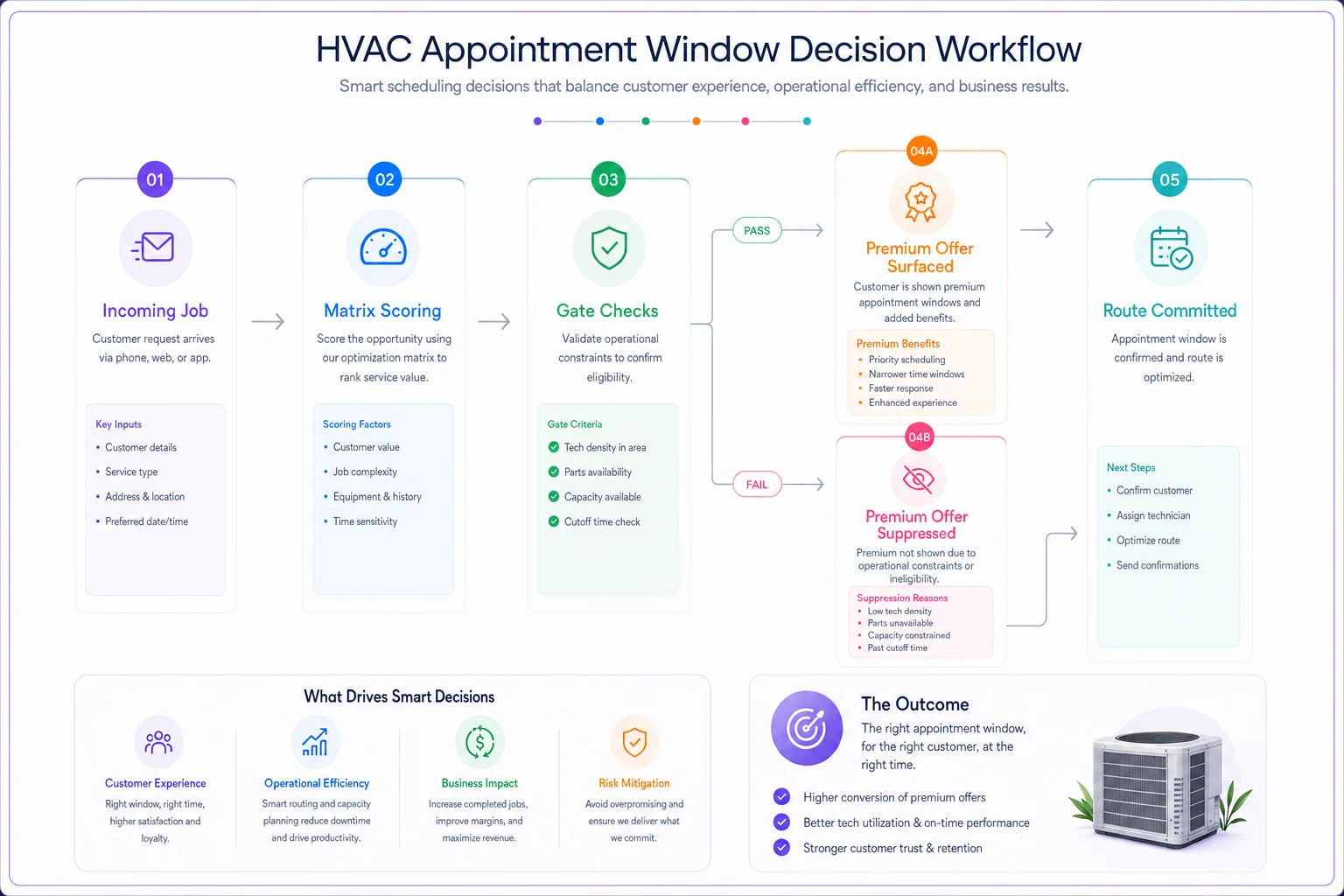
This is also where modern scheduling platforms earn their keep. Instead of a CSR mentally juggling territory rules, the booking tool checks density, parts, and capacity gates automatically and only surfaces the premium slot when the job actually qualifies. The gate enforces itself rather than relying on everyone remembering the policy.
The territory tier system is worth building even if you only have two zones. Once you've tagged addresses and set the rules once, the CSR doesn't need to make judgment calls — the system just reflects what the route economics actually support in that area.
When premium windows actually make sense
Premium windows are safest on your most routine work, not your most urgent.
-
Dense territories with naturally high route density
-
Routine, predictable job types with strong first-time-fix history
-
Membership and high-LTV customers you want to retain
-
Van-stocked parts and confirmed inventory
-
Early-route commitments made before the day is built out
The pattern worth internalizing: premium windows work best when your operational risk is lowest.
When premium windows are a bad idea
Sparse or rural territories with long inter-stop drives are the obvious case, but it goes beyond geography. Unknown-diagnosis and emergency calls are the other big one — jobs where you genuinely don't know what you're walking into have no business carrying a precision arrival guarantee. Same goes for days that are already near capacity, late bookings after the route is largely locked, and any job where the likely parts aren't on the van.
The pattern worth internalizing: premium windows work best when your operational risk is lowest. When a day or a job is already chaotic, adding a tight commitment makes it worse, not better.
Who should NOT roll this out yet
If you can't currently measure your first-time-fix rate by job type, or you don't have a clean loaded-hourly cost, hold off on aggressive premium pricing.
You'll be guessing at the two variables that decide whether the premium is profitable. Nail down FTFR tracking and your cost-to-serve first, then layer window pricing on top. Selling premium precision while blind to your callback rate is how shops convince themselves a money-losing policy is working.
A real scenario
A mid-size residential shop running two territories — one dense suburban, one semi-rural — had a flat "2-hour window, $29 premium, available everywhere" policy. It felt like a win because attach rate on the premium was solid, around 25% of bookings.
When they actually ran the per-job math, the suburban premiums were netting roughly $18–$22 each after drive cost. Fine. The rural premiums, though, were running negative once callback risk was included — the tight windows there were forcing long detours and the rushed arrivals were tanking first-time-fix on the harder rural jobs.
They didn't kill the premium. They gated it: premium offers shut off in the sparse territory unless a route was already anchored there that day, capped premium slots at two per tech, and required van-stocked parts to qualify. Rural standard jobs moved to wide windows with a modest overall price bump.
Over the following couple of months, premium attach dropped a bit — but blended margin on windowed jobs improved noticeably, and rural callbacks fell enough that the techs stopped dreading those days. The owner's takeaway was the quiet one: they'd been subsidizing their worst routing with their best customers' premium fees and calling it a service feature.
Pulling it together
Appointment window pricing isn't a single policy you set and defend. It's a per-job decision that depends on route density, parts certainty, job predictability, customer value, and the territory the address sits in. The shops that get this right stop asking "should we offer tight windows" and start asking "does this job, today, in this zone clear the gates."
Put the three colliding numbers — premium revenue, drive-time cost, and the FTFR-to-LTV chain — into a simple matrix and a per-job calculator, enforce it with hard dispatch gates, and tune the rules by territory. That's the difference between selling convenience at a loss and actually making the premium earn its keep.
Ready to optimize your HVAC operations?
Join hundreds of HVAC businesses using Coolyly to save time, improve technician utilization, and enhance customer satisfaction.