

Most HVAC shops don't have a quality problem they can see. They have a quality problem buried inside completed-job records that nobody reviews until the customer calls back angry, or until the warranty accrual line on the P&L starts climbing and the owner asks the office manager, "why are we spending this much on redos?"
The uncomfortable part: by the time warranty spend shows up as a number, the mistakes that caused it happened weeks ago, across dozens of jobs, by techs who have already repeated the same shortcut a hundred times. You're paying for problems that are already systemic.
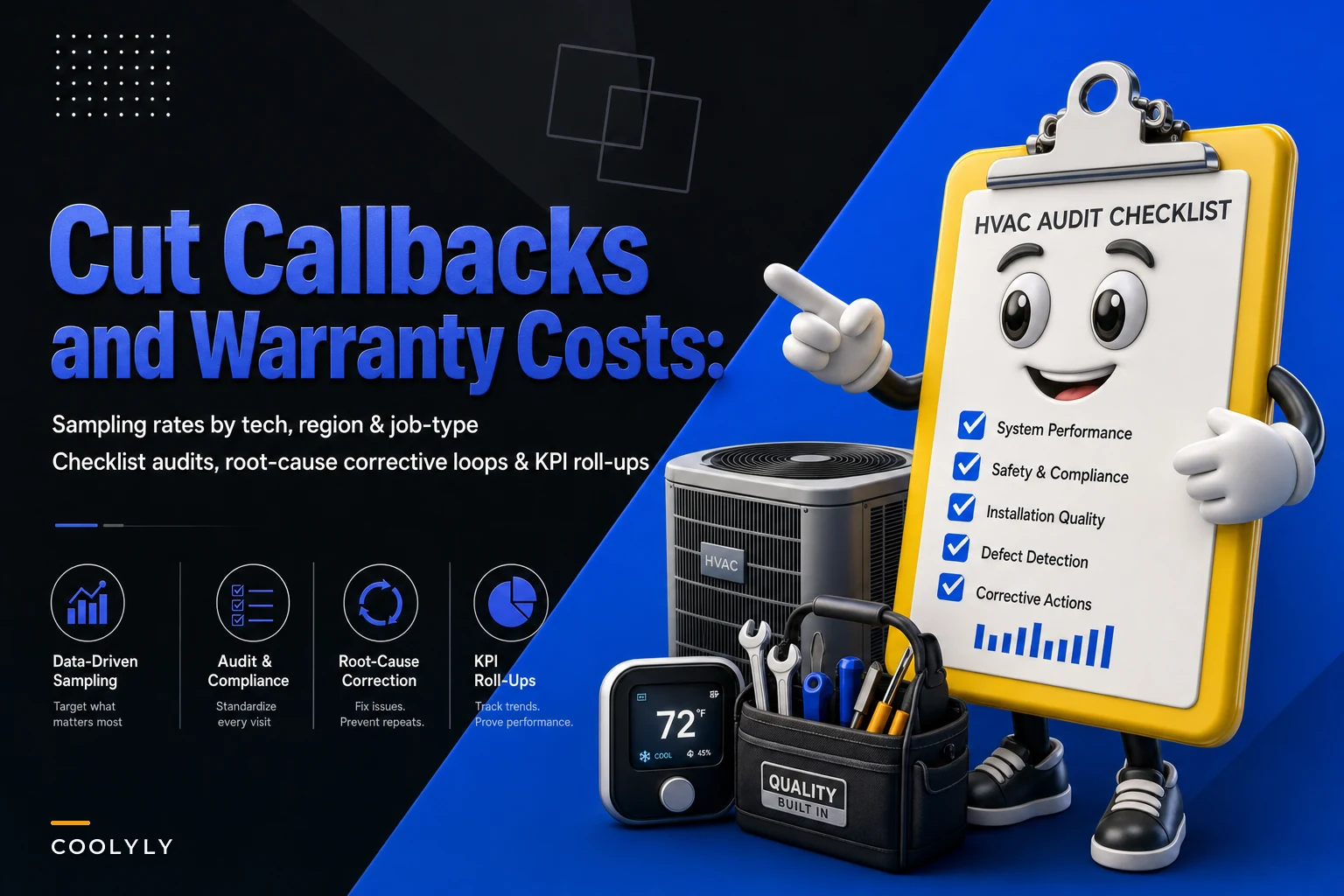
A post-job quality audit for HVAC isn't about checking every job. That's impossible and nobody has the labor for it. It's about sampling the right slice of jobs, scoring them against a real checklist, sorting failures into root-cause buckets, and feeding those buckets back into training and into your warranty KPIs. Done right, a sampling program covering maybe 5–8% of completed work will tell you more about your callback risk than reviewing 100% of jobs badly.
This is the operational build for that program.
Why callbacks hide from you until they're expensive
Callbacks are sneaky because they arrive detached from their cause. A tech brazes a line set with a nitrogen purge skipped on a Tuesday. Nothing happens for six weeks. Then a slow leak drops the charge, the system short-cycles in a heat spell, the customer calls, and you roll a truck for free. On the books, that's a warranty callback in August. Nobody connects it to the July install, and definitely nobody connects it to the fact that this tech skips nitrogen purges on tight jobs to save 20 minutes.
Multiply that across a team. The pattern only becomes visible if someone is deliberately looking at a sample of finished work before the customer complains, scoring it against what "done right" actually means.
-
One or two techs generate a disproportionate share of comebacks
-
Certain job types — line-set replacements, thermostat swaps on older wiring, condensate work — fail more than others
-
Specific regions or crews carry higher rates because of how they were trained, or who trained them
-
New hires cluster failures in their first 90 days on a pretty predictable set of tasks
None of that shows up if you only look at the warranty number. It shows up when you sample the work and categorize why the sampled jobs fail.
Sampling rates: don't audit everything, audit the right things
The first mistake people make is treating a quality audit like a blanket policy — "we'll review 10% of all jobs randomly." Random sampling wastes your reviewer's time on low-risk work and under-samples the stuff that actually generates warranty spend.
Eliminate scheduling chaos and missed jobs.
Coolyly helps HVAC companies book, coordinate, and track every service efficiently.
- Unified appointment & dispatch management
- Automated client notifications
- Technician scheduling & job tracking
No credit card required
Sampling should be weighted by risk. Pull more audits from the segments most likely to produce a callback, and fewer from the segments that rarely do.
| Segment | Baseline sample rate | Why |
|---|---|---|
| New techs (first 90 days) | 20–25% of their jobs | Highest failure clustering, training window |
| High-callback job types (line sets, brazing, condensate, control wiring) | 12–15% | Failures are expensive and often invisible day-of |
| Tenured techs, routine jobs (filter, capacitor, standard maintenance) | 3–5% | Low risk, spot-check only |
| Any tech after a recent failed audit | Temporarily 15%+ | Verify corrective action stuck |
| New region or newly acquired crew | 15% for first quarter | Unknown quality baseline |
The exact percentages aren't the point. The point is that a tenured tech doing a capacitor swap and a 60-day hire doing a line-set replacement should not get sampled at the same rate. That's the difference between a program that catches real risk and one that just generates paperwork.
Start with conservative increases on high-risk segments and watch trends for two cycles before adjusting rates again.
Shops that weight sampling by job type usually find that 3–4 job categories account for the majority of their warranty dollars. Once you know which ones, you can raise sampling on those specifically and stop burning review hours everywhere else. If you don't have clean job-type definitions yet, that's a prerequisite — the same discipline that goes into a proper flat-rate estimate and job-type library is what lets you segment audits by job type at all.
What actually goes on the audit checklist
A quality-audit checklist is not a copy of the tech's completion checklist. The completion checklist is "did you do the job." The audit checklist is "was it done in a way that won't come back." Those are different questions.
For a sampling program to be useful, the checklist has to be:
-
Objective — pass/fail items, not "does the work look good"
-
Job-type specific — a mini-vac audit item makes no sense on a thermostat job
-
Evidence-backed — photos, gauge readings, micron levels, torque confirmations, not the tech's word
-
Tied to a root-cause category — every fail should map to a bucket
Here's a sample of what a line-set/refrigerant job audit might include:
-
Vacuum pulled to target microns, with photo of the micron gauge reading
-
Nitrogen purge documented during brazing
-
Pressure test held and recorded before evacuation
-
Correct charge verified by subcooling/superheat, with readings logged
-
Line set properly supported and insulated, photo included
-
Electrical connections torqued and disconnect labeled
-
Condensate drain tested with a poured-water check, photo of clear drain
-
Customer-facing components (registers, thermostat, panel) clean and reset
Notice how much of this is about evidence capture, not opinion. The single biggest reason quality audits fail as programs is that there's nothing to audit — the tech marked "complete," there are no readings, no photos, and the reviewer is just guessing. If your field process doesn't force the tech to capture the micron reading and the subcooling number at the job, you don't have an audit. You have a vibe check.
Root-cause categories: turn failures into fixable buckets
A failed audit is useless as a data point unless you can say why it failed in a way that repeats. This is where root-cause categories matter. Every failed checklist item should be tagged to a small, fixed set of buckets. Keep the list short — if you have 30 categories, nobody will tag consistently.
A workable set looks like this:
-
Skill/technique gap — the tech didn't know how to do it correctly
-
Shortcut/rushed — the tech knew but skipped it (time pressure, heavy dispatch, laziness)
-
Wrong or missing parts/materials — didn't have the right component on the van
-
Diagnostic error — misdiagnosed the actual problem
-
Documentation only — work was fine, evidence wasn't captured
-
Process/spec gap — no clear standard existed for the tech to follow
That last distinction matters more than people expect. If half your fails are "documentation only," you don't have a quality problem — you have a data-capture problem, and the fix is tooling, not retraining. If half your fails are "shortcut/rushed," you may actually have a dispatch and workload problem. Techs cut corners when they're stacked too tight, which is why quality and scheduling are more connected than most owners realize — the same overload that produces rushed work also produces the emergency comebacks that push you into a triage-and-prestage approach for truck rolls.
Sorting fails into these buckets is what converts a pile of audit results into a decision about where to spend your training and process dollars.
The corrective-action loop that actually closes
Auditing without a corrective loop is theater. Most quality programs die within a quarter because failures get logged and nothing happens — techs figure out the audit has no teeth and reviewers stop bothering.
A corrective-action loop that sticks looks like this:
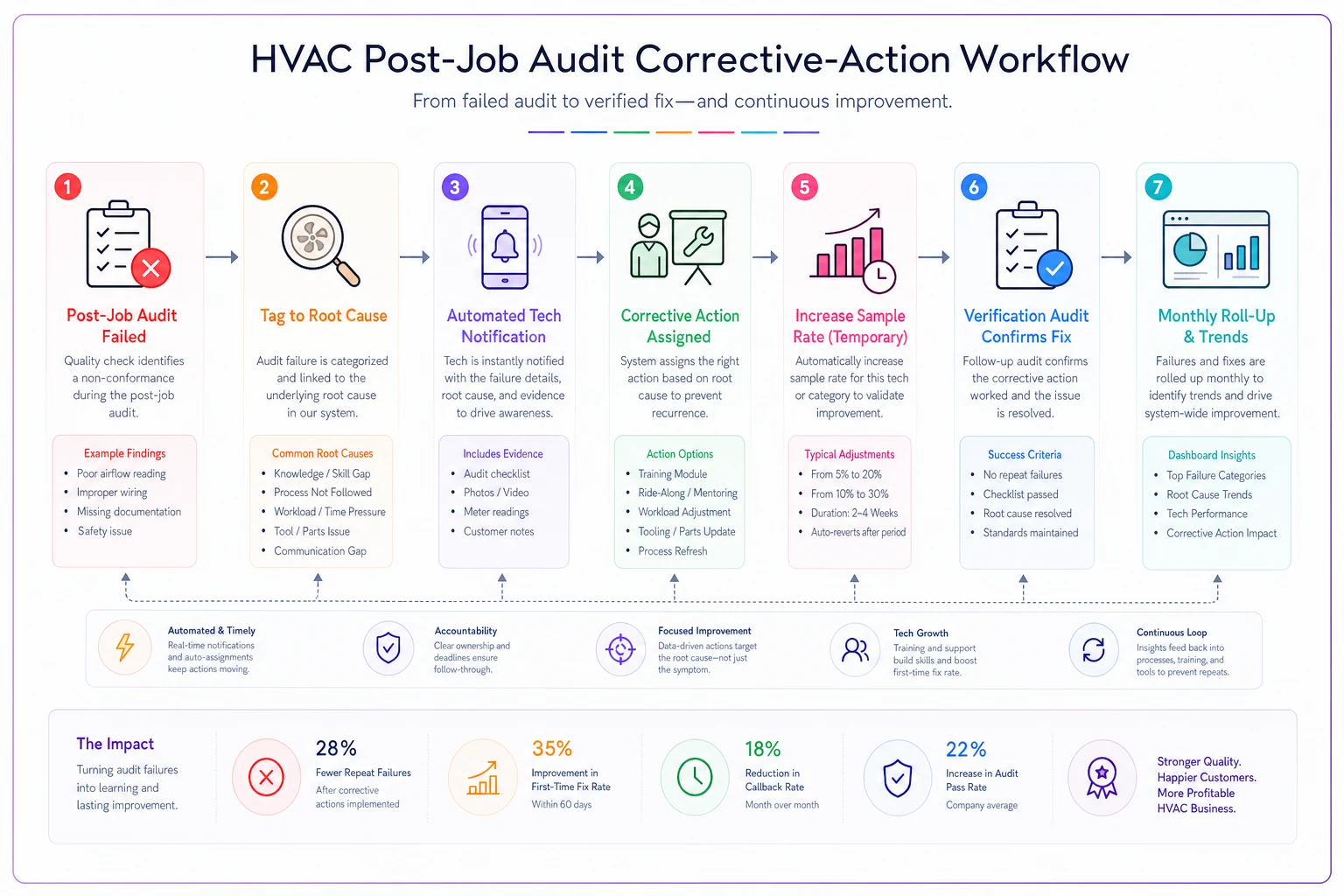
A visual flow of the steps helps teams understand who does what and when during the corrective loop.
-
Failed audit is tagged to a root-cause category within 48 hours of review.
-
Tech is notified with the specific item, the evidence, and what "correct" looks like — not a vague "you failed an audit."
-
Corrective action is assigned based on the category
a skill gap gets a short training or ride-along; a shortcut gets a direct conversation and a workload check; a documentation-only fail gets a tooling reminder.
-
Sample rate on that tech increases temporarily to verify the fix held.
-
The verification audit either confirms improvement (rate returns to baseline) or escalates.
-
Category trends roll up monthly so you can see whether a failure pattern belongs to one tech or the whole team.
The verification audit in step 4 is what closes the loop. Without it, you're just telling people they messed up and hoping. With it, you're confirming the correction actually changed behavior, which is the entire point.
One thing that comes up regularly: when a specific technique gap — say, condensate drain testing — shows up across multiple techs in the same region, that's not an individual coaching issue. That's a training curriculum gap, and it means whoever onboarded that crew never covered it properly. The audit data just told you your training program has a hole in it.
Tie it to warranty KPIs so the money is visible
The reason to do any of this is money, so the program has to connect to the warranty line — not float off as an HR exercise.
-
Callback rate by tech / region / job type (comebacks ÷ completed jobs)
-
Warranty cost per completed job — trending down as the program matures
-
Audit fail rate by root-cause category — tells you where to spend training dollars
-
Time-to-correction — how long from failed audit to verified fix
-
Repeat-fail rate — same tech failing the same category twice (the real red flag)
The one owners care about most is warranty cost per job, because it's a dollar figure they can watch move. When you can show that raising sampling on line-set jobs drove down the callback rate on those jobs over a couple of quarters, and warranty spend per job followed, the program justifies itself.
Where the software actually helps
For a two-truck shop, you can run a basic version of this on a spreadsheet and you probably should start there. But the loop breaks at scale for boring reasons: nobody remembers to pull the sample, evidence lives in five places, tagging is inconsistent, and verification audits never get scheduled because everyone's putting out fires.
This is the narrow spot where an AI-assisted operational platform earns its keep — not by replacing the reviewer's judgment, but by handling the parts humans forget. Weighted sampling can be automated so the right jobs get flagged based on tech tenure, job type, and recent fail history, instead of someone manually deciding each week. Evidence capture — micron readings, photos, subcooling numbers — can be required at job completion so there's always something to audit. Failed audits can auto-trigger the corrective-action task, bump the tech's sample rate, and schedule the verification audit without anyone tracking it on a sticky note. Root-cause tags roll up into warranty KPIs automatically so the trends surface instead of hiding in a folder nobody opens.
The value isn't automation for its own sake. It's that the loop stays closed even when everyone's buried in peak season, which is exactly when quality slips and callbacks spike.
A real scenario
A residential HVAC company running about seven trucks was watching warranty and callback costs creep up through the cooling season without a clear source. Warranty spend was landing somewhere around $5k–$7k a month and the owner had basically accepted it as part of the business.
They started a weighted sampling program: 20% on their two newest techs, 15% on line-set and condensate jobs across the board, 4% on routine maintenance. Within the first six weeks the pattern was obvious — most fails tagged to "shortcut/rushed" on nitrogen purge and vacuum, concentrated on line-set jobs, and heavily clustered around the two newest hires plus one tenured tech who'd gotten sloppy under a heavy summer load.
The corrective action was straightforward: two ride-alongs for the new hires, a workload conversation with the tenured tech, and required micron-gauge photos on every refrigerant job going forward. Verification audits over the next month confirmed the purges and vacuums were actually happening.
By the end of the season, callback rate on line-set jobs had dropped noticeably and monthly warranty spend settled roughly a third lower than where it started. Not a dramatic turnaround — just the result of looking at the right sample of jobs and closing the loop instead of paying for the same mistake fifty times.
When this makes sense — and when it doesn't
This is worth building when:
-
You're running enough trucks that you can't personally eyeball everyone's work
-
Warranty and callback spend is a visible line you can't fully explain
-
You're onboarding new techs regularly and want a training feedback loop
-
You've had at least one expensive callback cluster you didn't see coming
This is probably overkill when:
-
You're a solo op or two trucks where the owner reviews most jobs anyway
-
Your job mix is almost entirely low-risk routine work
-
You don't yet capture any field evidence — fix that first, then audit
Who should not start here: if your techs aren't capturing readings and photos at the job, don't build the audit program yet. You'll have nothing objective to review and the whole thing turns into arguments about whose memory is right. Get evidence capture working in the field first, then layer sampling on top of it.
A post-job quality audit isn't about catching people. It's about seeing the pattern in your completed work before your customers do — and turning that pattern into training and warranty savings you can actually measure.
A post-job quality audit isn't about catching people. It's about seeing the pattern in your completed work before your customers do — and turning that pattern into training and warranty savings you can actually measure.
Ready to optimize your HVAC operations?
Join hundreds of HVAC businesses using Coolyly to save time, improve technician utilization, and enhance customer satisfaction.