


Most HVAC owners find their margin leakage the same way: the P&L comes back lower than the job-costing reports said it should, nobody can explain the gap, and the controller shrugs because "the numbers just don't tie out." That gap is almost never one big leak. It's a hundred small disconnects between what happened in the field and what landed in the general ledger.
The field and the office run on two completely different clocks. A technician pulls a compressor off the van at 2pm, installs it, drives home, and the parts system shows it as "consumed" — maybe. The accounting system doesn't see that compressor until a vendor invoice clears three weeks later, and by then nobody remembers which job it went on. Multiply that by dispatch events, fuel, warranty returns, and core credits, and month-end close becomes basically a guessing game.
This is a finance-to-ops operating model for HVAC, and the whole point is to stop treating the close as an accounting exercise. The close is an operational exercise. Every dollar in your GL started as a physical event in the field. If you can't trace the event back to the artifact, you can't trust the margin.
Why the field-to-finance handoff breaks in the first place
In most shops under $15M, there's no formal moment where custody of a cost transfers from the field to the books. Parts leave the warehouse, get used, get returned, get warrantied — and the GL just sort of absorbs whatever the vendor invoices and whatever the techs remember to log.
The breakdown usually isn't incompetence. It's that nobody owns the seams between systems. Dispatch owns the schedule. The warehouse owns inventory. Accounting owns the ledger. Each does their job fine. But the moment a part moves from the warehouse's responsibility to the job's cost, there's no gate — no explicit "this is now a job cost, recorded here, matched to this invoice." Things fall through that seam.
A few patterns come up over and over:
-
Fuel gets booked as a lump-sum overhead instead of being allocated to routes, so route-level margin is fiction.
-
Warranty parts go out but the credit never comes back because nobody tracks the return as a receivable from the manufacturer.
-
Core charges (the deposit on rebuildable parts) get paid out and never recovered because the old core sits in a van for six months.
-
Dispatch events and labor hours don't match payroll, so job labor cost is understated and the real number hides in the overhead bucket.
At small scale you can paper over this. The owner knows roughly where the money is. But the model doesn't survive growth.
What actually breaks at scale
When you're running 4 trucks, the owner personally remembers that the Johnson rooftop job ate two extra compressors because the first one was DOA. At 20 trucks across two branches, that institutional memory is gone. The DOA compressor is now a mystery charge, and the warranty recovery that should've offset it never happens because the DOA paperwork lives in a tech's glovebox.
Eliminate scheduling chaos and missed jobs.
Coolyly helps HVAC companies book, coordinate, and track every service efficiently.
- Unified appointment & dispatch management
- Automated client notifications
- Technician scheduling & job tracking
No credit card required
The failure compounds in three places as you grow:
-
Volume outpaces reconciliation capacity. A bookkeeper can eyeball 200 transactions a month. At 2,000, they stop matching and start trusting, which means errors become permanent.
-
More custody handoffs = more leak points. Every branch, every warehouse, every subcontractor adds a seam. Parts transfer between branches with no transfer artifact. A core gets shipped to the wrong supplier. Warranty windows expire while the paperwork routes around.
-
The lag gets longer. The gap between the field event and the GL entry stretches from days to weeks. The longer the lag, the colder the trail — and warranty recovery is brutally time-sensitive. Miss the manufacturer's claim window and that money is gone.
This is also where SLA-driven commercial accounts make everything harder, because now you're not just reconciling your own costs — you're tracking contractually billable parts and labor that have to be invoiced precisely or you eat the difference.
The core idea: map every operational event to a GL artifact
The fix isn't a better spreadsheet. It's deciding upfront that every operational event produces a specific accounting artifact, and defining the gate where custody transfers.
Four questions for every type of event:
-
What happened in the field? (the operational event)
-
What document proves it? (the artifact)
-
Who's holding the cost right now? (custody)
-
What has to match before it's final? (the reconciliation gate)
Here's a working mapping table you can adapt. This is the backbone of the whole model.
| Operational Event | GL Artifact | Custody Holder | Transfer Gate | Reconciliation Match |
|---|---|---|---|---|
| Part pulled for job | Inventory issue ticket | Warehouse → Job | Tech confirms install on work order | Issue ticket ↔ work order ↔ vendor PO |
| Dispatch / labor logged | Timecard + work order hours | Dispatch → Payroll | EOD hour confirmation | Dispatch hours ↔ payroll ↔ job labor cost |
| Fuel purchase | Fuel card transaction | Overhead → Route | Card mapped to vehicle/route | Fuel card ↔ route log ↔ vehicle |
| Warranty part out | Warranty claim document | Job → Manufacturer AR | Claim filed within window | Part issued ↔ claim filed ↔ credit received |
| Core return | Core credit memo | Van → Supplier | Core shipped + logged | Core charge paid ↔ core shipped ↔ credit |
| Inter-branch transfer | Transfer order | Branch A → Branch B | Receiving branch confirms | Transfer out ↔ transfer in |
The magic isn't the table — it's the transfer gate column. That's what most shops skip. Without a defined gate, custody is ambiguous, and ambiguous custody is where margin dies.
Custody and transfer gates, explained
A transfer gate is a required confirmation before a cost moves from one owner to another. If the gate isn't satisfied, the cost stays with the current owner and shows up on a reconciliation exception list.
Walk through a compressor:
It lives in the warehouse — warehouse custody. A tech requests it for a job, an issue ticket is created, but custody doesn't fully transfer yet. The compressor is now "in transit" on the van, which is its own accountability state. This is exactly why van-level parts custody workflows matter — the van is a mobile warehouse that nobody treats like one.
Treat the van as a mobile warehouse with its own custody controls and require tech confirmation on the work order to close the gate quickly.
The tech installs it and confirms on the work order. Gate satisfied — custody transfers to the job. The cost is now a job cost, matched to the issue ticket. When the vendor invoice arrives, it matches the PO, which matches the issue ticket, which matches the work order. Three-way match, done.
If the compressor was a warranty replacement, a second track opens: a warranty claim artifact is created the moment the part is issued, and the old part becomes a manufacturer receivable. That receivable sits open until the credit arrives. No credit by the window deadline = exception.
Each gate catches the leak before it becomes permanent. Miss the gate and the error ossifies into the ledger.
The month-end reconciliation checkpoints
Here's the sequence a COO can run every month. The order matters — reconcile from the field event outward to the ledger, not the other way around.
-
Parts consumption vs. issues. Pull every inventory issue ticket for the period. Match each to a work order. Flag issue tickets with no matching work order (shrinkage or unbilled) and work orders with parts logged but no issue ticket (phantom inventory).
-
Vendor invoices vs. POs vs. issues. Three-way match. Flag any invoice without a PO, any PO without a receipt, any price variance over your threshold (say, 5%).
-
Labor hours
dispatch vs. payroll vs. job cost.
Dispatch logged X hours, payroll paid Y hours, jobs absorbed Z hours. All three should tie within a tight band. Gaps are usually unbilled travel or OT buried in overhead. -
Fuel allocation. Map every fuel card transaction to a vehicle and route. Unmapped fuel goes on the exception list — it's either overhead or theft, and you want to know which.
-
Warranty claims aging. List every warranty part issued against claims filed and credits received. Anything approaching the manufacturer window gets escalated today, not next month.
-
Core charge recovery. Match core charges paid against cores shipped and credits received. Aged cores are cash sitting in a van.
-
Inter-branch transfers. Every transfer-out must have a matching transfer-in. Unmatched transfers are inventory in limbo.
Run these seven and the exceptions list is your margin leakage. Everything that doesn't match is money you're either losing or failing to recover.
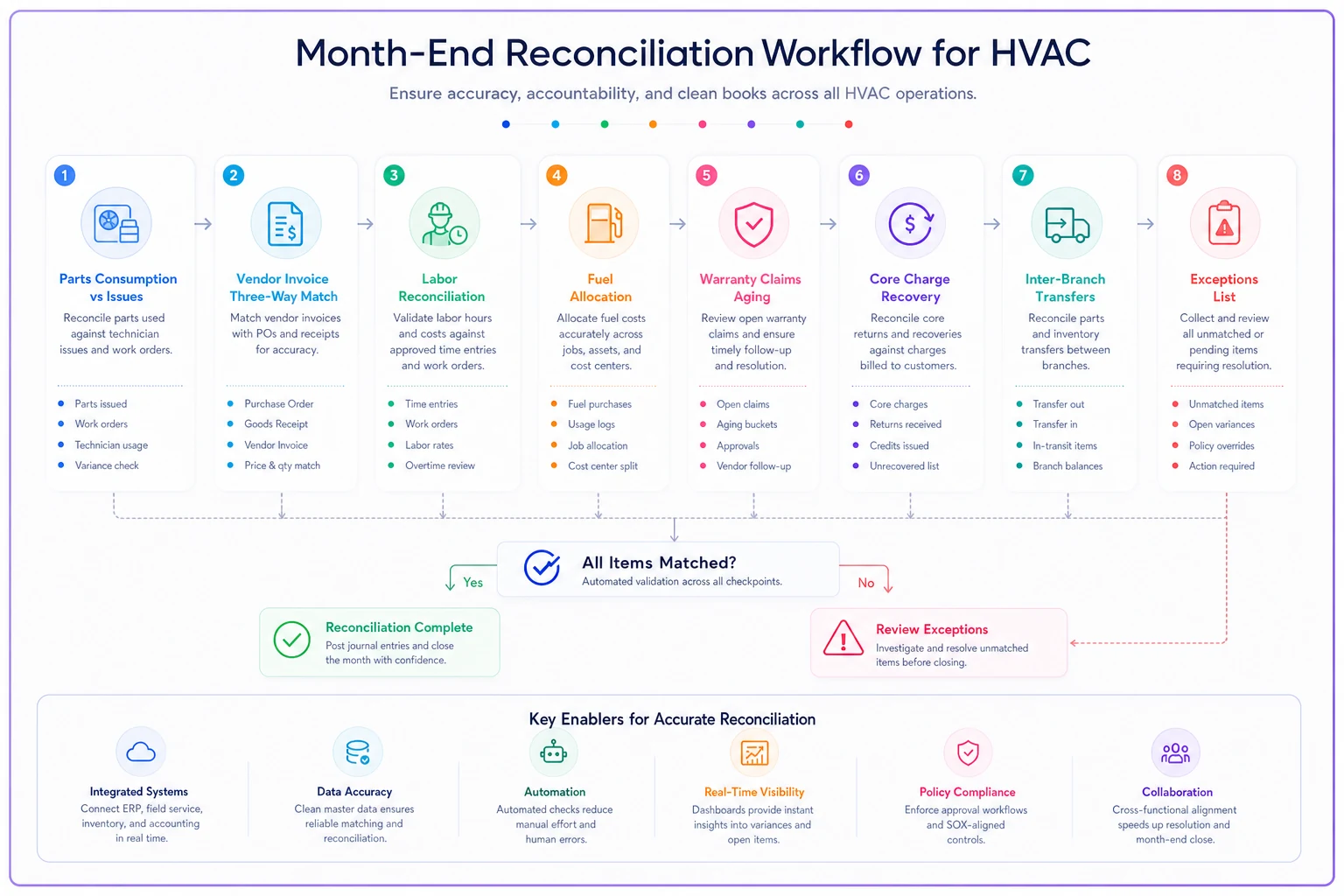
The graphic shows the checkpoint workflow and where exceptions are collected.
A real scenario
A residential-and-light-commercial shop, about 14 trucks across two locations, roughly $9M in revenue. Job-costing reports said gross margin was running around 48%. The actual P&L kept landing closer to 42–43%. That 5-ish point gap was roughly $450k a year they couldn't explain.
-
Warranty credits never recovered somewhere in the $70k–$80k range annually — manufacturer credits that expired because claims weren't filed in time.
-
Unrecovered core charges cores sitting in vans and back rooms, around $25k tied up and partially written off.
-
Fuel booked entirely to overhead not a true loss, but it was hiding route-level unprofitability — two routes were actually losing money and nobody could see it.
-
Phantom parts and mismatched invoices price variances and parts issued but never billed, roughly $90k–$110k over the year.
They didn't fix all of it. But within two close cycles they'd recovered most of the warranty and core money, and tightened invoice matching enough to pull measured margin back to around 46%. Not perfect, but a few points of margin on $9M is real money — and most of it was recovery, not cost-cutting.
The deeper win was trust. The job-costing numbers and the P&L started agreeing, which meant pricing decisions were finally based on real cost-to-serve. If you haven't built that foundation yet, the cost-to-serve and job-margin reconciliation system is the prerequisite — this operating model is the enforcement layer that sits on top of it.
The invoice/dispute bundle
When a vendor invoice doesn't match, you don't want your bookkeeper hunting through three systems. You want a standard dispute bundle assembled the same way every time:
-
The vendor invoice
-
The matching PO
-
The receiving record
-
The issue ticket showing where the part went
-
The work order it was consumed on
-
A one-line variance note (price, quantity, or missing receipt)
Standardizing this does two things. It makes disputes fast enough that your team actually files them instead of eating the variance. And it builds a paper trail that makes the next dispute easier because the vendor learns you check.
The warranty-recovery workflow runs on a parallel bundle: part issued, failure documentation, serial/model numbers, install date, and the claim form — assembled at the moment of install, not scavenged weeks later when the credit is already at risk.
When this model makes sense — and when it doesn't
When it makes sense: You're past the point where the owner personally remembers every job. Usually that's somewhere north of 8–10 trucks, or whenever you add a second branch. The moment custody crosses a person or a location boundary, you need gates.
When it's overkill: A 3-truck shop where the owner opens every vendor invoice doesn't need formal transfer gates for inventory. You'll spend more on process than you recover. Build the discipline of tracking warranty and core recovery, skip the heavy reconciliation machinery.
Who should NOT start here: If your job-costing data is garbage — techs not logging parts, no consistent work order structure — fix that first. This model reconciles field events to the GL. If the field events aren't captured reliably, you're reconciling noise. Get clean field data capture, then layer this on top.
Where software carries the weight
None of this requires exotic technology, but it does require the seams to stop being manual. The reason warranty credits expire isn't that nobody cares — it's that nobody got a reminder the window was closing. The reason fuel sits in overhead is that mapping each transaction to a route by hand is tedious enough that people just skip it.
This is the practical role of an AI-assisted operational platform: it watches the seams you can't. It flags the issue ticket with no matching work order the day it happens, not at month-end. It ages warranty claims automatically and escalates the ones approaching a deadline. It matches invoices to POs to issue tickets and surfaces only the exceptions — so your controller reviews fifteen problem transactions instead of grinding through two thousand clean ones. The reconciliation checkpoints above become a dashboard that's always current instead of a monthly fire drill.
The work of designing the model — the mapping table, the gates, the checkpoints — is still yours. The software just makes sure the gates actually hold when you've got thousands of transactions a month and nobody has time to check them by hand.
Closing the loop
The gap between your job-costing reports and your P&L isn't an accounting mystery. It's a collection of custody handoffs with no gate, warranty windows nobody watched, and fuel nobody allocated. Every one of those leaks started as a physical event in the field that never cleanly became an artifact in the ledger.
Build the mapping. Define the gates. Run the checkpoints every close. The exceptions list will tell you exactly where your margin is going — and most of what you find won't be cost you need to cut, but recovery you've been leaving on the table.
Ready to optimize your HVAC operations?
Join hundreds of HVAC businesses using Coolyly to save time, improve technician utilization, and enhance customer satisfaction.