

Most HVAC coaching programs are built backward. Someone decides techs "need more refrigerant training" or "should brush up on controls," and a trainer throws together a half-day session. Everybody sits through it, nods, signs the attendance sheet, and three weeks later the same three fault categories are still driving the majority of your callbacks.
The problem isn't that your techs can't learn. It's that the coaching isn't connected to the faults that are actually costing you money. If you've already got a post-job audit sampling program running — and if you don't, start there — you're sitting on a map of exactly where your work falls apart. The coaching should follow that map, not a curriculum catalog from a distributor.
This post is about building a technical coaching HVAC fault curriculum organized by job class and failure category, tied directly to your QA data, with competency checks and remediation timelines you can actually measure against warranty spend.
Start from the fault categories, not the skill categories
Stop organizing training around topics like "electrical," "airflow," or "refrigeration" and start organizing it around the specific faults that keep showing up in your QA sampling and warranty claims.
When you pull six to twelve months of callbacks and warranty jobs and tag them by root cause, the distribution is almost never even. In most residential-heavy shops, a small handful of fault categories drive the bulk of rework. A typical breakdown looks something like this:
-
Improper refrigerant charge on split-system installs and changeouts
-
Condensate drain failures and improper slope/trap work
-
Thermostat and low-voltage wiring faults, especially on communicating systems
-
Incomplete combustion setup on gas furnaces — gas pressure, flue, CO verification
-
Capacitor/contactor diagnosis where the tech swapped parts without confirming the actual fault
That last one is sneaky. It doesn't always show up as a callback — it shows up as a warranty part claim and a margin leak, because the tech replaced a good capacitor to "be safe" and the real problem (a failing fan motor bearing) walked back in two weeks later.
Your fault categories are specific to your shop, your climate, your equipment mix, and your crew. A shop doing a lot of communicating heat pumps will have a very different failure profile than one doing mostly 80% furnaces and builder-grade AC. So the first real deliverable isn't a lesson plan. It's a ranked list of your top fault categories by frequency and by cost.
Frequency alone will mislead you
One mistake worth flagging early: ranking fault categories by count only. A high-frequency, low-cost fault — a loose wire that generates a quick no-charge callback — can feel urgent but barely moves your P&L. Meanwhile a low-frequency charge problem that eats a compressor under warranty is a multi-thousand-dollar event.
Rank by combined impact. A rough way to do it: multiply approximate frequency by average true cost per occurrence — warranty parts, return labor, the follow-on truck roll, and the customer goodwill hit you can't fully quantify. Sort descending. The top three to five categories are your curriculum for the next quarter. Everything else waits.
What a fault-class curriculum unit actually contains
A curriculum "unit" for a single fault class isn't a slideshow. It's a small package built so a lead tech or trainer can deliver it, verify it, and track it. Each unit should contain four things:
Eliminate scheduling chaos and missed jobs.
Coolyly helps HVAC companies book, coordinate, and track every service efficiently.
- Unified appointment & dispatch management
- Automated client notifications
- Technician scheduling & job tracking
No credit card required
-
The failure anatomy — what the fault actually looks like in the field, the most common wrong diagnoses, and the specific steps techs skip that cause it. For charge faults, that's superheat/subcooling procedure, line-set accounting, and ambient correction — and the shortcut techs take when they "weigh in and walk."
-
The competency check — a hands-on verification, not a quiz. More on this below.
-
The ride-along template — a structured observation sheet the lead uses to watch the tech perform the task live.
-
The remediation timeline — what happens, and by when, if the tech fails the check.
Keep each unit tight. One fault class, one unit. If you try to cram "all of refrigeration" into a single unit, you've recreated the generic training that already failed you.
Competency checks that mean something
A written test proves a tech can recognize the right answer on paper. It does not prove they'll run subcooling correctly on a 95-degree roof when they're behind on their route. Competency checks have to be performance-based.
-
It's observable. The lead watches it happen or inspects the completed work against a spec — not a memory.
-
It has a pass/fail threshold, not a vibe. "Charge verified within spec, documented readings present, correction factor applied" either happened or it didn't.
-
It's done on a real or realistic job, not a classroom mockup where nothing is actually under load.
For the condensate category, the check might be: slope confirmed, trap correct for the unit's static, secondary protection functional, and a float switch tested live. Pass means all four. Three of four is a fail, because the one missing item is usually the one that floods a ceiling in August.
The ride-along template — where most programs quietly fall apart
Ride-alongs sound great and almost always decay into "the lead rode with the new guy and said he's doing fine." That's not data. That's an opinion delivered in a parking lot.
A ride-along template forces structure. It should list the specific sub-steps for the fault class being observed, with a simple mark for each: performed correctly / performed with coaching / not performed. The lead isn't writing an essay — they're checking boxes against a known-good procedure, and those boxes map directly to the fault category being coached.
Here's a stripped-down example of what a ride-along observation row set looks like for a charge-verification unit:
| Observed step | Correct | With coaching | Missed |
|---|---|---|---|
| Measured line-set length, adjusted charge accordingly | |||
| Ran subcooling with calibrated gauges | |||
| Applied ambient/correction factor | |||
| Documented final readings in the work order | |||
| Verified airflow before finalizing charge |
The "with coaching" column is the most useful one over time. A tech who needs coaching on correction factors across three consecutive ride-alongs isn't ready, no matter how confident they seem. A tech who moves from "with coaching" to "correct" across two sessions is exactly the progression you want to see. That column is your evidence of whether the coaching is actually working.
Audit your leads against the same competency checks before you let them certify anyone else.
One thing worth paying attention to: the person doing the ride-along matters. If your most senior installer is himself skipping the correction factor, every tech he mentors inherits the same gap. Audit your leads against the same competency checks before you let them certify anyone else. Otherwise you're just scaling the bad habit.
Mapping remediation timelines to QA sampling data
This is the part that turns coaching from a one-time event into an actual system. The curriculum shouldn't run on the calendar — it should run on the signal coming out of your QA sampling.
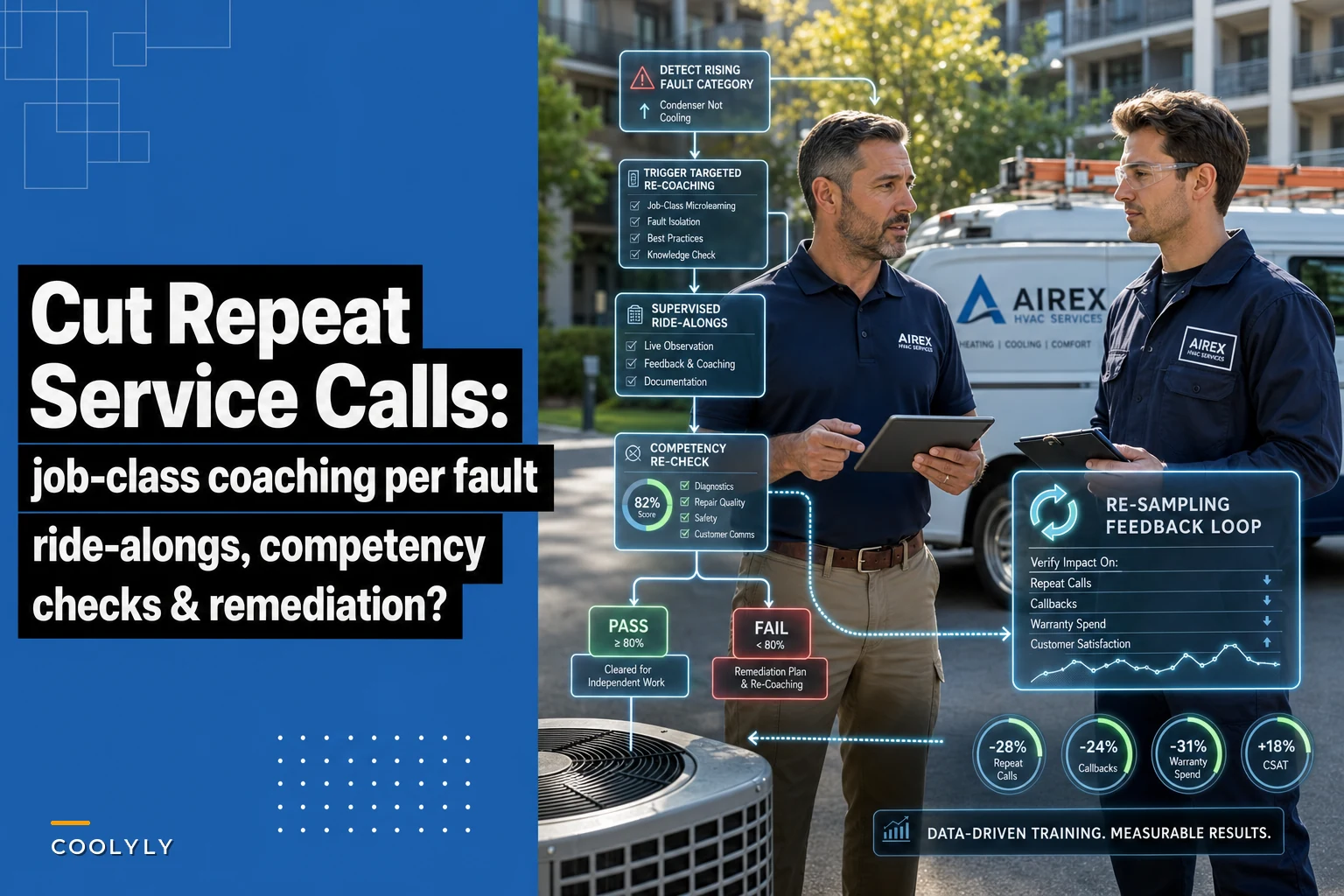
The logic is simple: when your audit sampling shows a fault category climbing, that category's curriculum unit gets triggered for the techs responsible. When a specific tech's work shows a repeated fault, that tech enters a remediation timeline. You're not training everyone on everything — you're routing training to where the data says it's needed.
-
Day 0 — Failed check logged against the specific fault class. Tech is told exactly what failed and why it matters (cost and callback risk), not just "redo the training."
-
Days 1–5 — Targeted re-coaching on that single fault class. Short, focused, hands-on. Not a general refresher.
-
Days 5–10 — Supervised ride-along on a live job in that category, using the template.
-
Day ~14 — Re-check. Pass means back to normal rotation with a note to spot-sample their next few jobs in that category. Fail means escalate: pair with a different lead, reduce exposure to that job type temporarily, or address whether this is a coaching issue or a fit issue.
The timeline being written down matters more than the exact day counts. Without it, "remediation" means a vague promise to "keep an eye on him" that nobody follows up on. With it, the same fault showing up a third time triggers a clear next step instead of a shrug.
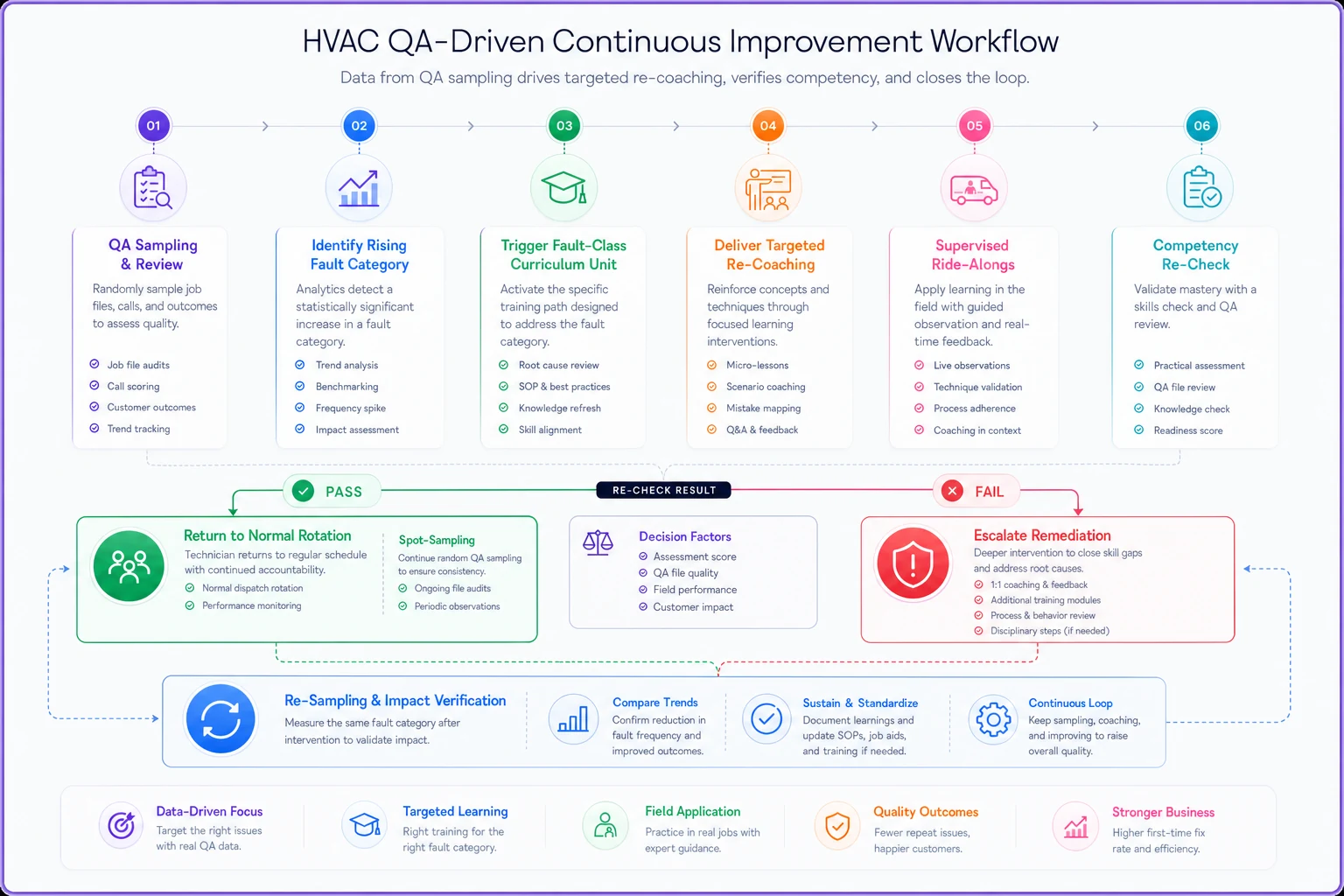
Here's a simple visualization of that loop.
Close the loop back to the QA data
The whole program only works if you measure the fault category trend after the coaching — not just whether coaching happened at all. Pull the same fault-class sampling 30 and 60 days after a unit runs. If charge faults were showing up in roughly 1 in 6 sampled installs before the unit, and you're down to 1 in 15 two months later, the curriculum earned its keep. If the number didn't move, the problem isn't the tech — it's your unit content or your check threshold, and you fix that.
This feedback loop is exactly why coaching should sit on top of a structured sampling program rather than standing alone. The post-job quality-audit sampling program gives you the fault signal; the curriculum gives you the response; and tying both into your broader technician coaching and performance-review system keeps it from becoming a one-off project that dies after the first quarter.
A real scenario
A residential-and-light-commercial shop running about nine field techs was carrying warranty and callback costs that nobody wanted to look at directly. When they finally tagged six months of rework by root cause, two categories jumped out: refrigerant charge on changeouts, and condensate failures. Together they were driving somewhere around 55–60% of their callback truck rolls and a meaningful chunk of warranty part claims.
Instead of a general "refrigeration refresher," they built two tight units — one per category — with competency checks and ride-along templates. The first round of checks was humbling: roughly half the techs weren't applying correction factors consistently, and two were skipping the live float-switch test entirely.
They ran the remediation timelines over about six to eight weeks, then re-sampled. Charge-related callbacks on changeouts dropped to under a third of what they'd been. Condensate callbacks nearly disappeared because the fix was mostly procedural — the float-switch test became non-negotiable and verifiable. Monthly warranty part spend came down meaningfully, and the arguably bigger win was the callback truck rolls that never happened — labor and fuel recovered without hiring anyone.
Nothing about that outcome required a fancy new certification. It required coaching aimed at the two things that were actually breaking, verified by someone watching, with a clear timeline for what happens if it doesn't stick.
When this makes sense — and when it doesn't
This approach makes sense when you already have some form of QA sampling or at least clean callback and warranty tagging — no fault data means no fault curriculum. It also works when a small number of fault categories clearly dominate your rework, and when you have at least one or two leads capable of running honest competency checks.
It's a bad idea when your callbacks are spread thin across many unrelated causes with no clear pattern, because that usually points to a dispatch, scoping, or hiring problem rather than a skills gap. It's also the wrong move if your leads haven't been validated themselves — you'll just certify the wrong habits faster. And if you're treating it as a paperwork exercise to satisfy a franchisor, you've built a binder, not a program.
Very small shops — one or two techs where the owner already inspects most jobs personally — probably don't need this formalized. At that scale the feedback loop already exists informally, and adding structure brings overhead without adding much signal. The payoff shows up once you're past the point where one person can personally eyeball the work.
Keeping it alive past quarter one
The failure mode for even a well-built curriculum is neglect. It runs hot for a quarter, the top two fault categories improve, and then everyone moves on. Six months later a new hire wave brings the same faults back because nobody re-ran the units for them.
Treat the fault curriculum as a standing rotation, not a project. Every new tech runs the top units during onboarding. Every quarter, re-pull the fault ranking — the list shifts as your equipment mix and crew change, and last quarter's number one problem might now be number four while something new has climbed. Retire units that are consistently passing and promote the next fault category up.
The shops that get durable results don't have better trainers. They have a tighter loop between what their QA data shows breaking and what they coach next week. The curriculum is just the mechanism that keeps those two things connected month after month — so the faults that cost you the most are always the ones getting attention, and your warranty spend reflects it.
The shops that get durable results don't have better trainers. They have a tighter loop between what their QA data shows breaking and what they coach next week. The curriculum is just the mechanism that keeps those two things connected month after month — so the faults that cost you the most are always the ones getting attention, and your warranty spend reflects it.
Ready to optimize your HVAC operations?
Join hundreds of HVAC businesses using Coolyly to save time, improve technician utilization, and enhance customer satisfaction.