

Most HVAC owners already track first-time fix rate and upsell numbers. The problem shows up when you try to do something about a tech whose numbers are slipping. You pull them into the office, say "your callbacks are up," they nod, nothing changes, and three weeks later you're having the exact same conversation. The scorecard exists. The coaching doesn't connect to it.
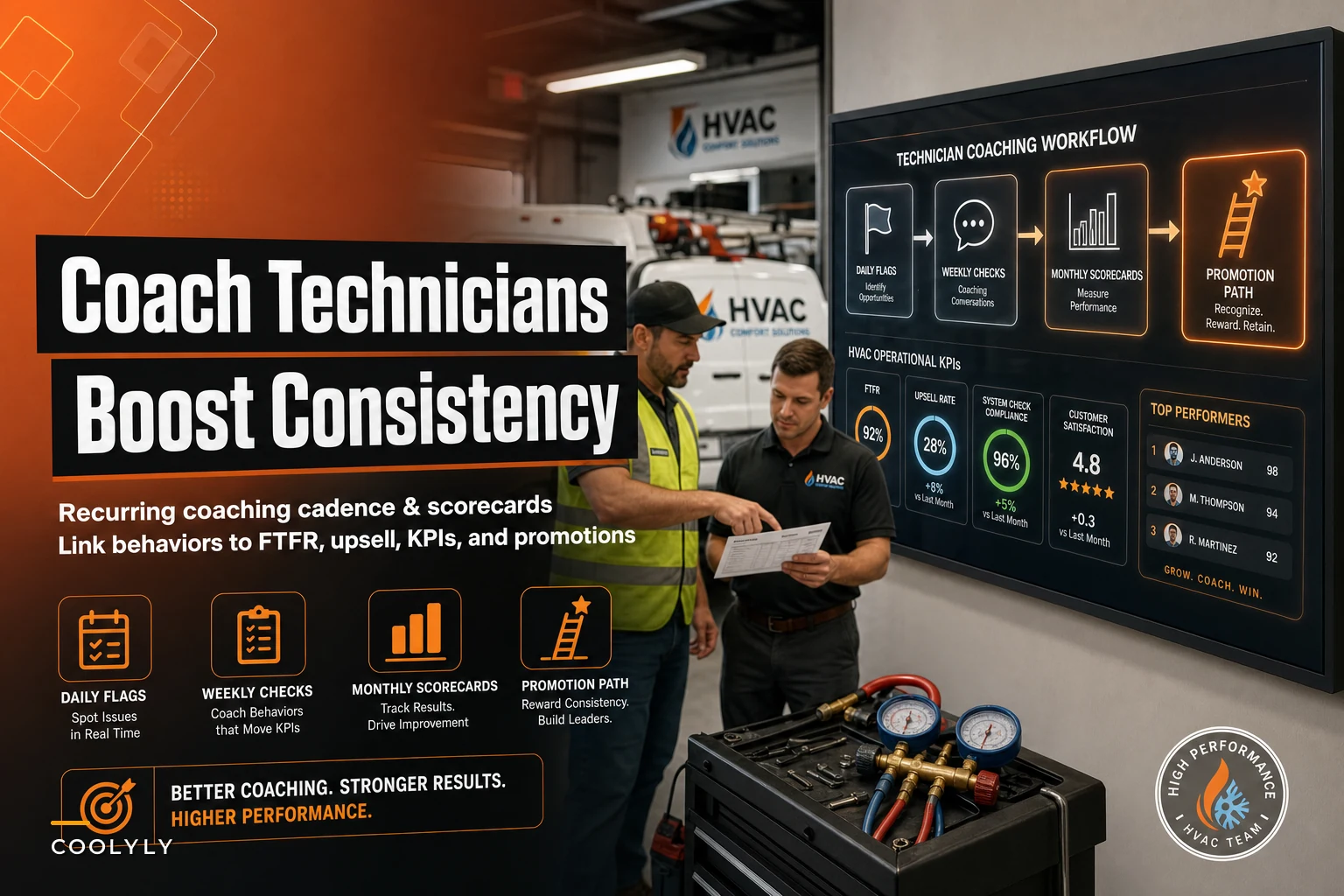
That gap is what this article is about. A real technician coaching program isn't motivational talks or annual reviews. It's a repeatable loop where a specific KPI points at a specific behavior, the behavior gets coached, and the next scorecard shows whether it moved. When that loop runs consistently, average techs become reliable, and reliable techs are why your margins hold.
Why "your numbers are down" never fixes anything
The mistake almost everyone makes when reviewing techs against KPIs: they coach the outcome instead of the behavior.
First-time fix rate (FTFR) is an outcome. Telling a tech "get your FTFR up" is like telling a pitcher to give up fewer runs. True, useless. FTFR is the result of a dozen behaviors — did they confirm the symptom with the customer, check likely parts on the truck before rolling, test the repair under load before leaving, document model and serial so the next visit isn't blind.
When you coach the outcome, the tech has no idea what to change tomorrow morning. When you coach the behavior, they do.
A common scenario: a tech's FTFR is sitting around 74% while your team average is 86%. You could hammer him on the number. Or you pull the five callback jobs and notice four of them were "no cooling" calls where he replaced a capacitor and left — real issue being a failing compressor drawing high amps. The behavior is obvious once you look. He's not amp-testing the compressor on no-cooling calls. That's coachable in one ride-along. The number alone wasn't.
Every KPI on your scorecard needs to trace back to one or two observable behaviors you can actually watch, describe, and correct.
Mapping the KPIs to behaviors that drive them
Before you write a single coaching template, you need the map. Most shops skip this step, which is why their reviews feel vague. Below is the mapping that holds up in practice — left column is the number, right column is what the tech is actually doing (or not doing) to produce it.
Eliminate scheduling chaos and missed jobs.
Coolyly helps HVAC companies book, coordinate, and track every service efficiently.
- Unified appointment & dispatch management
- Automated client notifications
- Technician scheduling & job tracking
No credit card required
| KPI | Behaviors that actually move it |
|---|---|
| First-Time Fix Rate (FTFR) | Confirming the reported symptom before diagnosing; full system test under load; amp/pressure readings logged; checking truck stock against likely parts before arrival |
| Upsell / Add-on Conversion | Presenting findings with photos; offering good/better/best instead of one price; explaining the why (safety, efficiency, failure risk) not just the part; not pre-judging what the customer can afford |
| Callback Rate | Testing the repair after completion; cleaning up and confirming operation with the customer; documenting model/serial and work done |
| Average Ticket | Completing a full system inspection, not just the presenting problem; flagging maintenance opportunities |
| On-Site Efficiency (time per job) | Pre-staging parts; using diagnostic sequence instead of guessing; not over-explaining or under-explaining to customers |
Notice something about upsell conversion. The behavior that moves it most isn't "sell harder." It's presenting findings with photos and offering actual options. Techs who show a customer a photo of a rusted heat exchanger convert two to three times better than techs who describe it verbally. That's not a personality trait — it's a documentable behavior you can train into anyone. If you've already built systems around turning job data into revenue, this connects directly to the workflows in turning completed-job data into upsell and retrofit opportunities.
A sample technician scorecard that people will actually use
Scorecards with 22 metrics fail. Nobody coaches to 22 metrics. Pick four to six, weight them, leave room for a note.
-
FTFR — target 85%+ | weight 30%
-
Callback rate — target under 5% | weight 25%
-
Upsell conversion — target 25–35% of eligible jobs | weight 20%
-
Average ticket — trailing 90-day comparison | weight 15%
-
Documentation completeness — model/serial/photos captured | weight 10%
Then, and this part matters, one free-text line: "One thing we're working on this month."
That line is what turns a scorecard from a report card into a coaching tool. Without it, you have data. With it, you have a plan. The tech should be able to recite their one thing without looking. If they can't, the review didn't land.
On documentation getting 10% weight even though it's not glamorous — incomplete documentation quietly wrecks FTFR on the next visit and makes callback data unreliable. Techs who skip it aren't just being sloppy; they're taxing the whole team's numbers. Putting it on the scorecard fixes it faster than any lecture will.
Setting the feedback cadence so it actually sticks
The annual review is where technician development goes to die. By December, the behaviors you'd want to correct happened in March and nobody remembers them clearly.
-
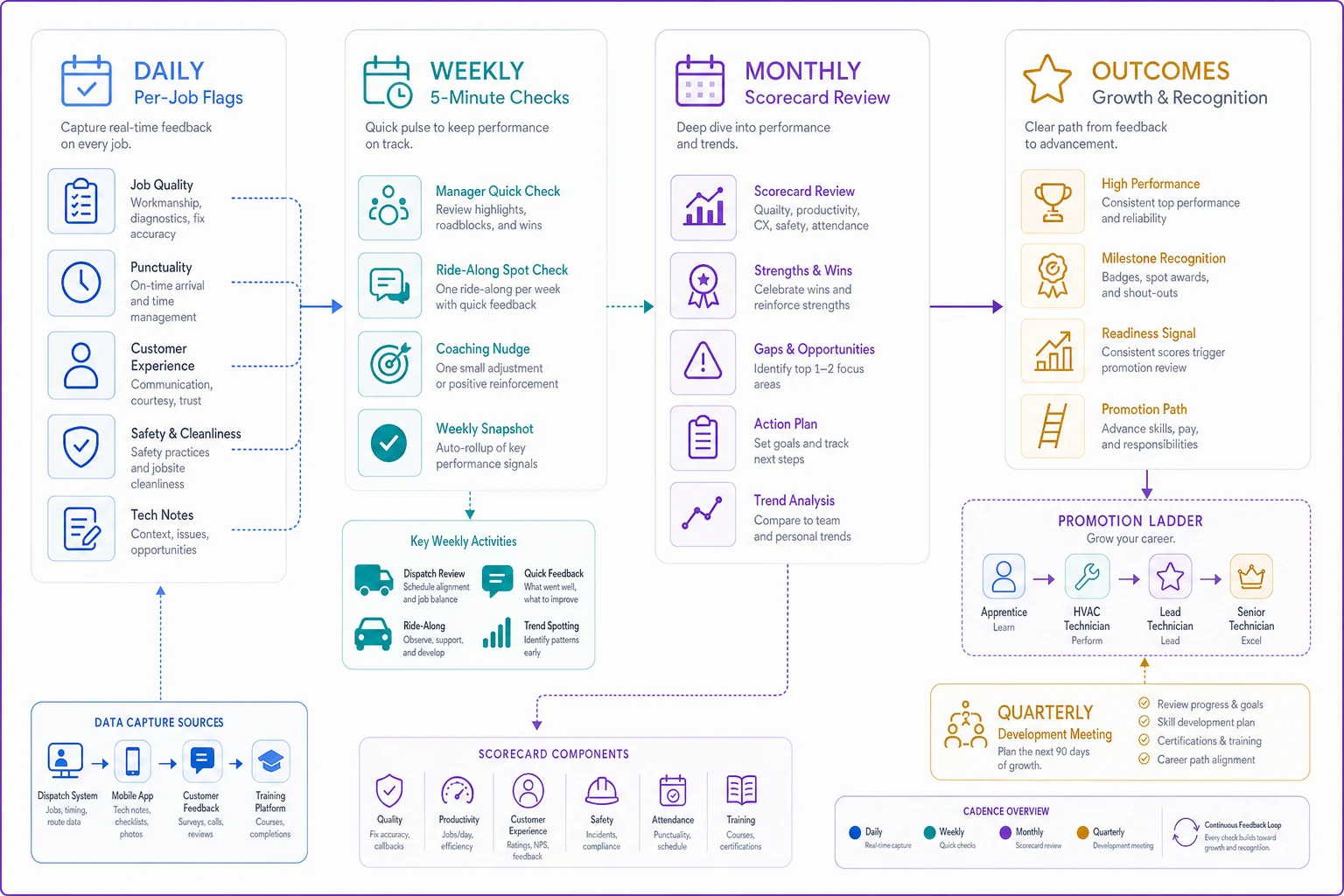
Daily / per-job (informal) dispatch or a lead notices a callback, flags it same-day. No formal meeting, just "hey, that Miller job came back, let's look at it before you head out." Fast, low-stakes, high-frequency.
-
Weekly (5-minute check) lead tech or manager glances at running numbers and has a two-minute conversation with anyone trending the wrong direction. Catches drift before it becomes a pattern.
-
Monthly (formal scorecard review) 20–30 minutes, one-on-one, walk the scorecard, agree on the "one thing," ride-along if needed.
-
Quarterly (development / promotion track) the bigger conversation — is this tech ready for more responsibility, what's the path, what pay tier are they tracking toward.
The monthly review is only as good as the weekly touchpoints feeding it. If a tech is blindsided by anything on their monthly scorecard, the cadence is broken. Monthly should be a summary of conversations already had, not a surprise reveal.
One pattern worth watching — when weekly check-ins get skipped during a busy stretch, monthly reviews get tense and defensive because now they're the only feedback the tech has gotten. Protect the small weekly touches even when you're slammed. Especially then.
Protect the small weekly touches even when you're slammed.
Especially then.
Turning scorecards into a promotion ladder
A coaching program without a destination burns people out. Techs will grind on their FTFR for a while, but if hitting targets doesn't lead anywhere visible, motivation flattens. This is where you tie the scorecard to a clear promotion ladder — so improving the numbers actually means something.
The point isn't the exact tiers below. It's that the criteria are the same KPIs you're already coaching, so there are no surprises about what "getting to the next level" actually requires.
-
Tech I → Tech II FTFR consistently 80%+ for 3 months, callback rate under 8%, documentation complete on 90%+ of jobs
-
Tech II → Senior Tech FTFR 88%+, callback under 4%, upsell conversion at or above team average, capable of running complex diagnostics unassisted
-
Senior Tech → Lead / Trainer all of the above sustained for two quarters, plus demonstrated ability to coach a junior tech — measured by that junior's improvement
That last one is underused. When you promote based on the ability to improve someone else's numbers, you build a coaching culture that scales without you in every conversation. Your best techs stop being just producers and start being multipliers. If you're thinking about how KPI gates fit into broader staffing decisions as you grow, this connects to the framework in scaling HVAC field operations without chaos.
Where the manual version breaks down
You can run all of this on a spreadsheet, and plenty of solid shops do at the start. There's a predictable point where it strains, though.
The friction is in data-gathering, not the coaching itself. To review a tech monthly, someone has to pull their jobs, count callbacks, calculate FTFR, cross-check upsell opportunities against what was actually presented — for every tech, every month. In an eight-tech shop, that's an afternoon of manager time, and it's the first thing that gets dropped when things get busy. When the prep disappears, the reviews disappear, and the whole loop dies.
The honest case for AI-powered operational software here isn't that it coaches for you. It's that it pulls scorecard data automatically from jobs already moving through dispatch and invoicing. When FTFR, callbacks, and upsell conversion populate on their own, the monthly review takes fifteen minutes of actual conversation instead of two hours of assembly. Platforms with built-in AI automation can also flag drift early — surfacing something like "this tech's callback rate moved up six points this week" before you'd have caught it manually — so the weekly touchpoint actually happens instead of staying an intention.
The tool doesn't replace the ride-along or the conversation. It removes the reason people stop having them.
When this system makes sense — and when it doesn't
This makes sense when you have five or more techs and enough job volume that patterns represent real signal, not noise. Below a certain volume, one bad week skews everything and your trends are just randomness.
This is a bad idea when you try rolling out all six KPIs, weekly checks, monthly reviews, and a promotion ladder in the same month. It'll feel like surveillance, techs will resent it, and you'll abandon it. Start with two KPIs — FTFR and callback rate are the usual pair — get the cadence working, then layer in upsell and the promotion ladder once the loop is trusted.
Who should not do this: shops with a broken dispatch or documentation baseline. If your job data is unreliable — missing model numbers, inconsistent callback tagging, no clean record of what a tech presented — your scorecards will be garbage, and garbage scorecards destroy trust faster than no scorecards at all. Fix the data hygiene first. Coaching on bad numbers is worse than not coaching.
Real scenario: a mid-size residential shop
A residential service company running about nine techs and somewhere around 340–360 jobs a month had a familiar spread: three strong techs, four solid, and two quietly dragging the averages. Team FTFR sat around 81%, and those two weaker techs were closer to 70%, generating most of the callbacks.
They started narrow — FTFR and callback rate only, weekly two-minute check-ins, and a monthly one-on-one built around a single "one thing." The two weaker techs turned out to have completely different issues. One was rushing no-cooling calls and skipping the compressor amp check. The other documented poorly, which made his repeat visits blind and inflated his callbacks. Two different behaviors, two different fixes.
Over roughly four months, team FTFR moved from the low 80s into the high 80s. Callbacks dropped enough to claw back a meaningful chunk of unbillable return-trip time — the kind of thing that quietly adds up to a few thousand dollars a month once you count truck time and lost first-visit capacity. Neither weak tech got fired. Both just needed someone to name the one specific behavior, on a schedule, with a number they could watch move.
Most underperforming techs aren't bad techs. They're techs nobody ever pointed at the right behavior, consistently, with a scorecard that made the drift visible before it became a habit.
Bringing it together
A technician coaching program works when three things line up: the KPIs on your scorecard trace back to observable behaviors, the feedback runs on a cadence fast enough to catch drift, and the whole thing points toward a promotion ladder people actually want to climb. Miss any one of those and you're back to "your numbers are down" conversations that change nothing.
Start smaller than feels right. Two KPIs, weekly two-minute checks, one monthly conversation. Get the loop turning cleanly before adding weight to it. Once techs trust that the scorecard reflects real behavior and leads somewhere real, coaching stops feeling like criticism and starts feeling like the path forward.
That shift — from criticism to direction — is exactly when average performers turn into the consistent ones your business actually runs on.
A technician coaching program works when three things line up: the KPIs on your scorecard trace back to observable behaviors, the feedback runs on a cadence fast enough to catch drift, and the whole thing points toward a promotion ladder people actually want to climb. Miss any one of those and you're back to "your numbers are down" conversations that change nothing.
Start smaller than feels right. Two KPIs, weekly two-minute checks, one monthly conversation. Get the loop turning cleanly before adding weight to it. Once techs trust that the scorecard reflects real behavior and leads somewhere real, coaching stops feeling like criticism and starts feeling like the path forward.
Ready to optimize your HVAC operations?
Join hundreds of HVAC businesses using Coolyly to save time, improve technician utilization, and enhance customer satisfaction.