

Most HVAC companies wake up one day and realize they're sitting on a mountain of data they never planned to collect. Thermostats reporting runtime every 15 minutes. Rooftop units pushing pressure and amperage readings. Vans broadcasting GPS pings every few seconds. Techs snapping photos of equipment nameplates, panels, and customer property. None of this was a decision. It just accumulated.
That's exactly where the trouble starts. When telemetry piles up without any governance behind it, you end up with data you legally can't explain, can't secure, and can't produce when a customer, a commercial client's legal team, or an insurer asks about it. Nobody wants to own this layer of the business until something goes wrong.
This is a playbook for the boring-but-critical part: how data gets classified, who consented to what, how it moves and stays encrypted, and how you keep evidence that holds up when someone challenges you. Not theory — the actual operational plumbing.
Why telemetry governance breaks in the first place
The core problem isn't malicious. It's that HVAC telemetry grows sideways. You add a remote diagnostics offering. Then a fleet tracking tool. Then a new dispatch platform that stores photos. Each system was adopted to solve one problem, and each one quietly became a place where sensitive data lives.
A typical mid-size residential shop runs fleet GPS through one vendor, thermostat data through a manufacturer portal, customer records in the CRM, and job photos inside a field app. Four systems, four data stores, four different retention policies — or none — and zero clarity on who can access what. When a customer emails asking what data you have on their house and whether you can delete it, nobody actually knows the full answer.
At small scale this is survivable because volume is low and everyone knows everyone. Governance failures don't show up until you cross a threshold — usually when you land your first real commercial account with a procurement team, or when you have enough technicians that "we trust everyone here" stops being a control.
The failure points cluster in a few predictable spots:
-
GPS data that tracks technicians during and outside work hours, with no policy on personal-time tracking
-
Customer premise data — equipment, home layout from photos, access codes — stored indefinitely with broad internal access
-
Telemetry feeds flowing in plaintext between a sensor gateway and your cloud
-
No record of what a customer actually agreed to when they signed up for monitoring
-
Photos and notes in a mobile app that syncs to personal devices and stays there
Each of these is manageable alone. Together they form a liability surface that grows every quarter you ignore it.
Start with data classification, because everything else depends on it
You cannot secure, route, or delete data you haven't sorted. Classification sounds bureaucratic, but in practice it's just deciding — once — which buckets your data falls into and what rules apply to each. Everything downstream (encryption, retention, access, consent) hangs off this.
Eliminate scheduling chaos and missed jobs.
Coolyly helps HVAC companies book, coordinate, and track every service efficiently.
- Unified appointment & dispatch management
- Automated client notifications
- Technician scheduling & job tracking
No credit card required
For an HVAC operation, four tiers usually cover it:
| Classification | Examples | Handling rule |
|---|---|---|
| Operational telemetry | Runtime hours, pressures, amperage, error codes | Low sensitivity, but tied to a customer premise — treat as identifiable |
| Location data | Van GPS, tech geolocation, arrival/departure stamps | Sensitive; restrict access, define off-hours policy |
| Customer premise data | Equipment photos, panel images, home layout, gate/alarm codes | High sensitivity; encrypt, limit access, short retention on codes |
| Personal / account data | Names, addresses, payment info, contracts | Highest; strict access controls and audit logging |
The thing most owners miss: operational telemetry isn't as anonymous as it feels. A stream of runtime and error codes might seem harmless, but once it's linked to an address it reveals occupancy patterns — when someone's home, when the house is empty, when they went on vacation. A commercial client's building telemetry can reveal shift patterns and headcount. That's why runtime data gets treated as identifiable, not "just numbers."
Once you've got tiers, everything else becomes concrete. "Encrypt sensitive data" is vague. "Encrypt Tier 3 and 4 at rest and in transit, restrict Tier 2 access to dispatch and management" is something you can actually implement and audit.
Treat runtime logs as identifiable when they're linked to an address — classify them as at least Tier 1 operational telemetry.
Once you've got tiers, everything else becomes concrete. "Encrypt sensitive data" is vague. "Encrypt Tier 3 and 4 at rest and in transit, restrict Tier 2 access to dispatch and management" is something you can actually implement and audit.
Consent and GPS clauses: the two documents most shops get wrong
There are two consent surfaces in an HVAC business and they're completely different animals. Confusing them is where companies get into trouble.
Customer consent covers what you collect from their equipment and property. If you're selling remote monitoring or pulling telemetry from a connected thermostat, the customer needs to have agreed to it in a way you can prove later. Not buried in a work order they signed for a repair — a clear, separate acknowledgment tied to the monitoring service. This matters especially for commercial accounts, where the building owner and the tenant may have different rights over the same data.
-
What data you collect (runtime, faults, sensor readings — name the categories)
-
Why you collect it (diagnostics, preventive maintenance, SLA reporting)
-
How long you keep it
-
Who it's shared with (the manufacturer? a third-party analytics tool?)
-
How they can request deletion or a copy
The mistake that keeps coming up: shops that started a remote diagnostics program and never went back to formalize consent, so they're now monitoring hundreds of homes on the strength of a verbal "sure, sounds good." If you've built a paid sensor service, this paperwork has to sit underneath it.
Employee GPS consent is the second surface, and it's arguably higher-risk because it involves labor law, not just customer expectations. Tracking a van is generally defensible. Tracking a technician's personal phone, or tracking their location after hours, is a different question — and in several states it's a legal one.
-
What's tracked
the vehicle, the company device, or both
-
When
during working hours only, or continuously
-
Why
dispatch, routing, safety, timekeeping
-
What it's not used for
surveillance of personal errands, off-clock movement
-
Retention
how long location history is kept before it's purged
Worth flagging: companies that track continuously "just in case" almost never use the off-hours data, but they carry all the liability of having it. Turning off tracking when the tech clocks out isn't just cleaner ethically — it shrinks the data you have to protect and eventually explain.
Routing and encryption: how the data actually moves
This is the part that gets hand-waved because it feels like an IT problem. But routing decisions are operational decisions — they determine who can see what and where data could leak.
Telemetry flows through three legs, and each leg needs its own protection:
-
Sensor to gateway — the reading leaving the equipment. Often the weakest link, especially with older gateways or cellular modems that default to unencrypted transmission.
-
Gateway to cloud — data moving from the site to your platform or the manufacturer's. This should be encrypted in transit (TLS), no exceptions.
-
Cloud to your systems — telemetry landing in your dispatch, CRM, or analytics tools via integrations and APIs.
The third leg is where HVAC companies quietly create the most exposure, because that's where data gets copied into multiple systems. Every integration that pulls telemetry into another tool is another place the data now lives and another store you're responsible for. It's the same sprawl problem that turns into full-blown integration chaos across sensors, CRM, inventory and dispatch — governance and architecture are two sides of the same coin.
A workable routing standard for most shops:
-
All telemetry encrypted in transit and at rest — check that your gateway vendor actually does this, don't assume
-
Access to raw telemetry limited by role
dispatch sees location and status, techs see their assigned jobs, management and admin see the full customer record
-
No sensitive data (premise photos, access codes) syncing to personal devices — enforce this in your mobile app settings, not with a policy nobody reads
-
API connections between systems using scoped keys, so a compromised integration exposes one data type, not everything
Encryption is usually the easy part. The hard part is access scoping — making sure that just because data flows into a system, not everyone in that system can see it. A dispatcher doesn't need to see a customer's alarm code. A new tech doesn't need history on every home in the territory.
Audit-ready evidence: the workflow that saves you later
When a dispute happens — a damaged-property claim, a commercial SLA challenge, a wrongful-something complaint, a data request — you don't get to reconstruct evidence after the fact. You have what you captured, timestamped and untampered, or you have nothing.
This connects directly to how you handle physical incidents. The same discipline behind an audit-ready field safety and incident-management framework applies to data: the goal is a clean, chronological, defensible record that exists before anyone asks for it.
For telemetry and mobile data, audit-readiness means a few specific things are always true:
-
Every telemetry alert has a timestamp, a source, and a record of what was done about it
-
Photos carry metadata (time, and ideally location) and can't be silently edited or deleted
-
Consent records are stored and retrievable by customer — you can pull what this customer agreed to and when
-
Access to sensitive data is logged, so you can show who looked at a customer record and when
-
Deletion requests are executed and recorded — proof the data was actually removed
A simple evidence workflow that holds up:
-
Capture — telemetry, photo, or note is created and stamped at the source
-
Classify — it lands in the right tier automatically (a premise photo isn't treated like a runtime log)
-
Store — encrypted, with retention rules attached to the classification
-
Log access — every view or export of sensitive tiers is recorded
-
Retain or purge — data is kept for its defined window, then deleted on schedule, with the deletion logged
The pattern that fails: evidence scattered across a tech's phone, three apps, and someone's email. When you actually need it, half is gone and the other half can't be trusted because there's no chain of custody. Centralizing capture and logging isn't about being fancy — it's about being able to answer questions confidently a year later.
Here's a compact workflow diagram to keep on hand when you map your processes.
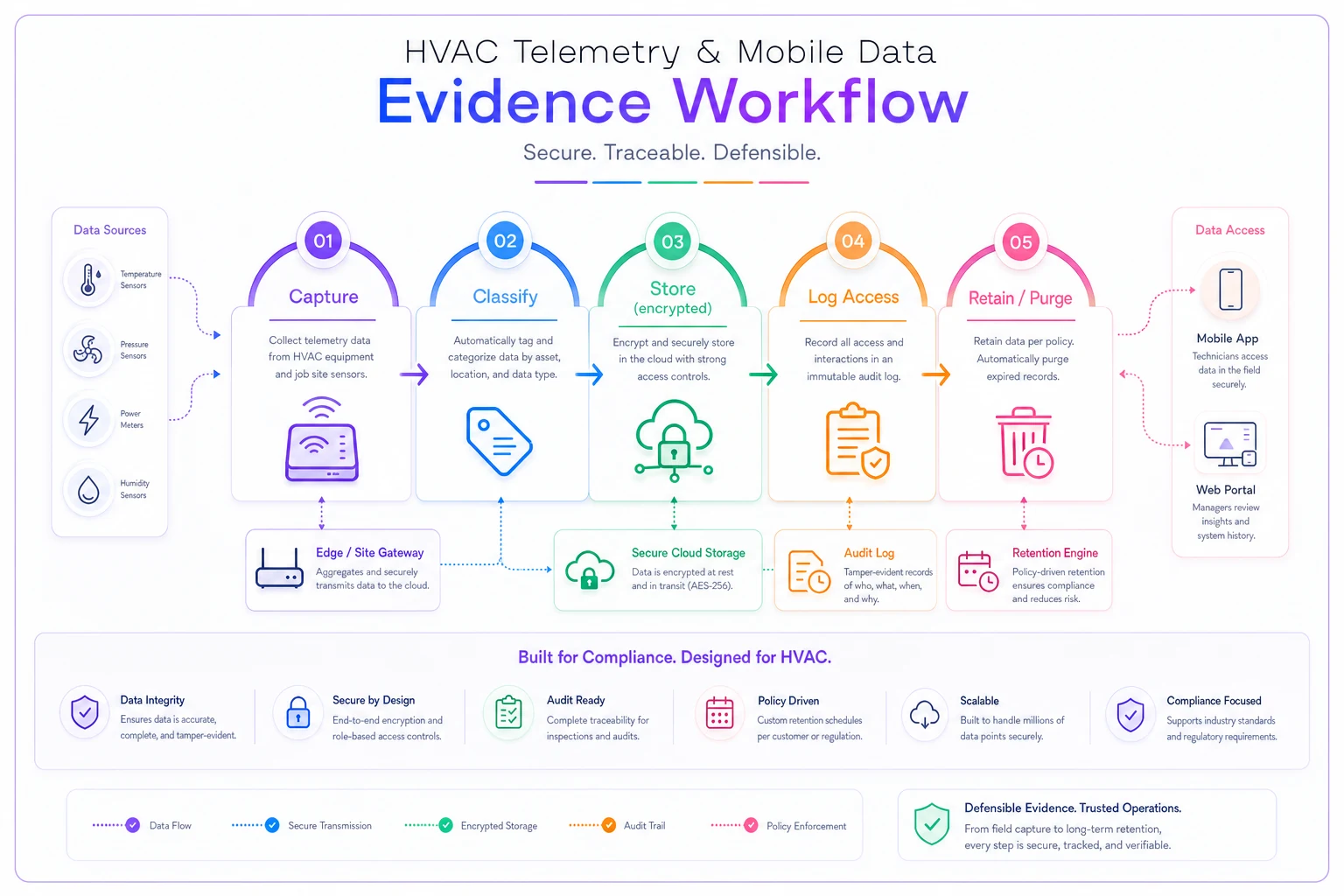
Centralizing capture and logging isn't about being fancy — it's about being able to answer questions confidently a year later.
A real scenario
A commercial-focused HVAC contractor with around 18 techs rolled out remote monitoring on roughly 60 rooftop units across a handful of retail and office clients. Good revenue, real value. But the data was flowing through the manufacturer's portal, mirrored into a spreadsheet tracker, and referenced in emails — with no consent language in the service agreements and no retention policy anywhere.
The wake-up came during a lease dispute at one client's building. The property manager's attorney requested all data the contractor held on the building, including who had accessed it. The contractor couldn't produce a clean answer. It took close to a week to piece together where the data lived, and there was no access log at all. No lawsuit came of it, but the client didn't renew — they cited "data handling concerns."
After that, the contractor did the unglamorous work: classified their data into tiers, added a monitoring consent clause to commercial agreements, consolidated telemetry into one governed system with role-based access, and set retention windows with logged deletion. The cost was modest — some legal review and a few weeks of cleanup. The payoff showed up the next time a procurement team sent over a vendor security questionnaire and they could actually answer it. They won an account partly because they could. Data governance quietly became a sales advantage instead of a hidden risk.
When this level of governance actually makes sense
Not every shop needs a formal program on day one.
This makes sense when:
-
You're selling remote monitoring or telemetry-based services
-
You have commercial clients with procurement or legal review
-
You've crossed roughly a dozen techs and trust-based controls no longer scale
-
You're tracking employee location and want to stay clean on labor law
-
You're carrying customer premise data — access codes, alarm info — at any real volume
This is overkill when:
-
You're a two-truck residential shop with no connected devices and no GPS
-
You collect nothing beyond names, addresses, and job notes in one system
-
You have no commercial accounts and no monitoring offering
Who should not rush this: a shop mid-transition on their core systems. If your dispatch and CRM are in flux, layering governance on top of tools you're about to replace just means redoing it. Stabilize the platform first, then build governance into the version that's staying.
Where software quietly does the heavy lifting
Governance sounds like binders and policies, but in practice it either lives inside your operational systems or it doesn't happen at all. Policies nobody can enforce are decoration.
The realistic version is that classification, access scoping, encryption, consent records, and access logging are baked into the platforms your team already uses every day — so the right handling happens by default, not by remembering. A field app that keeps premise photos off personal devices. A system that stamps and logs telemetry automatically. Consent records tied to the customer record instead of buried in an email folder. When your operational software carries this weight, governance stops being a project you dread and becomes a byproduct of working normally. AI-assisted platforms can also flag the obvious gaps — a monitored account with no consent on file, a data store with no retention rule — before they become the thing an attorney asks about.
That's the whole point of an HVAC telemetry security playbook: not to bury the business in compliance, but to make the safe way the default way, so the data you collect works for you instead of sitting there as a risk you forgot you were carrying.
Closing thought
Telemetry is only going to grow — more connected equipment, more sensors, more location data, more mobile capture. Shops that treat governance as an afterthought will keep accumulating exposure until something forces the reckoning. The ones that sort their data, formalize consent, lock down how it moves, and keep clean evidence will find that the same discipline protects them and wins them work. Sort the data first. The rest follows.
Ready to optimize your HVAC operations?
Join hundreds of HVAC businesses using Coolyly to save time, improve technician utilization, and enhance customer satisfaction.