


A 40-ton rooftop replacement on a mid-size retail building looks like a clean win on paper. You've got the equipment, the crew, the crane booked, the GC happy. Then the inspector shows up, asks for the mechanical permit's final sign-off, the gas line pressure test documentation, and the condensate drainage detail that matches the approved plans — and three of those things are either missing, in someone's truck, or were never pulled in the first place.
Now you're looking at a re-inspection fee, a crew standing around, a crane you're paying for again next week, and a property manager who's deciding whether to hold your final payment.
That's the real shape of commercial installation compliance HVAC risk. It's almost never a technical failure. The equipment works fine. The problem is that the paperwork, the permit status, and the field evidence all live in different places, owned by different people, and nobody confirmed they lined up before the truck rolled.
This article stays narrow on purpose. We're not covering estimating, scheduling, or site access here — some of that is handled in the commercial HVAC scheduling SOPs around site access, credentialing and pre-visit validation. What we're digging into is the handoff chain between permit pulled, work performed, and inspection passed — and the evidence pack that keeps all three honest.
Where commercial installs actually fall apart
The failure isn't dramatic. It's a slow accumulation of small gaps that nobody owns.
A typical breakdown looks like this: sales closes the job, the project coordinator pulls the permit — or thinks they did, but the jurisdiction kicked it back for a missing load calc and the email went to a shared inbox nobody checks daily. The install crew does excellent work. The lead tech takes a few photos because he always does, but there's no standard for what to photograph. The job gets marked complete. Two weeks later someone schedules the inspection, the inspector finds the permit was never finalized, and the whole thing unravels.
-
Permit status is assumed, not verified. Somebody "pulled the permit" becomes gospel even when the application is still sitting in review or got rejected.
-
Nobody owns the handoff. The coordinator thinks the field confirms compliance. The field thinks the office handles permits. The gap between them is where failed inspections live.
-
Evidence is captured randomly. Photos exist, but not the right photos. Pressure test readings are in a text thread. The approved plan set is a PDF on someone's laptop.
The insight most owners miss: on commercial work, the inspection isn't the moment compliance is tested. It's the moment compliance is revealed. Everything was already decided weeks earlier based on whether a reliable handoff system existed.
The real cost, and why it's bigger than the re-inspection fee
The re-inspection fee is the smallest number in the whole mess. Usually a couple hundred dollars. What actually hurts shows up in everything surrounding it.
Eliminate scheduling chaos and missed jobs.
Coolyly helps HVAC companies book, coordinate, and track every service efficiently.
- Unified appointment & dispatch management
- Automated client notifications
- Technician scheduling & job tracking
No credit card required
Consider a single failed final inspection on a rooftop unit swap for a grocery chain:
| Cost driver | Rough impact |
|---|---|
| Re-inspection fee | $150–$350 |
| Crane / lift re-mobilization | $1,200–$2,500 |
| Crew return trip (2 techs, half day) | $600–$900 |
| Delayed final payment (cash flow hit) | 30–45 days on a $40k+ invoice |
| GC confidence damage | Hard to price, easy to lose |
A "small" compliance miss on one job quietly turns into $2,000–$3,500 of direct rework plus a month-plus of delayed revenue. Run that across eight or ten commercial installs a year with a 20–25% inspection failure rate, and you're bleeding real money — often $15k–$25k annually — on something that's entirely preventable with process, not skill.
The chargeback angle is worse than the rework. On accounts with strict GCs or national property managers, a failed inspection can trigger a backcharge for their delayed turnover — tenant occupancy pushed, other trades idled. That's where a single bad install can threaten the whole relationship. We've gone deeper on protecting those accounts in the enterprise HVAC account-management and escalation blueprint, but the short version is: GCs forgive a lot, but repeated compliance misses read as "this contractor can't be trusted on the next building."
The pre-visit validation checklist that actually prevents failures
Most checklists fail because they're generic and get rubber-stamped. A useful pre-visit validation for commercial installs is specific, verifiable, and blocks the job from dispatching if items aren't green.
Here's what actually catches problems before a crew mobilizes:
-
Permit confirmed issued — not applied, not submitted. You have the permit number in hand and a copy on file.
-
Approved plan set matches scope — the stamped drawings reflect the actual equipment being installed, not a prior revision.
-
Required special inspections identified — welding, structural attachment, fire/life-safety ties, if applicable.
-
Jurisdiction-specific requirements noted — some AHJs want a pre-pour or pre-cover inspection before you close anything up.
-
Gas, electrical, and structural sign-off dependencies mapped — do you need another trade's inspection to pass before yours?
-
Who pulls the inspection, and the lead time — some jurisdictions need 48–72 hours' notice. Booking it the morning of is a guaranteed miss.
-
Evidence capture requirements communicated to the crew — the lead tech knows exactly what photos and readings are mandatory before the job closes.
Gate dispatch on a confirmed permit number.
The non-negotiable rule: if the permit isn't confirmed issued, the install doesn't get on the dispatch board. Not "probably issued." Not "the city said it's close." Issued, with a number. This single gate prevents the most common and most expensive failure mode in commercial HVAC.
The permit-tracking handoff that eliminates the "I thought you had it" gap
The handoff is where most of the damage happens, so it deserves its own clear workflow rather than getting buried in a general process doc.
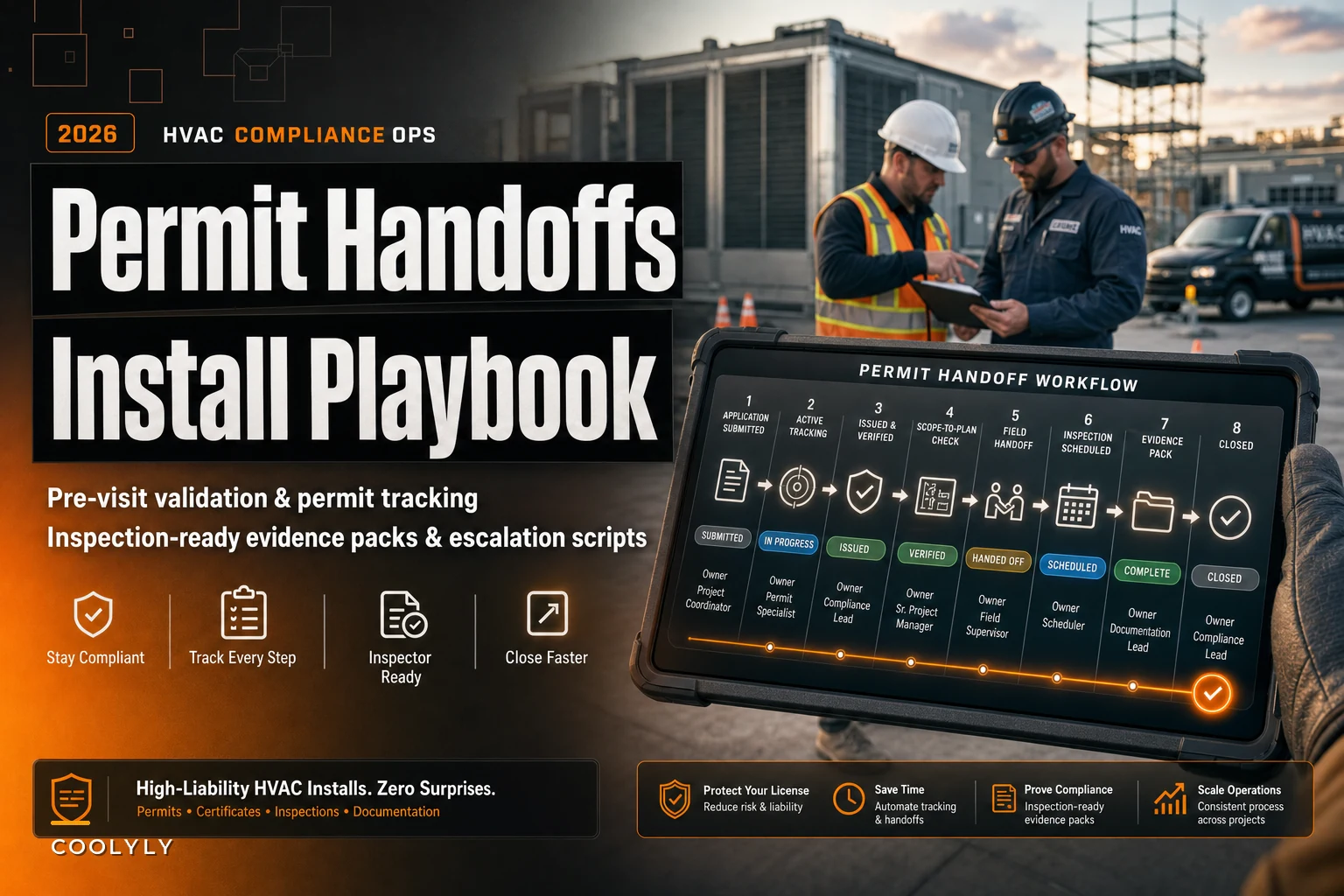
Permit Application Submitted ↓ Active Status Tracking (per-jurisdiction schedule) ↓ Permit Issued & Verified → Copy Filed to Job ↓ Scope-to-Plan Check (before dispatch) ↓ Field Handoff Briefing (permit + plans + evidence requirements) ↓ Inspection Scheduled (against jurisdiction lead time) ↓ Evidence Pack Assembled During Work ↓ Job Closed — Compliance Confirmed
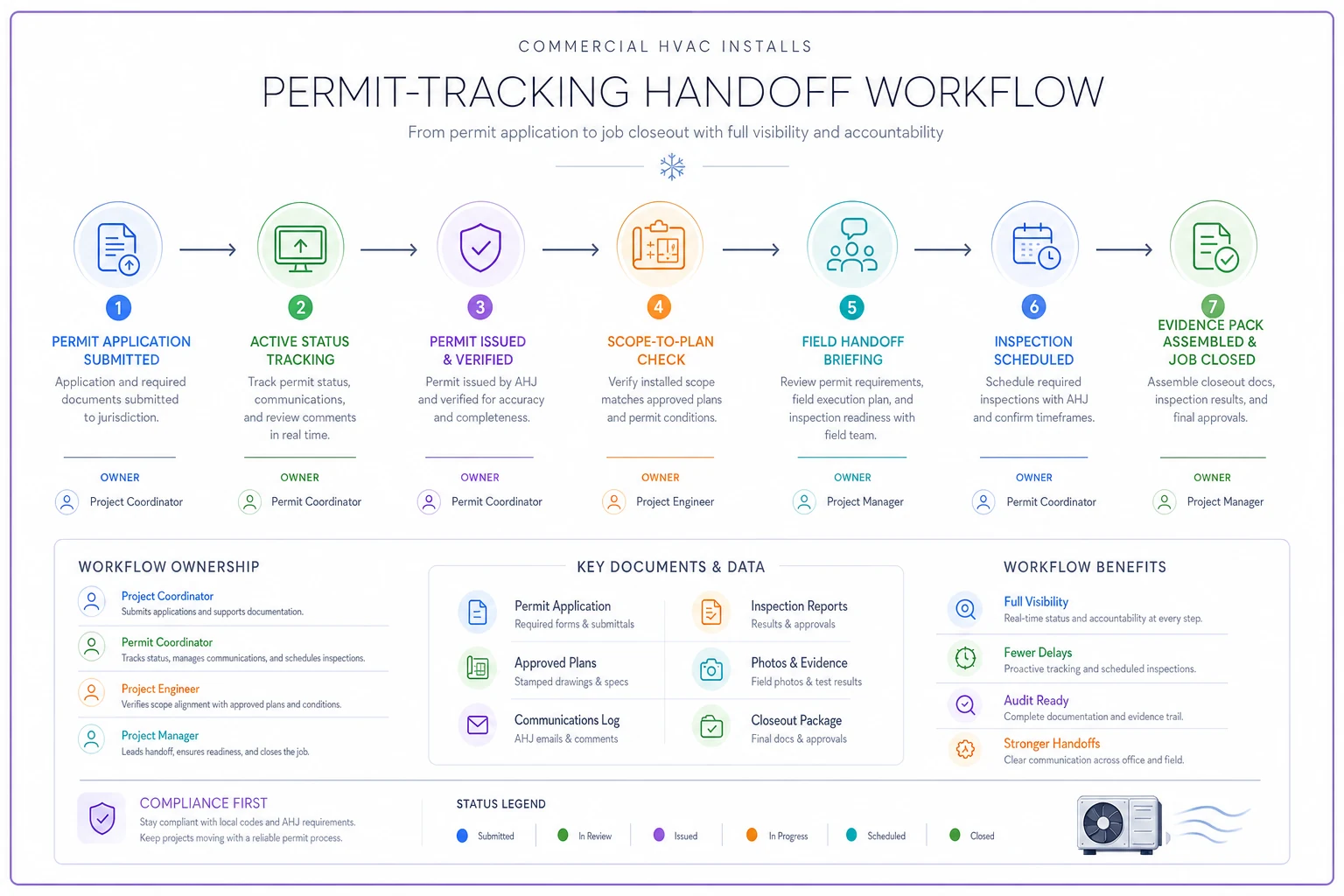
The flow above maps each handoff step to an owner and a verifiable output.
Each step needs one named owner and one verifiable output. The reason handoffs fail is diffusion of responsibility. "The office" and "the field" are not owners. A specific person with a specific confirmation step is.
This is also where a decent operational platform earns its keep — not because software is magic, but because it refuses to let a job advance to dispatch while the permit status is still blank. When the handoff gates are enforced by the system instead of by someone remembering to check, the "I thought you had it" conversation stops happening. A bit of automation watching permit-status fields and flagging stalled applications removes the single most common human lapse: forgetting to follow up on an application that quietly got rejected.
Every one of these steps has a clear owner. The reason commercial handoffs break down isn't that people are careless — it's that responsibility gets shared across too many people and nothing forces the gap to surface until it's too late.
Inspector coordination: the part everyone underestimates
Getting the inspection to pass on the first visit is partly about the work and partly about how you manage the inspector relationship.
A few things that come from actually dealing with AHJs regularly:
-
Inspectors have patterns. The inspector for a given jurisdiction tends to care about the same handful of things — specific clearances, specific labeling, how condensate is routed, how the disconnect is mounted. On repeat work in the same area, your crews should know that inspector's hot buttons cold. Keeping a short, living note per jurisdiction ("Inspector focuses heavily on seismic strapping and economizer damper operation") does more for your first-pass rate than any amount of generic training.
-
Schedule against reality. If the jurisdiction needs 72 hours and inspects Tuesdays and Thursdays only, your crew completion date has to work backward from that, not from your ideal schedule. Mismatched timing is a silent killer — the work's done, the inspection sits for a week, the crew's photos are now stale, and the window to fix anything cheaply has closed.
-
Have the right person present. For complex commercial inspections, sending the apprentice to "just let the inspector in" is a bet you'll lose. The person on site should be able to answer questions, point to the evidence, and show the approved plans. An inspector who gets confident, prepared answers tends to move faster and flag less.
An inspector who gets confident, prepared answers tends to move faster and flag less.
The inspection-ready evidence pack
An evidence pack isn't a pile of photos — it's an organized record that proves the work matches the permit and the plans.
A solid commercial install evidence pack contains:
-
Permit number and the issued permit copy
-
The approved, stamped plan set actually used in the field
-
Pre-installation condition photos
-
In-progress photos of anything that gets covered (connections, straps, penetrations) — these are the ones you can't recreate later
-
Pressure test and leak test readings with timestamps
-
Electrical connection and disconnect photos
-
Equipment nameplate / serial photos confirming the installed unit matches the submittal
-
Condensate routing and clearance documentation
-
Any required special inspection reports
Why this matters beyond the inspection: when a GC or property manager raises a backcharge claim three weeks later, the evidence pack is your defense. "Here's the timestamped record showing the work was complete, compliant, and inspection-ready on this date" ends most disputes before they turn into chargebacks. Without it, you're arguing from memory against a sophisticated counterparty — and you'll lose.
The operational trick is capturing the pack during the job. Evidence reconstructed after the fact is always worse, usually incomplete, and sometimes impossible — once the drywall's up, you can't photograph the strap you forgot to shoot. Standardizing what gets captured and when, and making it part of the job-close step rather than an afterthought, is the whole game.
When this level of rigor makes sense — and when it's overkill
Not every job needs a full permit-tracking handoff and formal evidence pack. Being honest about that keeps the process credible with your crews.
When it's worth the full rigor:
-
Permitted commercial installs, especially rooftop units, new construction, and anything with gas or structural work
-
Jobs with national GCs or property managers who issue backcharges
-
Any jurisdiction with a history of kicking back your applications or failing your inspections
-
High-dollar installs where delayed final payment hurts cash flow
When it's overkill:
-
Like-for-like residential swaps that don't require permits in your area
-
Minor service work with no inspection component
-
Small repairs where the evidence capture takes longer than the job
Who should NOT skip this: any shop that's grown into larger commercial accounts without upgrading its back-office process. This is the most common trap — a company that was great at residential wins a few commercial contracts, keeps running the same informal "we'll handle the paperwork" approach, and gets hammered on the first few inspections because the stakes and the complexity both jumped at once.
A realistic before-and-after
A regional mechanical contractor doing roughly 30–35 permitted commercial installs a year was failing first-pass inspection on about a quarter of them. The causes were boringly consistent: permits assumed-issued but actually stalled, missing in-progress photos, and inspections scheduled with too little lead time.
They didn't hire anyone new. They built a hard dispatch gate — no permit number, no dispatch — and a standard evidence-capture step the install lead had to complete before marking a job closed. Jurisdiction notes went into a shared, living document.
Over the following couple of quarters, first-pass inspection rate climbed to around 90%. The re-mobilizations that used to eat $2k–$3k a pop mostly disappeared. The quieter win was with two GC relationships that had been cooling — fewer compliance headaches meant they started getting invited to bid the next buildings instead of getting phased out.
The numbers mattered, but the real shift was cultural: compliance stopped being something that got "handled" and became a checkpoint the job couldn't skip.
The bottom line
Failed commercial inspections aren't a craftsmanship problem. The crews usually did fine work. They're a handoff problem — permit status assumed instead of verified, evidence captured randomly instead of deliberately, inspections scheduled against hope instead of the jurisdiction's actual calendar.
Fix the chain, not the symptoms. Gate dispatch on a confirmed permit number. Give every step one named owner and one verifiable output. Capture the evidence pack while the work is happening, not after. Treat the inspector relationship as something you manage, not something you encounter.
Do that, and the inspection stops being the moment you find out whether you're compliant — because you already knew you were before the crane left the yard.
Do that, and the inspection stops being the moment you find out whether you're compliant — because you already knew you were before the crane left the yard.
Ready to optimize your HVAC operations?
Join hundreds of HVAC businesses using Coolyly to save time, improve technician utilization, and enhance customer satisfaction.