


Most HVAC shops price by zip code intuition. "The north side pays more, so charge more up there." That's not pricing — that's a guess dressed up as a policy. The real issue is that two jobs with identical ticket sizes can have wildly different margins depending on where the truck had to go, how full the day was, and what the tech cost you that hour. Territory pricing done right isn't about charging rich neighborhoods more. It's about making sure every zone carries its own cost-to-serve instead of getting quietly subsidized by your dense, easy routes.
This post is a working template. You'll end up with inputs you can pull from your own data — drive-time, fill-rate, labor cost — a set of modifier bands you can apply per territory, scripts your CSRs can read without sounding like they're inventing a surcharge on the spot, and billing rules that keep the whole thing clean. The goal is a table you can actually hand to dispatch and the front desk, not a spreadsheet that dies in your downloads folder.
The pricing leak nobody looks at
Here's the pattern that keeps showing up. A shop has a flat trip fee — say $89 — applied everywhere. In the tight suburban core, techs knock out six or seven calls a day. Out in the far territories, the same tech gets three, maybe four, because two of those "jobs" were 40-minute drives each way. The flat $89 covers the trip in the core and loses money on the edge. But because it all blends together on the P&L, the owner never sees it. The dense zones are carrying the sparse ones.
The second leak is fill-rate. A territory that only generates two or three calls a day forces you to either send a tech out half-empty or batch so loosely that response time suffers. Either way, that zone has a structurally worse labor-cost-per-job than your busy ones — and your pricing doesn't reflect it at all.
If you've already built out a cost-to-serve model and job-margin reconciliation system, you've probably spotted these gaps at the job level. Territory pricing is how you turn that diagnosis into a lever you pull before the job is booked, instead of discovering the margin hole at month-end.
The three inputs that actually drive territory cost
You don't need a data science team. You need three numbers per territory, pulled from the last 90 days.
Eliminate scheduling chaos and missed jobs.
Coolyly helps HVAC companies book, coordinate, and track every service efficiently.
- Unified appointment & dispatch management
- Automated client notifications
- Technician scheduling & job tracking
No credit card required
1. Drive-time per job (average billable round-trip minutes). Not distance — minutes. A 12-mile run through downtown can eat more clock than 25 highway miles. Pull actual GPS or dispatch timestamps, average the round-trip travel per completed job in each zone.
2. Fill-rate (completed jobs per tech-day in that zone). How many real, revenue-producing stops does a tech average when working that territory? This is probably the most under-measured number in the whole exercise. Low fill-rate zones are expensive even when the drive isn't bad, because you're paying a full tech-day to produce fewer tickets.
3. Loaded labor cost per hour. Wage plus payroll tax, benefits, workers' comp, and van cost allocated per working hour. Most shops use the raw wage here and badly underestimate. If a tech earns $32/hr, loaded cost is often somewhere in the $48–$55 range.
Once you have those three per zone, cost-to-serve per job is roughly: (Drive-time minutes ÷ 60 + average on-site hours) × loaded labor rate ÷ fill-rate adjustment
The fill-rate adjustment is the part people skip. If a zone only sustains a 65% fill-rate versus your core's 90%, you spread the unproductive time across fewer jobs — and each job in that zone absorbs more overhead.
Sample territory input table
Here's what this looks like with realistic numbers for a mid-size residential shop running four zones:
| Territory | Avg round-trip drive (min) | Fill-rate (jobs/tech-day) | Loaded labor/hr | Est. cost-to-serve/job | Modifier band |
|---|---|---|---|---|---|
| Core (A) | 18 | 6.5 | $52 | ~$78 | Base (0%) |
| Inner suburb (B) | 31 | 5.0 | $52 | ~$97 | +8–10% |
| Outer suburb (C) | 48 | 3.8 | $52 | ~$128 | +15–18% |
| Rural edge (D) | 72 | 2.9 | $54 | ~$171 | +22–25% or min-ticket |
The jump from Core to Rural edge is roughly $78 to $171 in cost-to-serve — more than double — on jobs that might carry the exact same flat price today. That spread is the money you've been giving away. The modifier band on the right is what you'll actually apply.
Building the modifier bands
Don't price each zone with a bespoke number. You'll never maintain it and your CSRs will never remember it. Instead, group territories into three or four bands and apply a consistent rule to each. Bands survive turnover; custom per-zip pricing doesn't.
-
Base band — your dense core. No modifier. This is your reference price.
-
Extended band — moderate drive, decent fill-rate. Apply a flat trip-fee uplift (e.g., +$25) rather than a percentage, because customers accept a named "extended service area fee" more easily than a vague markup.
-
Remote band — long drive, thin fill-rate. Higher uplift plus a minimum ticket so you never run a truck that far for a $120 capacitor swap.
-
By-appointment band — the far edge you'll only service on specific days to batch the drive. Price includes the premium of guaranteed routing.
One thing worth stealing from shops that have done this well: for the thinnest zones, a minimum-ticket rule does more for margin than a percentage uplift.
One thing worth stealing from shops that have done this well: for the thinnest zones, a minimum-ticket rule does more for margin than a percentage uplift. A +20% modifier on a small diagnostic still loses money against a 70-minute drive. A $225 minimum ticket forces either a real job or an honest "we can't serve that profitably" — both are better than the silent loss.
If you're also tightening how you batch far-flung stops, pairing these bands with smarter multi-stop route planning and buffer math is where the fill-rate problem in your remote bands actually starts to improve — you fix the cost, not just the price.
Customer scripts that don't sound like a surcharge ambush
The pricing math fails at the last ten feet if the CSR fumbles the explanation. The moment a customer hears hesitation, they assume they're being gouged. Scripts need to make the fee sound like a standard, geography-based policy — because it is.
Extended service area (booking): > "You're in our extended service area, so there's a $25 travel fee on top of the diagnostic. That covers the additional drive to your area. Want me to get you on the schedule for Thursday?" Say it flat, like you're quoting tax. No apology, no over-explaining. The over-explaining is what makes people suspicious.
Remote band with minimum ticket: > "Because you're a bit outside our main service area, we have a $225 minimum for visits out there. Most repairs run above that anyway, so you'd only notice it on something very small. Does that work for you?"
By-appointment batching: > "We run that area on Tuesdays and Fridays so we can keep the trip efficient and the pricing fair. The next opening out there is Friday morning — want me to hold it?" Notice the framing: "keep the pricing fair." Customers in remote areas generally understand they're far away. What they resent is a hidden markup that only shows up on the invoice. Disclosed up front, the resistance mostly disappears.
Billing rules that keep it clean
Pricing bands only hold if the billing side enforces them. Three rules prevent the whole system from quietly eroding:
-
The travel fee is a separate line item, always. Never bake it into the diagnostic. A separate "Extended Service Area" line is defensible, trackable, and easy to waive deliberately when you choose to.
-
Modifier is locked at booking, not at the truck. The zone determines the band the moment the address is entered, so techs aren't negotiating travel fees in driveways. Field negotiation is where margin dies.
-
Waivers require a reason code. You'll waive these sometimes — a maintenance-plan member, a repeat commercial account, a goodwill call. Fine. But every waiver gets logged with a reason, so at month-end you can see how much territory revenue you gave away and whether it was intentional.
That last rule is the one shops skip, and it's why territory pricing silently decays. Six months in, half the remote jobs have the fee waived "just this once" by whoever answered the phone, and you're back to subsidizing the edge.
A real scenario
A residential shop running roughly 340–360 completed service calls a month had one flat $89 trip fee across a service radius that stretched almost 40 minutes out. Their core zone was healthy. The outer two zones were quietly running near break-even, which they only realized after reconciling job margins by location.
They built four bands off the input table structure above. Core stayed flat. Inner suburb got a $25 line-item travel fee. Outer suburb got $45 plus a $200 minimum ticket. The rural edge went to by-appointment, two days a week, batched.
Over about three months, the picture shifted in ways worth noting. Far-zone fill-rate improved because batching meant techs weren't driving solo to a single call. The travel-fee line captured somewhere in the range of $3k–$5k a month that had previously been eaten by drive-time. A handful of rural customers pushed back or went elsewhere — and those were the jobs losing money anyway, so losing them helped. Blended margin on the outer zones went from roughly break-even to clearly positive. No price increase in the core at all.
When this makes sense — and when it doesn't
Do this if:
-
You serve a wide radius with real density differences between zones.
-
You've got at least basic drive-time and completed-job data per address.
-
Your remote zones feel busy but never seem to drive profit.
Skip or delay this if:
-
Your whole service area is tight and uniform. If every zone fills at a similar rate with similar drives, territory modifiers just add complexity for no return.
-
You can't yet pull fill-rate per zone. Without that input, you'll band on drive-time alone and misprice the zones that are close but thin.
-
You're in a market so competitive that a disclosed travel fee sends customers to a nearby competitor with no edge zones. In that case, the minimum-ticket approach alone is safer than percentage uplifts.
One group that should probably skip this entirely: brand-new shops still fighting for volume. If you're trying to fill the schedule at all, pricing remote jobs out of reach is premature. Nail your utilization first, then protect it.
Rolling it out without chaos
Don't flip the whole system on at once. A simple sequence works better:
-
Pull 90 days of drive-time, fill-rate, and loaded labor by zone.
-
Draw your band boundaries on an actual map — physical zip boundaries, not vibes.
-
Set modifiers and minimums per band using the cost-to-serve math.
-
Write the three or four CSR scripts and have the front desk practice saying them flat.
-
Load the band logic into your booking system so the modifier auto-applies by address.
-
Run it on one outer zone first for 30 days, watch the pushback and the margin, then expand.
-
Review waiver reason codes monthly and tighten anything that's leaking.
Here's a simple rollout workflow:
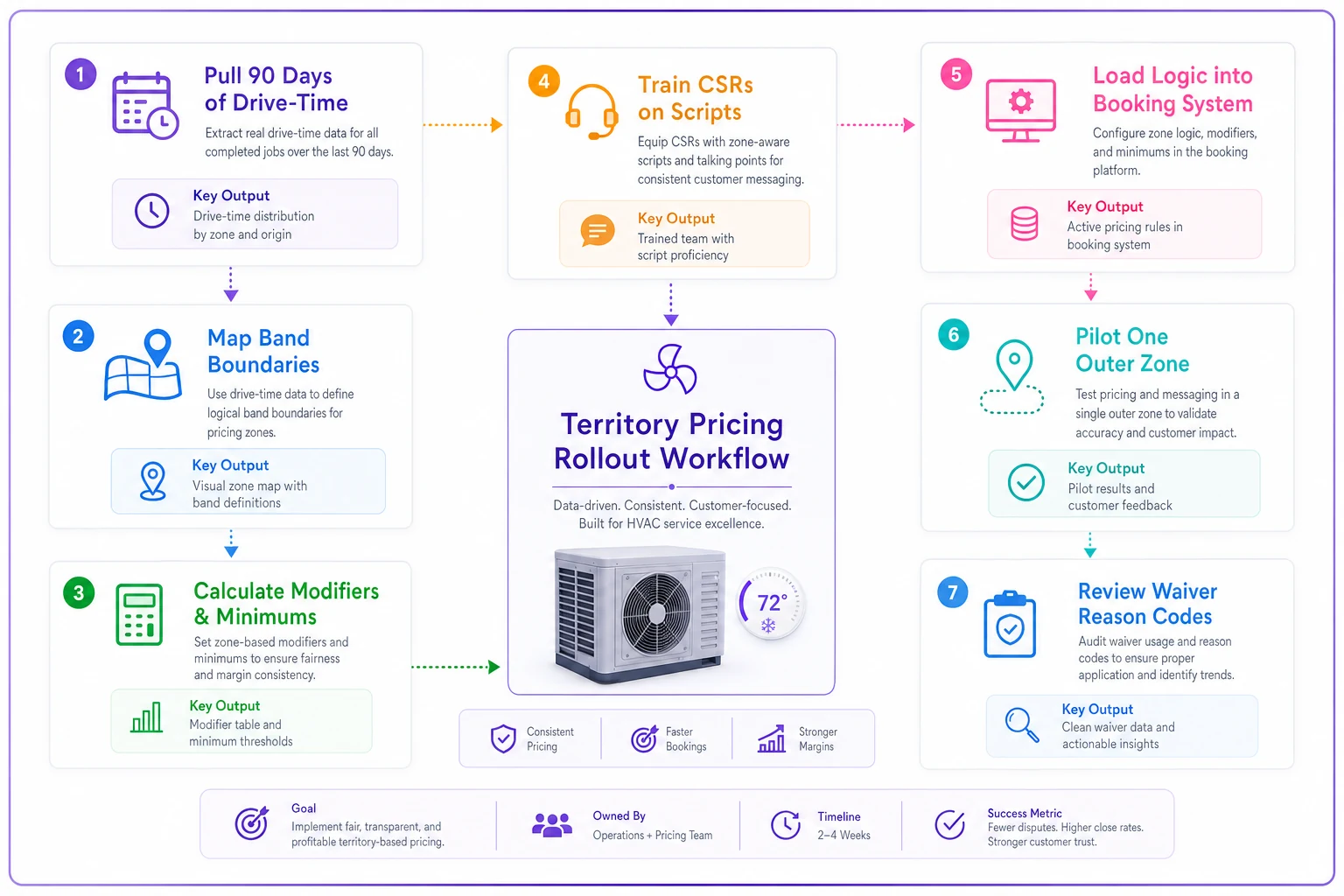
The reason to pilot one zone first is simple: you'll learn how your specific customers react to the script before you've committed your whole book to it. Adjust the number, not the whole model.
The takeaway
Territory pricing isn't about squeezing far-away customers. It's about refusing to let your efficient zones quietly fund your inefficient ones.
The three inputs — drive-time, fill-rate, loaded labor — tell you exactly how much each zone costs to serve. The bands turn that into something a CSR can quote in one breath. The billing rules keep it from eroding. Get all three working together and you protect margin in the zones that were bleeding, without touching pricing in the zones that were already fine.
Ready to optimize your HVAC operations?
Join hundreds of HVAC businesses using Coolyly to save time, improve technician utilization, and enhance customer satisfaction.