


Most HVAC companies don't fail at digital transformation because they picked bad software. They fail because they skipped the part where you prove something works on a small scale before betting the whole company on it. You buy a tool, roll it out to 40 techs at once, and six weeks later half the team has quietly gone back to paper because nobody designed the rollout like an actual experiment.
The real problem is sequencing. There's an order to this stuff, and when you get the order wrong, you end up with expensive software nobody trusts, dashboards nobody reads, and a dispatch team doing double the work because they're maintaining two systems at once. A proper digital transformation roadmap for HVAC field service isn't a shopping list of tools. It's a staged sequence where each phase has to earn its way into the next one.
This article walks through that sequence the way it actually plays out in the field — the pilot design, the sample-size math that tells you whether your results mean anything, the ROI gates that stop bad projects early, and the organizational readiness checks most owners skip entirely. If any of that sounds like overkill for a 25-tech shop, stick around. The companies that skip these steps are the ones paying for three different platforms that don't talk to each other.
Why transformation projects stall at the exact same point
Failed transformation efforts almost always die in the same spot: the gap between "the pilot looked good" and "it works at full scale." That gap is where coordination breaks.
The pattern plays out like this. A shop picks a new scheduling or field-tooling platform. They run it with three or four of their best techs — the ones who are already organized and tech-comfortable. It goes great. The data looks clean, the techs like it, the owner greenlights a full rollout. Then they deploy to the whole team, and suddenly:
-
The average tech isn't as careful about data entry as the pilot group was
-
Dispatch is fielding "how do I do this" calls all day
-
The new system doesn't sync cleanly with accounting, so someone's re-keying invoices
-
Three weeks in, half the field is back on texts and phone calls
The pilot didn't lie. It just measured the wrong population under the wrong conditions. Your four best techs are not a representative sample of your whole crew, and a four-person rollout doesn't surface the integration and coordination problems that only appear at volume.
This is why a stage-gated sequence matters. Each gate forces you to ask: did this actually work, under realistic conditions, with enough data behind it to trust the answer? If no, you stop or adjust before spending more. If yes, you scale with evidence instead of hope.
The stages, and what has to be true before you move forward
Think of transformation as five stages, each with a gate you can't pass until the criteria are met. The gates are the whole point — they're what separate a disciplined rollout from a hopeful one.
Eliminate scheduling chaos and missed jobs.
Coolyly helps HVAC companies book, coordinate, and track every service efficiently.
- Unified appointment & dispatch management
- Automated client notifications
- Technician scheduling & job tracking
No credit card required
| Stage | Core question | Gate to pass |
|---|---|---|
| 1. Readiness | Is the org actually set up to absorb this? | Data taxonomy agreed, owners assigned, baseline measured |
| 2. Pilot design | What exactly are we testing, and how will we know? | Hypothesis, sample size, success metric defined |
| 3. Pilot run | Did it work under realistic conditions? | Stat-significant result, no major integration breaks |
| 4. ROI gate | Does the math justify scaling? | Payback period and margin impact clear the threshold |
| 5. Scale to production | Can the whole org run on this? | Integration stable, training complete, fallback removed |
The temptation is to jump straight to stage 2 or 3 because that's the fun part — you get to try the new tool. But stage 1 is where most of the real work hides, and skipping it is why so many pilots produce misleading results.
Here's a visual workflow of the stage-gated sequence.
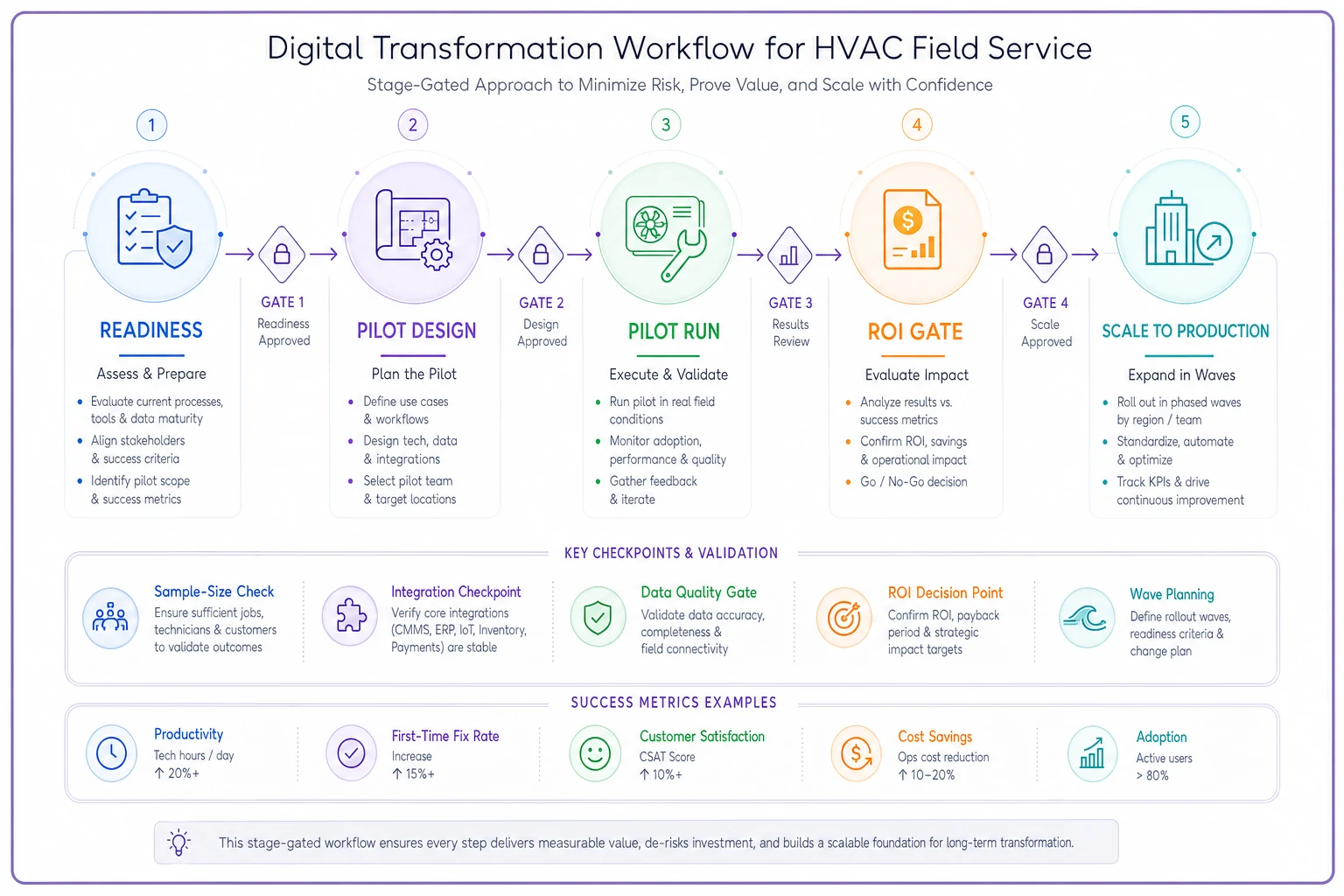
The gates force you to be evidence-driven: readiness creates trustworthy data, pilot design defines what success looks like, the pilot run proves it under load, the ROI gate assesses payback, and scale makes it part of operations.
Stage 1: Organizational readiness is the step everyone skips
Before you pilot anything, you need to know whether your operation can even generate trustworthy data. If your techs tag jobs inconsistently, if "no-cool call" means five different things depending on who logged it, and if nobody owns the definition of a completed job, then any pilot you run is measuring noise.
Readiness breaks into three practical checks:
-
Data consistency. Are your job types, status codes, and outcome fields standardized across the team? If not, your before-and-after comparison is garbage from the start. This is foundational enough that it deserves its own project — we've covered the full approach in the canonical service-data taxonomy work, because without agreed definitions, your analytics maturity caps out fast.
-
Metric ownership. Someone has to own each number you plan to track. When nobody owns "first-time fix rate," it drifts, nobody questions bad entries, and by the time you look at the pilot data, it's unusable. Clear ownership and decision rights are the backbone here, which ties directly into how you unify leadership KPIs with role-based dashboards and governance.
-
Baseline measurement. You cannot prove improvement without a clean "before." Spend two to four weeks capturing your current numbers before you touch anything. Average time-per-job, callback rate, dispatch-to-arrival window, invoice turnaround. If you can't measure these today, that's your first project — not the new platform.
A quick gut check: if someone asked you right now "what's your first-time fix rate this quarter, and how confident are you in that number," and you couldn't answer in under a minute with a straight face, you're not ready to pilot. Fix the measurement layer first.
If metric ownership is unclear, make a short RACI for each KPI before any pilot — those three lines save weeks later.
When readiness work is worth delaying everything else
If your data is a mess, do not proceed. A pilot run on bad baseline data will either flatter a tool that doesn't work or kill a tool that does. Both outcomes cost you. The extra month spent cleaning up definitions and assigning owners pays for itself the first time a gate decision comes down to a number you can actually trust.
Stage 2: Designing a pilot that produces a real answer
This is where the sample-size math comes in, and where most owners' eyes glaze over. Bear with it, because this is the part that saves you from fooling yourself.
A pilot is an experiment. An experiment needs a hypothesis you can measure. "We think this scheduling tool will help" is not a hypothesis. "We expect this tool to cut average dispatch-to-arrival time by 15% within six weeks" is. Now you have a number to hit and a timeframe to hit it in.
-
Small effects need big samples. If you expect a 3% improvement in time-per-job, you'll need hundreds of jobs to see it clearly through the noise. A two-week pilot with 60 jobs won't cut it.
-
Big effects show up fast. If a tool genuinely cuts your callback rate in half, you'll see it in a few dozen jobs. The bigger the real change, the less data you need to believe it.
-
Match the pilot group to reality. Don't pilot with only your top performers. Include a middle-tier tech and someone who hates new software. If it works for them, it'll work at scale. If it only works for your stars, you've learned nothing useful.
A rough planning rule: if you're chasing a modest improvement, budget for at least 150–200 completed jobs in both the before and after windows before you call the result real. For something you expect to move the needle hard, 50–80 jobs per window is often enough to see it.
Write down, before you start:
-
The single primary metric you're testing
-
The target change and the timeframe
-
How many jobs/weeks you'll observe
-
Who's in the pilot group and why they're representative
-
What result would make you say "no, this didn't work"
That last line is the one people refuse to write. Define failure in advance, or you'll rationalize any result into a success.
Stage 3: Running the pilot without contaminating the result
The run itself has two jobs: generate clean data, and surface the integration problems that will bite you at scale.
The quiet killer here is the Hawthorne effect — people behave differently when they know they're being watched. Your pilot techs will be extra diligent for the first two weeks. That's why a six-week window usually beats a two-week one; the novelty wears off and you see actual behavior.
Watch for integration friction too. A tool that works beautifully in isolation but requires someone to manually copy data into your accounting or inventory system isn't a win — it's a new bottleneck in disguise. Map every point where the new tool has to hand data to an existing system, and track how often that handoff breaks or needs manual help. This is exactly the kind of thing that turns into chaos at scale, and it's worth reviewing the integrations and data-architecture playbook before you commit, because the integration debt you ignore in a pilot becomes a daily tax in production.
During the run, keep a simple log of:
-
Any time a tech had to work around the system
-
Every data handoff that required manual intervention
-
Support questions that came up more than once
-
Anything that broke the "before" workflow in an unexpected way
That log is often more valuable than the headline metric. The metric tells you if the idea works. The log tells you what scaling will actually cost.
Stage 4: The ROI gate that kills zombie projects
This is the gate that saves the most money, and it's the one people are most tempted to wave through because they're emotionally invested by now.
The ROI gate is simple: given what the pilot actually showed — not what you hoped — does the full rollout pay for itself in an acceptable window?
Costs: license fees at full headcount, implementation time, training hours, the ongoing cost of maintaining integrations, and the productivity dip during rollout (there's always a dip — budget for it).
Returns: the measured improvement from your pilot, scaled to full volume, minus a discount for the fact that your whole team won't perform as well as your pilot group did.
That discount matters. A pilot that showed a 15% time-per-job improvement with a decent sample will usually deliver something like 8–11% across the whole team once you account for the less-careful techs and the learning curve. Plan for the haircut.
A realistic example
A mid-sized residential shop — about 22 techs, running roughly 300–340 completed jobs a month — piloted a field-tooling and scheduling platform with six techs over six weeks. The pilot showed average time-per-job dropping by around 18 minutes and callbacks dropping noticeably on the pilot crew.
When they built the ROI gate, they discounted the time savings by a third to account for the average tech. Scaled across the team, that still worked out to meaningful recovered capacity — roughly the equivalent of freeing up a few hundred tech-hours a quarter, which let them absorb summer demand without adding a full seasonal hire. Against platform and rollout costs in the low five figures for the year, payback landed inside about five months. Clear pass.
Had the pilot only shown a six-minute improvement, that same math would've pushed payback past a year once you added integration maintenance — and that's a project you quietly shelve, not scale.
When the ROI gate says no
Respect it. A failed ROI gate isn't wasted money; it's cheap insurance. You spent a small pilot budget to avoid a large rollout disaster. The owners who get burned are the ones who run the gate, don't like the answer, and scale anyway because they already told the team it was happening.
Stage 5: Scaling to production without the usual chaos
Passing the ROI gate earns you the right to scale — it doesn't make scaling easy. This is where sequencing matters most.
Roll out in waves, not all at once. A common rhythm:
-
Wave one the pilot group plus your most adaptable crews. They become your internal support network.
-
Wave two the broad middle of your team, once wave one is stable and you've documented the real-world quirks.
-
Wave three the holdouts and the hardest cases, with the most support attention.
Between waves, remove the fallback. The single biggest reason rollouts stall is leaving the old system running "just in case." If people can retreat to the old way, a meaningful chunk of them will, and you'll run two systems forever — paying for both and trusting neither. Set a hard date where the old process is gone.
Keep watching your core metrics through the scale-up, because the number that looked great on six techs can soften across sixty. If it softens too far, that's usually a training gap or an integration bottleneck you can still fix — not a reason to abandon the whole thing. A wave-based rollout gives you time to catch that before it becomes a full-team problem. It also gives your internal champions from wave one a chance to coach wave two in a way that no formal training session ever really does.
A short readiness checklist before you start any of this
Run through this before stage 1, honestly:
-
- [ ] Can you state your current first-time fix rate and callback rate with confidence?
-
- [ ] Are job types and status codes standardized across all techs?
-
- [ ] Does every metric you care about have a named owner?
-
- [ ] Do you have a clean two-to-four-week baseline for whatever you're about to pilot?
-
- [ ] Have you written down what pilot failure looks like, in advance?
-
- [ ] Have you mapped every point where the new tool must exchange data with an existing system?
-
- [ ] Is leadership aligned on respecting the ROI gate even if they don't like the answer?
If you can't check most of these, you're not ready to buy anything yet. That's not a setback — it's probably the single most valuable thing this roadmap can tell you.
Who should not run a staged transformation right now
This disciplined sequence isn't free, and for some shops the timing is genuinely wrong.
If you're a five-tech operation still figuring out your core workflows, you don't need sample-size math — you need stable processes first. Formal gates on a tiny team are bureaucracy for its own sake.
If you're in the middle of peak season, don't start. Transformation during surge demand means asking your team to learn new tools while they're already maxed out, and your baseline data will be distorted by the chaos anyway. Wait for a shoulder season.
And if leadership won't commit to actually honoring the gates — if the decision to scale is already made emotionally and the pilot is just theater — skip the whole exercise. A pilot you'll ignore is just an expensive way to delay a mistake.
The thread running through all of it
The reason to run transformation as a staged sequence isn't caution for its own sake. It's that every part of an HVAC operation is connected, and changing one system ripples into the others. New scheduling touches dispatch, which touches parts staging, which touches invoicing, which touches your margin numbers. A pilot run in isolation hides those ripples. A staged rollout, with real gates and honest data, surfaces them while they're still cheap to fix.
Get the sequence right and each stage pays for the next: readiness gives you trustworthy data, trustworthy data gives you a real pilot result, a real result gives you an honest ROI decision, and an honest decision gives you a rollout your team actually trusts. Get the sequence wrong, and you join the long list of shops with three half-adopted platforms and a crew that's quietly gone back to paper.
The reason to run transformation as a staged sequence isn't caution for its own sake. It's that every part of an HVAC operation is connected, and changing one system ripples into the others. New scheduling touches dispatch, which touches parts staging, which touches invoicing, which touches your margin numbers. A pilot run in isolation hides those ripples. A staged rollout, with real gates and honest data, surfaces them while they're still cheap to fix.
Get the sequence right and each stage pays for the next: readiness gives you trustworthy data, trustworthy data gives you a real pilot result, a real result gives you an honest ROI decision, and an honest decision gives you a rollout your team actually trusts. Get the sequence wrong, and you join the long list of shops with three half-adopted platforms and a crew that's quietly gone back to paper.
Ready to optimize your HVAC operations?
Join hundreds of HVAC businesses using Coolyly to save time, improve technician utilization, and enhance customer satisfaction.