


Most HVAC owners don't decide their service portfolio. It just accumulates. You started with residential repair, picked up a few maintenance agreements because a customer asked, landed a commercial account through a referral, and one day you're running three completely different businesses under one roof — each with its own margins, staffing needs, and failure modes. Nobody planned it.
That's fine until you try to scale. Then the cracks show. Commercial work eats your best techs. On-demand residential calls blow up your schedule. Maintenance contracts quietly subsidize everything else, but you can't see it because your P&L lumps it all together. You're busy, revenue's up, and margin is somehow flat or shrinking.
A real HVAC service portfolio strategy treats each offering as a distinct product with its own economics — and forces you to decide, deliberately, which tiers you're scaling, which you're capping, and which you're quietly using to fund the others. This isn't about adding services. Usually it's about understanding what you already have well enough to price and staff it correctly.
The three-tier reality most shops are actually running
Before you can manage the mix, you have to see it clearly. Almost every mixed residential-commercial HVAC business is running some version of three product tiers, whether they've named them or not:
-
On-demand service — the reactive break/fix work. High ticket variability, high dispatch cost, unpredictable volume. This is where most shops make their reputation and lose their margin.
-
Preventive maintenance (PM) / agreements — recurring, contracted work. Lower per-visit revenue but predictable, schedulable, and it feeds the other tiers. The stabilizer.
-
Remote / diagnostic-led service — the newest tier for most shops. Sensor-driven monitoring, remote diagnostics, condition-based service. Low marginal cost per account once the infrastructure is built.
Each tier behaves differently when you push volume through it. The mistake that quietly kills profitability is assuming they scale the same way. They don't. On-demand scales with headcount and trucks — linear, expensive. PM scales with route density and administrative efficiency. Remote scales almost like software: build the monitoring once, add accounts cheaply.
Worth internalizing: the tier that generates the most revenue is rarely the one that generates the most scalable profit. On-demand looks like the hero on the top line and often lags badly on the bottom line.
Channel economics: where the money actually comes from vs. where it stays
Revenue and profit live in different places across these tiers. This is the single most important thing to get right, and it's exactly what shop financials tend to obscure.
Eliminate scheduling chaos and missed jobs.
Coolyly helps HVAC companies book, coordinate, and track every service efficiently.
- Unified appointment & dispatch management
- Automated client notifications
- Technician scheduling & job tracking
No credit card required
| Tier | Typical gross margin | Marginal cost to add volume | Revenue predictability | Best scaling lever |
|---|---|---|---|---|
| On-demand residential | 45–55% before overhead, often 15–25% after true dispatch cost | High — needs trucks + techs | Low, seasonal spikes | Ticket size + dispatch efficiency |
| Commercial on-demand/project | 30–45% (labor-heavy, longer AR) | High + working capital | Medium, lumpy | Account depth, SLA pricing |
| PM agreements | 25–40% per visit, but low acquisition + high LTV | Low-to-moderate | High | Route density + renewal rate |
| Remote diagnostics | 60–80% after platform build | Very low | High (recurring) | Account count |
The numbers above are ranges, not gospel — your actual figures depend on how honestly you allocate overhead. But the shape is consistent across shops. On-demand throws off gross margin that gets eaten by drive time, callbacks, and the cost of keeping a tech available for unpredictable spikes. Commercial looks healthy until you account for a 45–60 day payment cycle and the occasional SLA penalty.
What shows up repeatedly across mixed shops is that PM agreements get undervalued precisely because each visit looks small. Owners see a $180 maintenance visit next to an $1,100 compressor replacement and conclude the repair is where the money is. But the agreement customer books three visits a year, renews at 80%+ rates, and hands you the diagnostic and upsell opportunities that make the on-demand tier profitable. The PM tier is the funnel, not the afterthought. There's a solid breakdown of how those recurring visits compound into predictable revenue in this piece on building a data-driven preventive maintenance program.
Operational cost triggers: the thresholds where a tier turns unprofitable
Every tier has a hidden line where growth stops helping and starts hurting. If you don't know your triggers, you scale past them and wonder why a busier quarter produced a worse margin.
On-demand cost triggers:
-
Drive-time-to-billable-time ratio crossing around 35–40%. Past that, you're paying techs to sit in traffic and your "busy" schedule is mostly windshield.
-
Callback rate above roughly 6–8%. Callbacks on on-demand are pure margin destruction — you eat the truck roll twice.
-
Same-day demand exceeding available capacity by more than ~20% consistently. That's when you start pulling techs off scheduled PM work to chase reactive calls.
PM cost triggers:
-
Route density falling below a threshold where a tech does fewer than 5–6 PM stops per day. Below that, the low per-visit revenue can't cover drive cost.
-
Renewal rate slipping under ~75%. Acquisition cost only makes sense if the account sticks.
Commercial cost triggers:
-
AR aging past 60 days on more than a quarter of the book. Working capital drag turns a "profitable" account into a cash-flow problem.
-
SLA response commitments that force dedicated standby capacity you can't bill for directly.
Remote cost triggers:
-
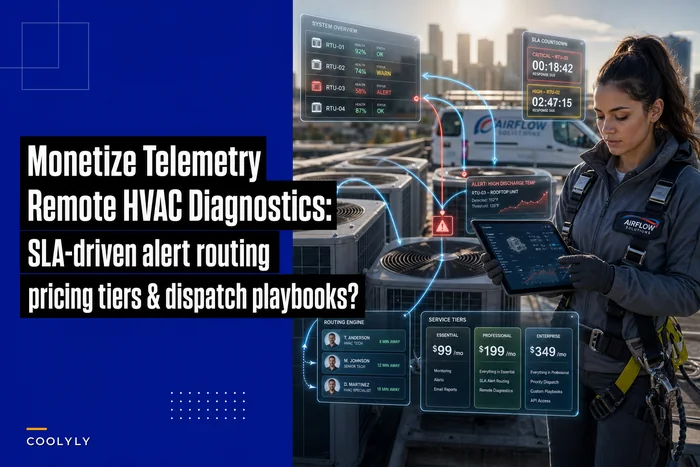
Alert-to-truck-roll conversion running too high. If your monitoring mostly generates dispatches, you haven't productized diagnostics — you've built an expensive lead generator. The whole point of remote monitoring is filtering, not just flagging. There's a useful framework for structuring this in this write-up on productizing remote diagnostics with SLAs and pricing tiers.
The trigger you'll hit first is almost always the on-demand drive-time ratio, because it's invisible in your financials. There's no P&L line for "hours lost to routing." It just shows up as techs being busy while jobs-per-day stays flat.
Sample tier-profitability rules for scaling each offering
You don't need a consultant to build governance around this.
You need a handful of simple rules that tell you when to add capacity, when to raise price, and when to stop taking work.
-
On-demand
cap it, price it, and route it tight.
Don't scale on-demand headcount to meet peak demand — you'll carry that cost in the off-season. Set a demand ceiling and use dynamic pricing (after-hours, emergency, same-day premiums) to shed the marginal calls that don't clear your margin bar. If a same-day call can't clear roughly 35% margin after true dispatch cost, it should either carry a premium or wait. -
PM
scale aggressively as long as density holds.
This is your growth engine. Add agreements wherever route density stays above your break-even stops-per-day. Never sell a PM agreement into a zip code where you can't cluster at least 4–5 more. Density is the whole game. -
Commercial
scale by account quality, not count.
Add commercial accounts only when they pass a working-capital and SLA screen. Any account requiring dedicated standby or net-60 terms needs to price in the carrying cost — or you pass. One badly-structured commercial contract can absorb the profit from five good ones. -
Remote
scale account count, protect the filter.
Marginal cost here is near zero, but only if your alerting is tuned. Track alert-to-dispatch conversion monthly. If too many alerts become truck rolls, fix the thresholds before adding accounts. -
Cross-tier rule — protect PM capacity from on-demand raids. The most common self-inflicted wound is pulling techs off scheduled PM to chase reactive calls. Set a hard rule that PM route commitments don't get cannibalized below a defined floor. Reactive demand should flex through pricing and overflow scheduling, not by eating your predictable book.
Reactive demand should flex through pricing and overflow scheduling, not by eating your predictable book.
Where the portfolio actually breaks at scale
A small shop can run all four tiers on instinct because the owner holds the whole picture in their head. They know which commercial account pays slow, which neighborhoods cluster well for PM, which techs handle rooftop units. It works until it doesn't — and the break point is almost always coordination, not demand.
Here's the workflow that quietly falls apart as you grow:
PM visit surfaces failing component ↓ Tech notes it in the field ↓ Signal needs to travel: field → office → quote → customer → schedule ↓ No system to track it = signal dies ↓ Retrofit opportunity evaporates
Sketching this flow helps you see where signals drop and opportunities evaporate.
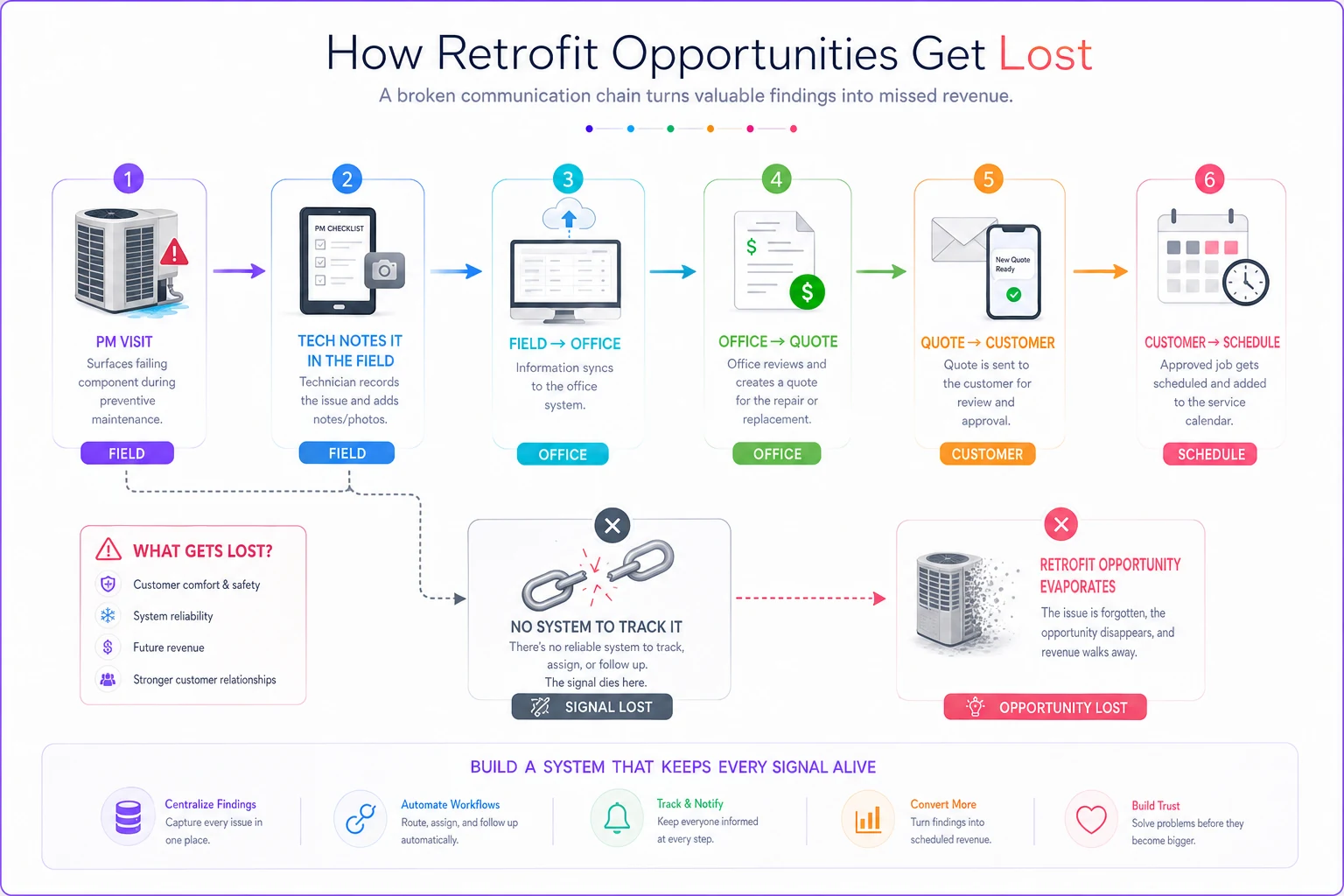
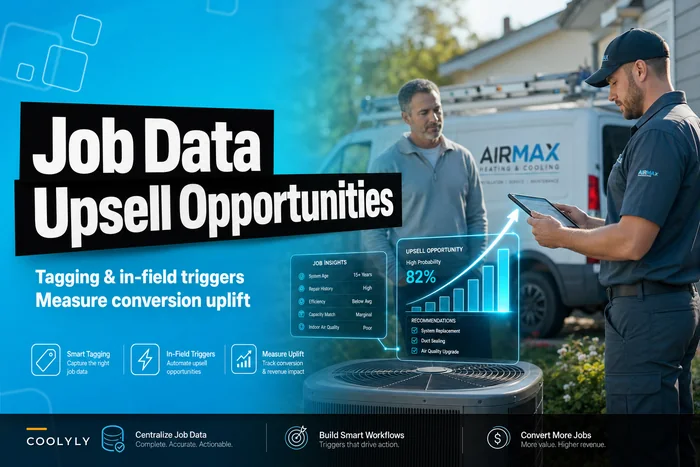
In a small shop, the tech mentions it, the owner follows up, it gets sold. At scale, that same handoff has to work across dozens of techs and hundreds of accounts simultaneously. Without a system for it, the maintenance tier keeps generating opportunities and the shop keeps letting them evaporate. This is exactly the leak that a structured tagging-and-trigger workflow is built to close, and this piece on turning completed-job data into upsell and retrofit opportunities is worth reading if this is already happening.
The second break point is visibility. At small scale you feel your margins. At larger scale you have to measure them — per tier — or you fly blind. A shop that can't break out true margin by tier is making portfolio decisions on gut feel. And gut feel reliably favors the loud, high-ticket on-demand work over the quiet, profitable recurring work.
This is where operational software earns its keep — not as a magic fix, but as the connective tissue that keeps tier-level economics visible and keeps signals moving between tiers. When dispatch, job data, and margin tracking are tagged by tier, the platform can flag a PM-surfaced retrofit before it evaporates, warn you when on-demand drive-time is creeping past your trigger, or hold your PM route floor when reactive demand spikes. The point isn't automation for its own sake. It's that the coordination a single owner does in their head has to live somewhere once you outgrow that single owner.
A real scenario: rebalancing a busy-but-flat shop
A mixed residential-commercial shop — around 14 techs, doing somewhere in the $3.8M–$4.2M range annually — hit a stretch where revenue was climbing but net margin had been stuck near 8% for three years. Everyone was busy. Nobody could explain the ceiling.
When they finally split the P&L by tier, the picture was pretty blunt. On-demand residential was roughly 55% of revenue and maybe 20% of the actual profit. Commercial looked solid on paper but was carrying around $180k in AR past 60 days, and two accounts with tight SLAs were forcing standby coverage that nobody had priced in. PM agreements — quietly renewing at around 82% — were carrying most of the real net margin. And the upsell opportunities surfaced during those PM visits? About 40% were never even quoted.
They didn't add services. They rebalanced. A same-day premium on on-demand let the marginal calls self-select or wait, which trimmed drive-time waste. The two problem commercial accounts got repriced — lost one, kept one at a workable margin. PM sales pushed hard into dense zip codes. And a simple trigger workflow meant field-surfaced retrofits stopped dying in someone's inbox.
Over the next three or four quarters, revenue stayed roughly flat — actually dipped slightly — but net margin moved from around 8% to the low teens. Same trucks, same crew, materially more profit. The change wasn't doing more. It was deciding which tiers to feed.
When this framework makes sense — and when it doesn't
This kind of portfolio thinking is worth the effort once you're running genuinely different service tiers at enough volume that no single person can track the economics of each. If you're a two-truck shop doing mostly residential repair, you don't need tier governance — you need more customers. Adding this structure too early is just overhead.
It also doesn't mean running all four tiers. Plenty of profitable shops deliberately skip commercial because the working-capital drag and SLA risk don't fit their model. Others never build a remote tier because their customer base won't pay for monitoring. A portfolio strategy isn't "run everything." It's knowing which tiers fit your market and cost structure, and scaling only those intentionally.
The shops that shouldn't touch this yet are the ones without clean job-level cost data. If you can't tell what a job actually cost to deliver, tier-level margin analysis will just produce confident-looking wrong answers. Get cost-to-serve visibility first. Then worry about rebalancing the mix.
The bottom of it
The difference between a busy HVAC shop and a profitable one usually isn't demand, pricing, or even efficiency in isolation. It's whether the owner is managing the service mix as a deliberate portfolio or just absorbing whatever work walks in the door. On-demand, PM, commercial, and remote each scale on different math and break at different thresholds. Once you can see those thresholds — and you've got rules that stop the profitable tiers from being cannibalized by the loud ones — scaling stops being a gamble and starts being something you actually control.
Ready to optimize your HVAC operations?
Join hundreds of HVAC businesses using Coolyly to save time, improve technician utilization, and enhance customer satisfaction.