


Most HVAC companies that start collecting field data hit the same wall about eighteen months in. The sensors are streaming, the techs are filling out mobile forms, completed jobs are flowing into the CRM — and yet nobody can build a model, a margin report, or a billable diagnostic product on top of any of it. The data exists. It's just not usable.
The reason is almost never volume. It's that nobody defined what "good" looks like before the data started piling up. Fields get labeled three different ways across four technicians. Photos get attached to the wrong job. A pressure reading lands in a free-text notes box instead of a numeric field. Six months later your analyst is spending the majority of their time cleaning instead of modeling, and the "data-driven service product" you promised a commercial client keeps slipping another quarter.
This article is about closing that gap with prescriptive standards — the kind that tie your field schemas and evidence-capture rules directly to the acceptance tests your analytics layer runs, the SLAs you sign with customers, and the gate that decides whether a report is good enough to bill for. If you've already built out a canonical service-data taxonomy, this is the next layer down: making that taxonomy enforceable at the point of capture and testable before anything downstream touches it.
Why field data breaks the moment you try to use it
In year one, data collection is usually informal. A tech snaps a photo of a corroded coil, writes "replaced cap, system good," and closes the ticket. That works fine for a one-truck shop where the owner remembers every job.
What breaks at scale is interpretation. When you have six techs, "system good" means six slightly different things. When you have 40 techs across three branches, it means nothing at all. And the day you try to train a fault-prediction model or sell a commercial client a quarterly health report, you discover:
-
The same fault was labeled "compressor fault," "comp failure," "bad compressor," and "unit down" depending on who typed it.
-
Refrigerant readings were captured as text in half the jobs and as numbers in the other half.
-
Evidence photos exist, but there's no reliable way to tell which photo proves which claim on the invoice.
-
Timestamps come from three systems that disagree by a few minutes, so reconstructing the actual sequence of a visit is guesswork.
None of these are exotic problems. They're the default state of field data when capture conventions aren't prescriptive. "Clean the data later" is a myth. You cannot reliably reconstruct intent after the fact. If the tech didn't record whether a reading was suction or liquid line pressure, no amount of downstream processing fixes that. The standard has to live at the point of capture.
This is also where a lot of analytics maturity efforts stall out. Teams jump to dashboards and models before the raw inputs are trustworthy, then quietly lose faith in the whole program when the numbers don't reconcile.
What "ML-ready" actually means for field telemetry
"ML-ready" gets thrown around loosely, so let's be concrete. For HVAC field data, ML-ready telemetry means the data meets four conditions before it enters your analytics pipeline:
Eliminate scheduling chaos and missed jobs.
Coolyly helps HVAC companies book, coordinate, and track every service efficiently.
- Unified appointment & dispatch management
- Automated client notifications
- Technician scheduling & job tracking
No credit card required
-
Canonical — every field maps to one agreed definition, one data type, one allowed value set.
-
Attributable — every record ties to a job, a technician, a device, and a precise timestamp.
-
Evidenced — any claim that could end up on an invoice or a customer report has linked proof (a reading, a photo, a scan) that can be independently verified.
-
Testable — the record can pass or fail an automated acceptance check without a human eyeballing it.
That fourth point is the one most shops skip. If a human has to judge whether a record is good, you don't have a standard — you have an opinion. The whole value of writing these conventions down is that a machine can enforce them at ingestion and reject what doesn't qualify.
A canonical field schema, concretely
{ "field": "suctionpressurepsig", "type": "number", "unit": "psig", "requiredfor": ["refrigerantcircuitservice", "nocooldiagnostic"], "validrange": [0, 400], "capturemethod": "gaugereading | connectedprobe", "evidencerequired": true, "evidencetype": "photo | probestream", "sourcetimestamp": "iso8601", "deviceid": "nullablestring", "technicianid": "required_string" }
Notice what the schema does. It doesn't just say "record suction pressure." It says when it's required, what counts as a valid value, what proof must accompany it, and what metadata has to travel with it. That specificity is what makes the field testable later.
Tying schemas to acceptance tests
An acceptance test is the gate between "raw" and "decision-grade." Every record that enters the analytics layer runs the gauntlet. Pass, and it's eligible for modeling, reporting, and billing. Fail, and it goes to a relabel or recapture queue — more on that below.
The key design principle: acceptance tests should map one-to-one back to schema rules. No orphan tests, no silent schema fields. Here's what an acceptance-test table looks like in practice.
| Test ID | Checks | Rule source | Severity | Action on fail |
|---|---|---|---|---|
| AT-01 | suctionpressurepsig is numeric and within 0–400 | schema valid_range | Hard | Reject to recapture |
| AT-02 | Evidence photo attached when evidence_required = true | schema evidence rule | Hard | Reject to recapture |
| AT-03 | fault_code exists in canonical fault vocabulary | taxonomy | Hard | Route to relabel |
| AT-04 | technicianid and jobid both present | attribution rule | Hard | Reject to recapture |
| AT-05 | Timestamp within job start/end window | attribution rule | Soft | Flag, allow with warning |
| AT-06 | Photo EXIF timestamp within 30 min of claim | evidence integrity | Soft | Flag for review |
| AT-07 | Free-text notes do not contain numeric readings | capture discipline | Soft | Flag for coaching |
A couple of things worth calling out from how these actually behave in production.
Hard vs. soft matters more than people expect. Make everything a hard failure and you'll reject half your legitimate records — techs will revolt within a week. Make everything soft and nothing ever gets fixed. The craft is deciding which rules protect billable integrity (hard) versus which are quality nudges (soft). Anything that could put an unverifiable claim on a customer invoice is hard. Everything else starts soft and tightens over time.
AT-07 is the sneaky-valuable one. Scanning free-text notes for numbers that should've been structured fields catches the slow drift back into bad habits. A tech typing "suction was around 118" into notes instead of the numeric field is a one-off problem that becomes a data-quality cancer at 40 techs. Catching it early keeps your structured capture rate from eroding.
The relabel pipeline: what to do with the records that fail
Rejected records aren't garbage. Most are recoverable, and a disciplined relabel workflow is what separates a 60%-usable dataset from a 95%-usable one.
Here's the workflow that makes sense for a mid-size operation:
-
Triage at ingestion. Failed records split into two buckets
recapturable (missing a reading or photo the tech could still provide) and relabelable (data exists but is mislabeled or free-text).
-
Recapture loop. If the job is still open or the tech is still on-site, a same-day prompt goes back to the mobile device: "Suction pressure reading missing — add before closing." This is where most hard failures get fixed cheaply, because the tech hasn't left yet.
-
Relabel queue. Records where the information is present but non-canonical — "bad compressor" needs mapping to
faultcode: COMPFAIL— go to a structured relabel interface. A reviewer picks from the canonical vocabulary. No free typing allowed. -
Mapping memory. Every relabel decision gets stored as a mapping rule. The next time "bad compressor" shows up, it auto-suggests
COMP_FAIL. Over a few months this shrinks the manual relabel load considerably. -
Escalation for ambiguous cases. If a reviewer can't confidently map a record, it escalates to a senior tech or the metric owner rather than getting a wrong label forced on it. Wrong labels poison models worse than missing ones.
A quick visual of this flow helps align teams on who owns each step.
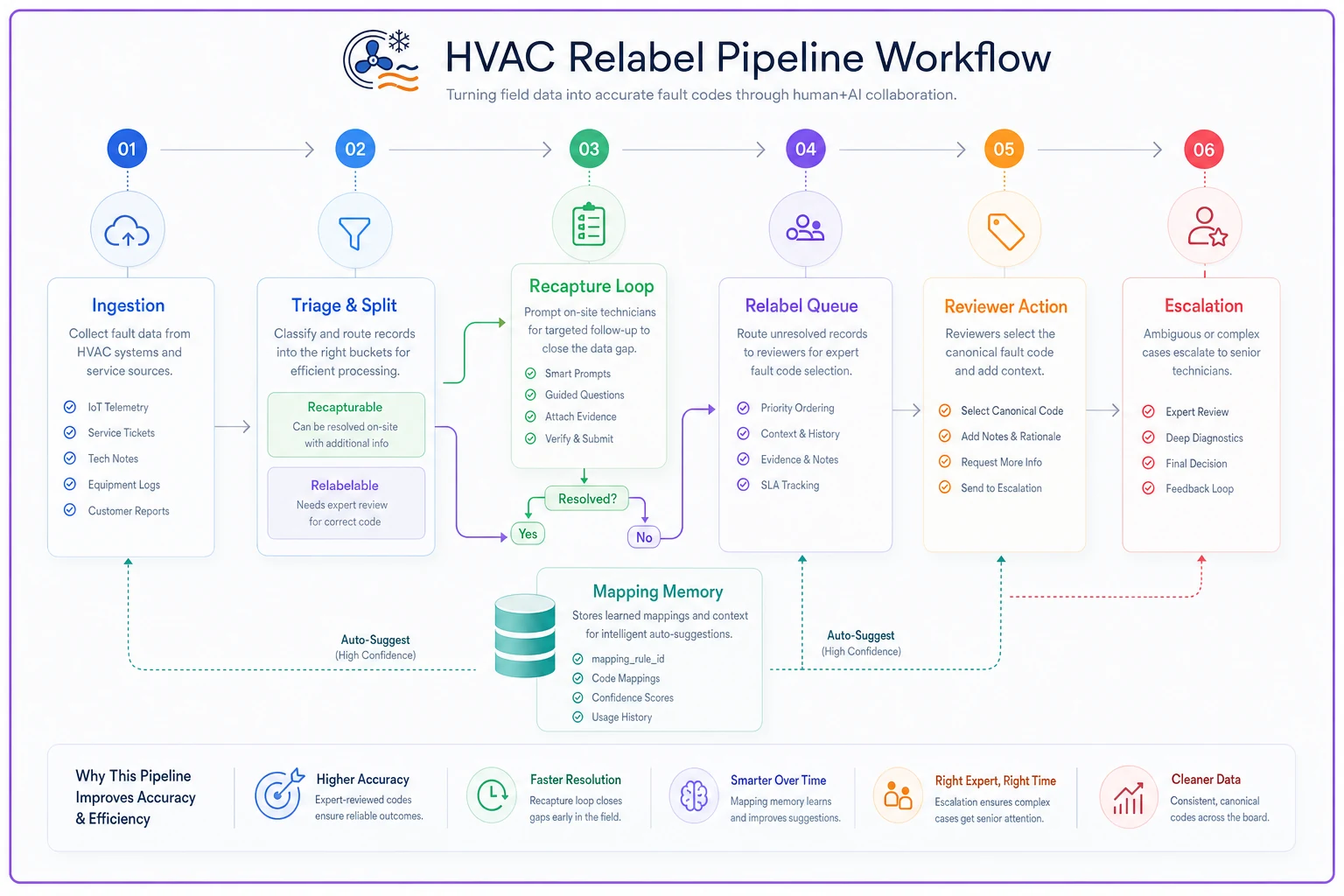
Store every relabel decision as a mapping rule so the system can auto-suggest mappings and reduce manual review over time.
A relabeled record looks something like this before and after:
// Raw { "jobid": "J-48821", "faulttext": "bad compressor, unit wont start", "faultcode": null, "status": "FAILEDAT-03" }
// After relabel { "jobid": "J-48821", "faulttext": "bad compressor, unit wont start", "faultcode": "COMPFAIL", "relabeledby": "reviewer14", "mappingruleid": "MAP-COMP-003", "status": "ACCEPTED" }
The mappingruleid is what compounds in value. You're not just fixing one record — you're teaching the pipeline a rule it reuses indefinitely. This is where lightweight AI assistance earns its keep: suggesting canonical mappings from messy free text so reviewers confirm instead of classify from scratch. The reviewer stays in control; the automation removes the repetitive typing. Done right, a reviewer who used to clear 80 records an hour can move through several hundred, and the queue stops being the bottleneck it usually is.
Where SLAs and billing come in
Everything above is internal plumbing. It becomes commercially meaningful the moment you sell a report or a monitoring service, because now the quality of your field data directly determines whether you can bill — and whether a customer can dispute.
If you're productizing remote diagnostics, this connects directly to how you'd structure SLAs and alert routing for a paid sensor service. The acceptance tests are what let you promise data quality in a contract without overcommitting.
Here's the kind of SLA language that actually holds up, because it's backed by the acceptance-test layer rather than by optimism:
> Data Quality Commitment. Provider warrants that no fewer than 95% of telemetry records included in any billable Quarterly System Health Report will have passed Provider's automated acceptance tests, including evidence verification for all reported fault findings. Any finding presented to Client as actionable shall include linked supporting evidence (sensor reading or dated photograph) captured within the service window. Records failing evidence verification shall be excluded from billable findings and are not grounds for additional charges.
> Remedy. Should a billable report be found to contain a reported finding lacking valid linked evidence, Provider shall, at Client's election, re-issue the corrected report within 5 business days or credit the affected report at 100% of its value.
You're not promising your techs are perfect — you're promising that anything you bill for passed a test and carries evidence. That's a promise your pipeline can actually keep, and it protects you from the dispute where a facilities manager says "prove the compressor was actually failing when you charged us for the diagnosis."
The commercialization gate
The last piece is the gate that decides whether a batch of reports is billable. Think of it as a release checklist that runs before anything goes out the door or gets invoiced.
-
[ ] ≥95% of records in the reporting period passed hard acceptance tests
-
[ ] 100% of billable findings carry linked, timestamp-valid evidence
-
[ ] No unresolved records sitting in the relabel queue for this account
-
[ ] Fault codes reconcile against the canonical vocabulary (zero free-text codes)
-
[ ] Attribution complete — every finding ties to a job, tech, and device
-
[ ] Soft-failure flags reviewed and either cleared or documented as accepted
If any hard item fails, the batch doesn't ship as billable. It either gets held for recapture and relabel, or the affected findings get stripped out and the report goes out narrower. This gate is what keeps a commercial account from receiving a report you can't stand behind — which is exactly how SLA failures turn into lost contracts.
A realistic example
Consider a regional outfit running both residential and light-commercial work — call it around 30 techs, pushing roughly 320–360 completed jobs a week, trying to launch a quarterly health-report product for their commercial maintenance accounts.
Before standardizing capture, their analyst estimated that close to 40% of completed-job records were unusable for the report product — missing readings, free-text fault codes, orphaned photos. The first version of the commercial report took nearly six weeks to assemble because so much had to be manually cleaned, and two early reports got disputed because a finding couldn't be backed with evidence. That's exactly the scenario that erodes trust with a commercial buyer before the product gets any traction.
After putting canonical schemas, ingestion-time acceptance tests, and a relabel queue in place, the usable-record rate climbed into the low 90s over about two quarters. The report that took six weeks dropped to something they could generate in a few days, because the inputs were already decision-grade when they arrived. Just as importantly, the dispute problem effectively went away — not because the techs suddenly got dramatically better, but because anything lacking evidence never made it into a billable finding. The gate caught it first.
The margin story is quieter but real: the analyst stopped being a full-time data janitor and started building the predictive fault model that had been promised to leadership for a year.
When this is worth doing — and when it isn't
This makes sense when:
-
You're trying to sell a data-based service (health reports, remote monitoring, predictive maintenance) and need defensible quality.
-
You have enough techs that labeling drift has become real — usually somewhere past 8–10 field staff.
-
You've been burned by a report dispute or a model that produced garbage because the inputs were garbage.
This is overkill when:
-
You're a small shop using field data purely for your own operational gut-checks, not for billing or modeling.
-
You haven't yet agreed on a canonical taxonomy at all — do that foundational work first, or the acceptance tests have nothing to test against.
-
You're trying to retrofit standards onto historical data hoping to recover it. Set the standard going forward and treat the old data as lossy.
Who should hold off entirely: a one-or-two-truck operation. The overhead of maintaining schemas, test suites, and relabel queues won't pay back until the data is feeding something commercial. Build the habit of structured capture, sure — but don't stand up the full governance machine before there's revenue riding on it.
Pulling it together
The companies that successfully turn field telemetry into revenue aren't the ones with the fanciest sensors. They're the ones who decided, deliberately, what a trustworthy record looks like — and then wired that definition into capture, testing, relabeling, SLAs, and the gate that decides what's billable. Each layer reinforces the next. The schema makes the test possible. The test makes the relabel queue meaningful. The relabel queue feeds back into capture discipline. All of it is what lets you sign an SLA you can actually defend.
Raw telemetry is cheap and plentiful. Decision-grade, billable telemetry is rare, and that's precisely why it's worth building standards to produce it. Get the conventions right at the point of capture, enforce them with tests that don't require an argument, and the downstream products — the models, the reports, the recurring revenue — stop being a someday project and start being something you can ship this quarter.
The companies that successfully turn field telemetry into revenue aren't the ones with the fanciest sensors. They're the ones who decided, deliberately, what a trustworthy record looks like — and then wired that definition into capture, testing, relabeling, SLAs, and the gate that decides what's billable. Each layer reinforces the next. The schema makes the test possible. The test makes the relabel queue meaningful. The relabel queue feeds back into capture discipline. All of it is what lets you sign an SLA you can actually defend.
Raw telemetry is cheap and plentiful. Decision-grade, billable telemetry is rare, and that's precisely why it's worth building standards to produce it. Get the conventions right at the point of capture, enforce them with tests that don't require an argument, and the downstream products — the models, the reports, the recurring revenue — stop being a someday project and start being something you can ship this quarter.
Ready to optimize your HVAC operations?
Join hundreds of HVAC businesses using Coolyly to save time, improve technician utilization, and enhance customer satisfaction.