


Most multi-branch HVAC companies don't fail because their technicians are bad or their marketing dried up. They stall because nobody can answer a basic question: when something goes wrong across two branches, who actually gets to decide?
That single gap — unclear decision rights — quietly produces most of the operational chaos you see once a company moves past one location. A dispatcher in Branch B reroutes a tech who "belongs" to Branch A. A warehouse lead swaps a part from one van's stock to cover an emergency and forgets to log it. A billing clerk adjusts a flat-rate invoice without knowing the branch manager already promised the customer a discount. None of these are catastrophic alone. Stacked across 300+ jobs a month per branch, they bleed margin and trust.
This piece is about building the governance layer that sits above your daily operations — the rules, ownership maps, and review cadences that keep dispatch, inventory, and billing from stepping on each other as you scale. Not theory. The actual lifecycle of how an SOP gets written, who signs off, how it gets enforced, and when you kill or revise it.
Why governance breaks the moment you open a second branch
With one location, governance is informal and that's fine. The owner is usually in the building. Decisions happen by walking over to someone's desk. The "system" is tribal knowledge plus whoever's been there longest.
The second branch changes the physics of the whole thing. Now you have two dispatch desks making independent calls on a shared pool of technicians and trucks. Two inventory counts that are supposed to reconcile but never quite do. Two people interpreting the same pricing rules slightly differently because nobody wrote down the edge cases.
What tends to happen across growing service companies is that the first real governance crisis shows up around branch two or three, not later. The owner assumes the problem is "we need better SOPs." But the SOPs often exist. The real failure is that nobody defined decision rights — who is Responsible, who is Accountable, who must be Consulted, and who just needs to be Informed. Without that clarity, every SOP becomes a suggestion that each branch bends to fit its own habits.
A useful way to think about it: an SOP tells people how to do something. A decision-rights matrix tells people who is allowed to decide when the SOP doesn't cleanly apply. You need both. Companies obsess over the first and ignore the second, which is why they end up with beautiful binders and chaotic operations.
If you haven't already sorted out how roles map across locations, the groundwork in scaling HVAC field operations without chaos pairs directly with everything below — territory and staffing structure is the skeleton that decision rights hang on.
The three domains where cross-branch conflict actually lives
Governance sounds abstract until you anchor it to the places where branches genuinely collide. In HVAC, that's almost always dispatch, inventory, and billing. These three share resources and data constantly, which is exactly why they generate the most finger-pointing.
Eliminate scheduling chaos and missed jobs.
Coolyly helps HVAC companies book, coordinate, and track every service efficiently.
- Unified appointment & dispatch management
- Automated client notifications
- Technician scheduling & job tracking
No credit card required
Dispatch is where shared capacity gets contested. When Branch A is slammed and Branch B has an open tech, who authorizes the cross-branch assignment, and who eats the drive time on the P&L?
Inventory is where shared physical stock gets murky. A hub serving multiple branches, van-to-van transfers during surge weeks, emergency part pulls — all of it needs a custody and approval trail or your counts drift and your branch margins get polluted.
Billing is where shared pricing rules get interpreted differently. Flat-rate overrides, warranty call judgments, comp decisions, discount approvals. One branch is generous, another is strict, and your effective pricing becomes a coin flip depending on who answered the phone.
The pattern underneath all three is the same: the conflict is never really about the task. It's about an unassigned decision at the seam between branches. Governance exists to assign those seams before they become arguments.
Decision-rights matrices that actually hold up
Dispatch decision rights
| Decision | Dispatcher | Branch Manager | Ops Director | Technician |
|---|---|---|---|---|
| Standard same-branch assignment | R / A | I | — | I |
| Cross-branch tech reassignment | R | A | C | I |
| Overtime authorization (>2 hrs) | C | A | I | I |
| Emergency reroute of booked customer | R | A | I | C |
| SLA-risk escalation on commercial account | R | C | A | I |
Inventory decision rights
| Decision | Van Tech | Warehouse Lead | Branch Manager | Ops Director |
|---|---|---|---|---|
| Standard van restock | R | A | I | — |
| Emergency hub part pull | R | A | I | — |
| Van-to-van transfer during surge | R | C | A | I |
| Write-off damaged/shrinkage stock | I | R | A | C |
| Cross-branch stock rebalancing | — | R | C | A |
Billing decision rights
| Decision | Field Tech | Billing Clerk | Branch Manager | Ops Director |
|---|---|---|---|---|
| Standard flat-rate invoice | R | A | I | — |
| Discount up to 10% | R | C | A | — |
| Discount 10–25% | C | I | A | C |
| Warranty vs. billable judgment | C | R | A | I |
| Customer comp / credit >$250 | I | C | R | A |
One mistake worth calling out: too many companies stack A on the owner or ops director for everything. If the accountable person is three levels removed from where the decision actually happens, people will just make the call informally anyway and the matrix becomes fiction. Push accountability down as far as it responsibly can go.
The SOP lifecycle: write, ratify, enforce, retire
Decision rights tell you who decides. The SOP lifecycle tells you how the rules themselves get created, maintained, and eventually killed. Most companies have an SOP creation process and no retirement process, which is how you end up with 80 procedures, half of them contradicting each other.
-
Draft — The person closest to the work writes the first version. Not the owner, not a consultant. The dispatcher drafts the dispatch SOP. This keeps it grounded in reality.
-
Review — The accountable role from the RACI matrix reviews for conflicts with existing SOPs and decision rights. This is the gate most people skip.
-
Ratify — Ops director signs off and assigns an owner and a review date. An SOP without a named owner is already dead.
-
Pilot — Run it in one branch for a defined window, usually 30–45 days. Collect exceptions — the cases where people had to deviate.
-
Rollout — Push to all branches with the exceptions already folded in. Train against it.
-
Monitor — Track the KPI the SOP is supposed to move. If the number doesn't move, the SOP is theater.
-
Revise or Retire — At the review date, the owner decides
keep, revise, or kill. Retiring SOPs is a feature, not a failure.
The pilot step is where you actually discover your decision-rights gaps. Every exception a tech logs during those 30–45 days is usually a decision nobody assigned. Feed those back into the RACI matrix. The two systems tune each other — that feedback loop is what makes both of them tighten over time.
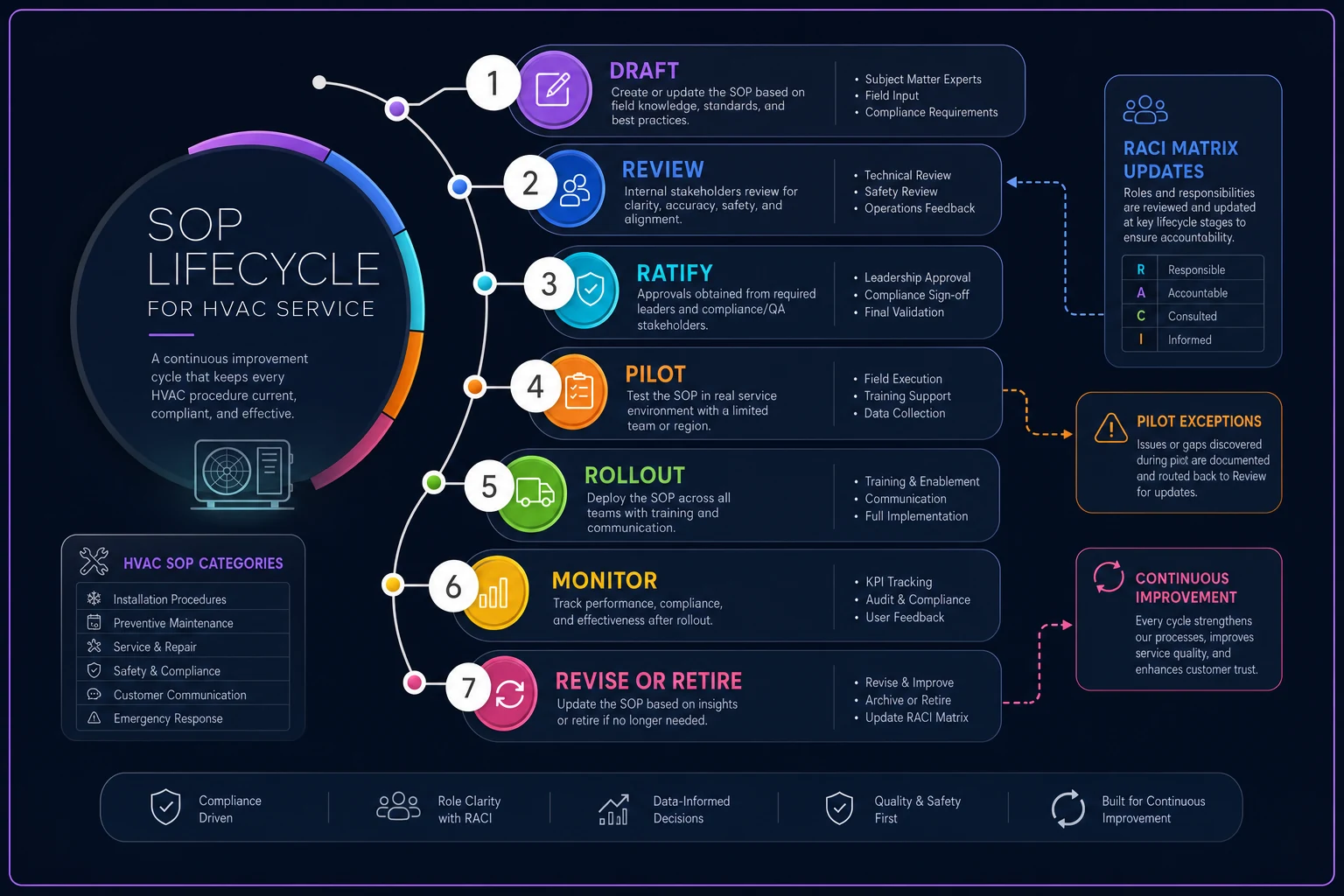
Log pilot exceptions directly against the RACI matrix so you can close decision gaps faster.
Worth noting: the rollout step trips up a lot of companies. They push the revised SOP to all branches at once, without accounting for the exceptions surfaced during the pilot. Those edge cases don't disappear — they just show up in a different branch three weeks later. Fold them in first, then roll out.
Cadence and gates: making governance a rhythm, not a fire drill
Governance dies when it only happens in emergencies. The fix is cadence — standing reviews at fixed intervals where the right people look at the right numbers and have the authority to change something.
-
- Daily (branch level) Dispatch desk reviews open exceptions, cross-branch assignments, and any overtime that tripped a threshold. Fast, 10 minutes, owned by the branch manager.
-
- Weekly (branch level) Billing holds and warranty-judgment disputes get cleared. Inventory variance over a set dollar threshold gets flagged. Owned by branch manager, ops director informed.
-
- Monthly (cross-branch) Ops director runs a governance review. SOP exceptions from the month, decision-rights conflicts, and KPI drift by branch. This is where SOPs get revised or retired.
-
- Quarterly (leadership) Maturity checkpoint. Are the governance mechanisms themselves working, or just existing on paper?
The "gate" concept matters here. A gate is a checkpoint where something cannot proceed until a decision is made by the accountable role. A discount over 25% is a gate — the invoice literally doesn't go out until the ops director clears it. Gates are where governance stops being advisory and starts being enforced.
-
- [ ] Every recurring review has a named owner who runs it, not a vague "the team"
-
- [ ] Each review has a fixed input (a report, a dashboard, an exception log)
-
- [ ] Each review produces a decision, not just a discussion
-
- [ ] Decisions get logged somewhere a tech in another branch can find
-
- [ ] At least one review per cycle looks at whether the SOPs themselves need to change
-
- [ ] Gates are enforced by the workflow, not by someone remembering to check
If more than two of those boxes are unchecked, your governance cadence is still mostly cosmetic.
KPI-maturity checkpoints: knowing if governance is actually working
The point of all this isn't tidy binders. It's measurable control. You want to see governance maturity move through stages, and you want branch-level KPIs to converge rather than diverge as you add locations.
A maturity model mapped to what you'd actually observe:
| Maturity Level | What it looks like | Telltale KPI behavior |
|---|---|---|
| 1 — Ad hoc | Decisions made informally, varies by who's on shift | Branch KPIs scatter widely; no two branches match |
| 2 — Documented | SOPs exist but inconsistently followed | KPIs improve in the branch that wrote them, not others |
| 3 — Enforced | Decision rights + gates are live | Branches start converging; exceptions logged |
| 4 — Monitored | Cadence reviews drive revisions | KPI variance between branches shrinks steadily |
| 5 — Self-correcting | SOPs revised from exception data automatically | New branches reach standard performance faster |
The KPI you're really watching isn't any single operational metric — it's variance between branches. When your three branches post wildly different first-time-fix rates, inventory shrinkage, or invoice-adjustment rates, that spread is your governance signal. Tight governance pulls the spread in. The dashboard structure for watching this across roles is covered in depth in the piece on unifying HVAC leadership KPIs with role-based dashboards and decision gates.
When heavy governance makes sense — and when it's overkill
Not every HVAC company needs this. If you're running one branch with a dozen techs, a formal decision-rights matrix will slow you down and annoy everyone. Governance has a cost, and that cost only pays off past a certain scale.
This makes sense when:
-
You're running two or more branches sharing techs, stock, or pricing rules
-
Cross-branch disputes are eating management time weekly
-
Branch-level KPIs are diverging and you can't explain why
-
You're preparing to acquire or open additional locations
This is a bad idea when:
-
You're a single location — informal governance is faster and cheaper
-
You're in survival mode with cash flow problems; fix the P&L first
-
Leadership won't actually enforce gates (a gate nobody enforces is worse than no gate, because it teaches people the rules are optional)
Companies that haven't nailed their basic data taxonomy should also hold off. If "completed job" means different things in different branches, governance built on top of that will just formalize the confusion. Clean definitions have to come first.
A real scenario: three branches, one inventory mess
A regional HVAC company running three branches — roughly 280–340 jobs per branch monthly — kept missing margin targets at two locations. The numbers told a confusing story: labor looked fine, close rates were fine, but material cost per job ran about 6–8% higher at the two lagging branches.
The problem wasn't theft or waste. It was undocumented van-to-van and hub pulls during busy weeks. Branch managers were authorizing emergency transfers verbally, warehouse leads weren't logging them consistently, and the cost never got attributed back to the right job. Inventory counts drifted, reorders got triggered on bad data, and the two branches were quietly over-ordering to compensate for stock that "disappeared" into other branches' jobs.
The fix was almost entirely governance, not new tooling. They wrote a single inventory decision-rights matrix — close to the one above — made emergency hub pulls a logged, approval-gated action, and added a weekly 15-minute branch review of any variance over a set threshold. No pull happened without a job number attached.
Within about two months, material cost per job at the lagging branches pulled back toward the stronger branch's number. Not perfectly, but the gap closed by more than half. The bigger win was that reorder data became trustworthy again, which stopped the over-ordering cycle. Nothing fancy. Just assigned decisions and a cadence to catch drift.
Where tooling fits — without pretending it replaces judgment
You can run all of this on spreadsheets and standing meetings. Plenty of companies do, for a while. The friction shows up when the logging and enforcement depend on people remembering to do things manually across locations — the emergency part pull that didn't get logged, the discount that skipped the gate because someone was slammed.
Operational software helps by making the gates structural: an invoice over a discount threshold can't advance without the accountable role's approval, a cross-branch transfer forces a job number before it saves, exceptions get captured automatically instead of relying on someone to write them down. AI automation can surface the branch-variance patterns worth reviewing so your monthly governance meeting starts with the right three problems instead of a blank agenda. The judgment stays human. The remembering and the routing stop being human failure points.
If your branches are stitched together with mismatched systems, the data problems will sabotage governance before it starts — the HVAC integrations and data-architecture playbook is worth reading alongside this, because clean data flow between dispatch, inventory, and billing is the precondition for any of these controls to actually work.
Multi-branch HVAC operational governance isn't about control for its own sake. It's about answering, in advance, the question every growing service company eventually trips on: who decides when branches collide? Write the decision-rights matrices first, build the SOP lifecycle so rules can be born and retired cleanly, set a cadence with real gates, and watch branch-to-branch variance as your scoreboard.
The companies that scale past three or four branches without constant firefighting aren't the ones with the thickest SOP binders. They're the ones where a dispatcher, a warehouse lead, and a billing clerk in three different buildings all know exactly where their authority ends and whose begins. That clarity is the whole game.
Ready to optimize your HVAC operations?
Join hundreds of HVAC businesses using Coolyly to save time, improve technician utilization, and enhance customer satisfaction.