

Most HVAC shops are surprisingly good at handling a bad day. A tech calls in sick, dispatch shuffles the board, everybody works a little late, and by 6pm the world is fine again. What breaks companies isn't the bad day. It's the bad week — the compounding shock where three things fail at once and the usual scramble stops working because the people doing the scrambling are also part of the problem.
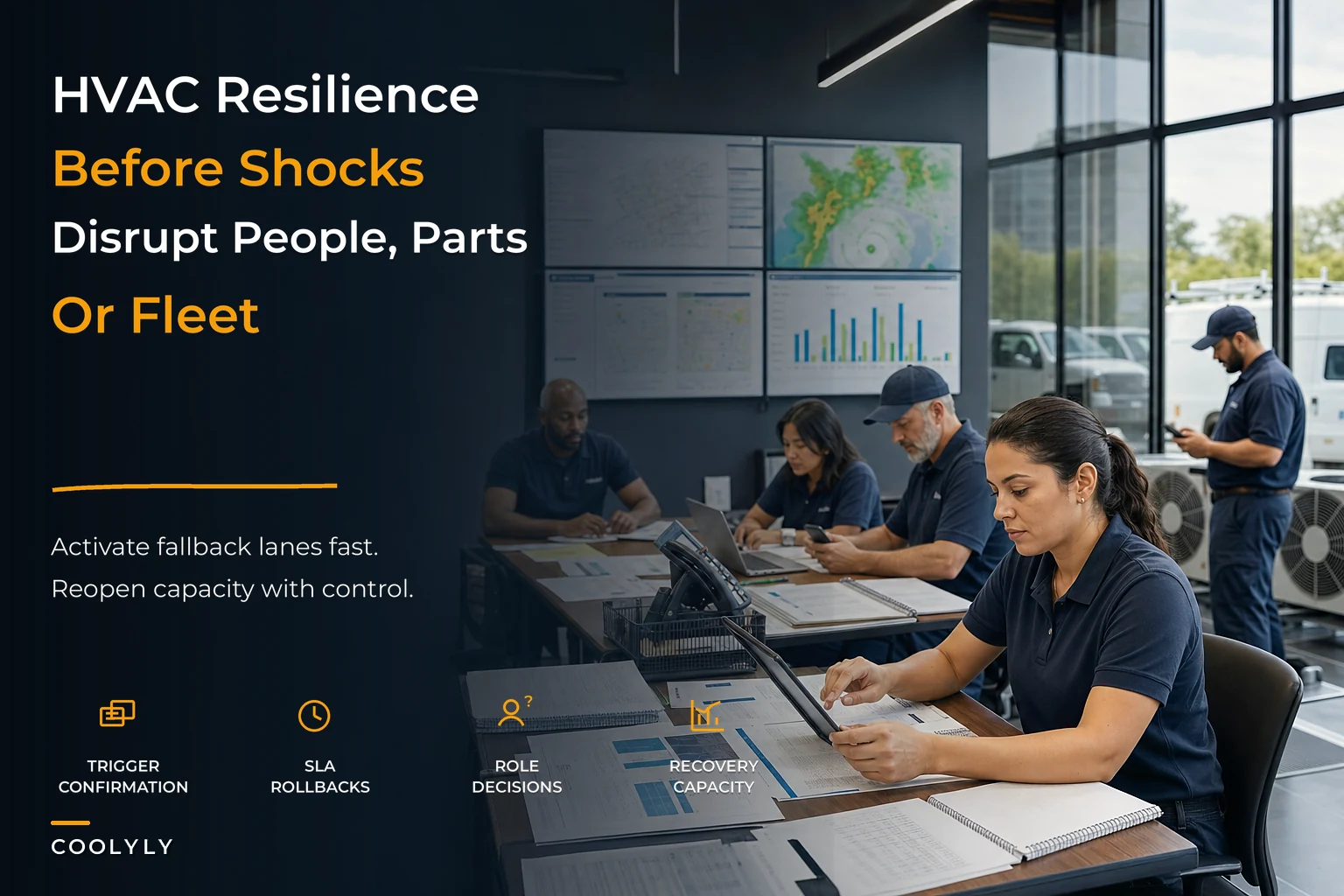
That's the gap this playbook is built for. Not "how do we handle one no-show," but "how does the business keep taking money when a heat wave, a supplier delay, a van in the shop, and a sick dispatcher all land in the same seven days." Real field service operational resilience for HVAC isn't a binder labeled "disaster recovery" that nobody opens. It's a set of pre-decided fallback lanes across five parts of the operation, so the people on shift don't have to invent a plan while the phones are melting.
The five lanes are simple to name and easy to under-invest in: people, parts, fleet, demand, and communications. Each one can degrade independently, and each one drags the others down when it does. Below is how they fail, how they interact, and — more usefully — the fallback rules and decision tables that let a mid-sized shop reopen capacity in hours instead of days.
Why resilience is a systems problem, not a checklist
Owners miss this one constantly. Resilience isn't a department. You can't hire a "resilience manager" and call it done. It lives in the seams between your functions — the handoff between dispatch and the parts counter, between the on-call tech and the after-hours answering service, between what the CSR promises and what the fleet can actually deliver.
When one lane fails in isolation, most shops absorb it. When two fail and they're coupled, the failure cascades. A typical example: a supplier misses a compressor delivery (parts lane). Normally fine. But it's July, you're already at 95% booked (demand lane), and the tech who could've improvised a temporary fix is out with heat exhaustion (people lane). Now dispatch is rebooking twelve jobs, the answering service is quoting wrong ETAs (communications lane), and two customers who waited three days are calling to cancel. One missed delivery just cost you a full day of throughput.
This pattern shows up across almost every shop that grows past roughly 8–10 techs. Below that size, resilience is basically the owner's head — they know every customer, every part, every tech's mood. Past it, that mental model stops fitting in one brain, and if it hasn't been written down as explicit fallback rules, the business gets fragile at exactly the moment it's making the most money. It's the same fragility that shows up when you try to grow headcount and territories without governance — we've covered the structural side of that in scaling HVAC field operations without chaos, and resilience is really the emergency-side companion to it.
The five lanes and their fallback positions
The core idea: for each lane, you pre-define a normal state, a degraded state, and a fallback state — plus the trigger that moves you between them. When a lane trips its trigger, nobody debates. You drop to the fallback lane, the SLA rolls back to a pre-agreed level, and everyone works from the same script.
Eliminate scheduling chaos and missed jobs.
Coolyly helps HVAC companies book, coordinate, and track every service efficiently.
- Unified appointment & dispatch management
- Automated client notifications
- Technician scheduling & job tracking
No credit card required
| Lane | Normal state | Degraded trigger | Fallback lane | SLA rollback |
|---|---|---|---|---|
| People | Full crew + on-call bench | 20%+ crew unavailable | Cross-trained backfill, defer PM/non-urgent | Emergency-only same-day; PM pushed 5–7 days |
| Parts | Van stock + hub replenish next-day | Key SKU stockout or supplier delay >48h | Substitution library + temp-fix protocol | "Restore comfort now, full repair scheduled" |
| Fleet | All vans road-ready | 15%+ fleet down | Route consolidation, shared-van shifts | Wider ETA windows (2hr → 4hr) |
| Demand | Booked ≤85% capacity | Booked >100% or surge event | Triage tiering, waitlist, dynamic booking freeze | New non-emergency bookings paused |
| Communications | Live dispatch + CSR | Dispatcher down or call volume 2x | Automated status updates, redirect scripting | Proactive ETA texts replace live callbacks |
The value isn't the table itself — it's that the triggers are numeric and boring. "20% of crew unavailable" is a fact anyone can check. "Things feel really busy today" is not a trigger, it's a vibe, and vibes don't scale across shifts and dispatchers.
People: your most correlated risk
People failures are sneaky because they correlate with your busiest periods. Heat waves make techs sick and exhaust them at the same time demand spikes. Flu season does it in winter. So your people lane is most likely to degrade exactly when you can least afford it.
The fallback that actually works is a skills matrix tied to a defer list. You need to know, before the crisis, which techs can cover which job types, and which jobs can be pushed without breaking anything. When you're down 20% of crew, you don't cancel randomly — you cancel by pre-ranked priority. Maintenance visits and non-urgent diagnostics defer first. Emergency no-cool/no-heat and commercial SLA accounts hold their slots.
A mistake that comes up constantly: shops keep the skills matrix in someone's memory or a stale spreadsheet, so when a senior tech is out, dispatch doesn't actually know who can handle a rooftop unit versus who's residential-only. The fallback plan exists on paper but can't execute because the underlying data is wrong.
Parts: substitution beats stockpiling
You cannot stockpile your way out of parts risk — carrying six months of every SKU murders your cash. Resilience in the parts lane is about substitution intelligence and temp-fix protocols, not inventory depth.
The single highest-leverage tool here is a substitution and compatibility library that dispatch and techs can actually query in the field. When the exact capacitor or motor isn't available, the question is "what interchangeable part gets this customer running today?" — and that answer needs to live somewhere searchable, not in the head of your best parts guy who's on vacation.
The fallback state also changes what you promise. Under normal ops you might say "we'll fix it right the first time." Under a parts shock, the promise rolls back to a two-step: "restore comfort today with a temporary or substitute fix, full permanent repair scheduled when the part lands." Customers accept this far more readily than a three-day wait for the perfect part — but only if the script is ready and the CSR isn't improvising.
Fleet: the lane everyone forgets until two vans die
Fleet resilience is the most physical and the most ignored. A van in the shop isn't just a vehicle down — it's a fully stocked mobile warehouse and a tech's whole workday out of commission.
The fallback is route consolidation plus a shared-van protocol. If you're down 15% of fleet, you don't try to run the normal route plan short a truck and hope. You consolidate — reassign jobs geographically so the remaining vans cover tighter clusters, widen ETA windows so consolidation is realistic, and if needed, run a shared-van shift where two techs split one vehicle across a staggered schedule.
Shops that keep one "swing van" — an older, fully-stocked unit that isn't on the daily board — recover from fleet shocks dramatically faster than shops running every vehicle at 100%. Running lean feels efficient until the day you have zero slack, and then a single breakdown takes a full route offline.
Demand: the trigger to stop taking bookings
This is the lane owners resist most, because turning off the booking tap feels like turning off money. But taking a job you can't deliver isn't revenue — it's a future cancellation, a bad review, and a callback all bundled together.
The fallback here is a booking freeze rule and triage tiering. Once you cross 100% of realistic capacity, new non-emergency bookings pause. Emergencies and contract SLA accounts still flow. Everyone else goes to a managed waitlist with honest expectations. The freeze isn't permanent — it lifts as capacity reopens — but it stops you from digging a hole you'll spend the next week climbing out of.
Communications: the multiplier
Communications is the lane that makes every other failure feel worse or better to the customer. A three-hour delay with a proactive text feels manageable. The same delay in silence feels like abandonment.
Under a shock, live callbacks don't scale — your dispatcher is drowning. The fallback is proactive automated status updates: "Your tech is running behind, new window is 2–4pm, reply to reschedule." This isn't about fancy tech. It's about deciding in advance that when call volume doubles, you switch from reactive callbacks to proactive broadcast updates, and you have the message templates already written.
A real scenario: mid-size shop, four-day cascade
A residential-heavy shop running about 11 techs and 9 vans hit a rough stretch in late July. Two techs out (one sick, one injured), a delayed condenser fan-motor shipment, and a van with a blown transmission — all inside four days, during a stretch where they were already booked around 90%.
Before they had a fallback model, a week like this would've looked like: dispatch improvising all day, roughly 15–20 jobs rebooked chaotically, a handful of angry cancellations, and probably $12k–$15k of throughput evaporating along with a couple of one-star reviews.
With pre-defined lanes, it went differently. People lane tripped its 20% trigger → PM visits auto-deferred, cross-trained techs backfilled priority calls. Parts lane hit the substitution protocol → seven affected jobs got temp-fixes with permanent repairs scheduled, instead of flat cancellations. Fleet dropped below threshold → routes consolidated into tighter clusters and ETA windows widened. Demand crossed 100% → non-emergency booking paused for about 48 hours. Communications flipped to proactive texts.
Still a hard week. But they held onto most of their revenue, deferred rather than lost work, and came out with two cancellations instead of eight. The difference wasn't heroics — it was that nobody had to invent the plan mid-crisis.
The leadership continuity checklist
This is the part owners and ops managers should actually keep somewhere visible. When a shock hits, run this before the day starts:
-
Which lanes are degraded right now? Check the numeric triggers, not the vibe. Write down each lane's current state.
-
Which fallback lanes are active? Announce them explicitly at the morning huddle so every dispatcher, CSR, and tech works from the same assumptions.
-
What SLA has rolled back? Confirm the reduced promise and make sure the CSR scripts match it. A rolled-back SLA that customer-facing staff don't know about is worse than no rollback at all.
-
What's the defer list? Confirm which jobs get pushed and in what order. Priority accounts and emergencies protected.
-
Are proactive comms firing? Verify affected customers are getting status updates, not silence.
-
What's the recovery trigger? Define the condition that returns each lane to normal so you don't stay in defensive mode longer than needed.
-
Who owns the call to escalate or stand down? One named person per shift. Not a committee.
The checklist is deliberately short. In a real shock, nobody reads a 40-item document. Seven questions you can run in five minutes beats a perfect plan nobody executes.
A simple activation sequence
When a lane trips, here's the order of operations that keeps things sane:
-
Confirm the trigger. Is a lane actually past its numeric threshold, or does it just feel busy? Don't activate fallbacks on a hunch.
-
Declare the fallback state out loud. Morning huddle, group text, whatever — everyone needs to hear "we're in parts-fallback today."
-
Roll back the SLA and update scripts. CSRs and dispatch adjust promises before they answer the next call.
-
Apply the defer list. Push non-priority work by pre-ranked order, protect emergencies and contracts.
-
Turn on proactive communications. Get ahead of the delay before customers call you.
-
Watch the recovery trigger. As soon as the lane clears its threshold, stand down and reopen capacity. Don't linger in defense mode.
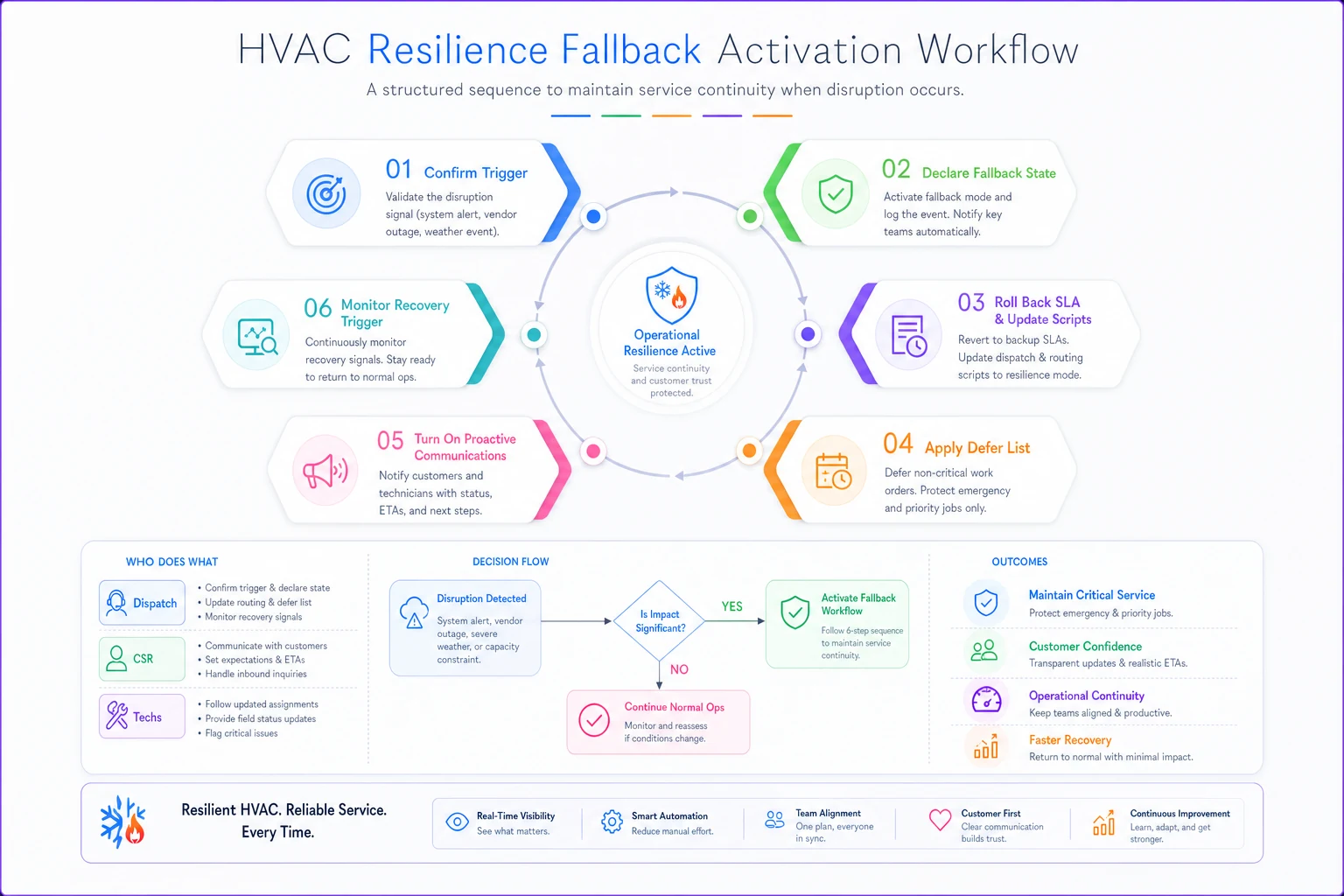
A simple flow diagram like this can be a quick reference during a huddle.
The whole thing works only when your underlying data is trustworthy — the skills matrix, the parts substitution library, real-time job and fleet status. If your systems can't tell you, in the moment, how many techs are actually available or which SKU is actually out, no decision table saves you. That's why resilience and data architecture are really the same project wearing two hats; getting the integration foundation right, as we laid out in the HVAC integrations and data-architecture playbook, is what makes fast, trustworthy fallback decisions possible at all.
When this model makes sense — and when it doesn't
When it makes sense: You're past roughly 8 techs, you serve any commercial SLA accounts, and you operate in a climate with real seasonal spikes. At that scale the owner can't be the single point of resilience anymore, and formalized fallback lanes pay for themselves the first bad week.
When it's overkill: A two- or three-tech shop where the owner still knows every job doesn't need decision tables — the coordination lives in one head just fine, and formalizing it adds paperwork without adding safety.
Who should be careful: Shops that write beautiful playbooks and then never drill them. An unpracticed fallback plan is a comfort blanket, not a system. Run a tabletop walkthrough once a quarter — talk through a fake three-lane shock and see if your triggers, defer lists, and scripts actually hold up. You'll find the gaps in a conference room instead of at 2pm on the hottest day of the year.
Where this fits in the bigger operational picture
Resilience isn't a standalone initiative — it sits on top of everything else you've built. Your triggers are only as good as the metrics feeding them, which is really a question of operational maturity. If you're still early on that curve, the HVAC analytics maturity framework is the honest place to start before you try to run trigger-based fallbacks.
The shops that recover fastest from shocks aren't the ones with the biggest inventory or the most techs. They're the ones who decided ahead of time what "degraded" looks like, what they'd stop doing, and what they'd promise instead — so that when the bad week comes, the plan is already made and the crew just executes it. That's the whole game. Not preventing shocks, which is impossible, but making the response boring, fast, and repeatable across every person who happens to be on shift when it hits.
The shops that recover fastest from shocks aren't the ones with the biggest inventory or the most techs. They're the ones who decided ahead of time what "degraded" looks like, what they'd stop doing, and what they'd promise instead — so that when the bad week comes, the plan is already made and the crew just executes it. That's the whole game. Not preventing shocks, which is impossible, but making the response boring, fast, and repeatable across every person who happens to be on shift when it hits.
Ready to optimize your HVAC operations?
Join hundreds of HVAC businesses using Coolyly to save time, improve technician utilization, and enhance customer satisfaction.